
Your Support System Is Broken: The Ultimate Guide to Upgrading Customer Support with Auto Dialer Technology
Introduction:
: The Silent Crisis in Customer Support:-
Most businesses believe their customer support system is working just fine.
Calls are being answered. Tickets are being resolved. Agents are doing their jobs.
But beneath the surface, something is breaking.
Customers are waiting longer.
Agents are overwhelmed.
And opportunities are quietly slipping away.
The truth?
Your support system might not be broken visibly—but it’s definitely underperforming.
In today’s fast-moving digital economy, customer expectations are higher than ever. Speed, personalization, and efficiency are no longer “nice to have”—they are mandatory.
If your system can’t keep up, your competitors will.
This blog will walk you through:
The warning signs of a failing support system
The core problems most businesses ignore
The game-changing role of auto dialer technology
A step-by-step upgrade plan
Real, measurable outcomes you can expect
Let’s fix what’s broken.
Section 1: The Hard Truth About Traditional Support Systems
Let’s start with reality.
Traditional customer support systems were built for a different era—an era where:
Customers were more patient
Channels were limited
Data was less critical
Today, none of that applies.
Modern customers expect:
Instant responses
Personalized interactions
Seamless experiences across channels
Unfortunately, most legacy systems fail to deliver this.
Instead, they create:
Delays
Confusion
Frustration
And worst of all—they make your team work harder for worse results.
This is not a people problem.
It’s a system problem.
Section 2: Warning Signs You Can’t Ignore
If your support system is struggling, the signs are always there—you just need to notice them.
🚨 1. Agonizingly Slow Responses
Every extra second of waiting reduces customer satisfaction.
Customers don’t compare you to your competitors.
They compare you to the fastest experience they’ve ever had.
🔄 2. No Unified Customer View
Your agents are asking the same questions repeatedly.
Why? Because your system doesn’t provide a complete customer history.
This leads to:
Frustrated customers
Longer call durations
Lower efficiency
📉 3. Zero Performance Visibility
If you can’t measure it, you can’t improve it.
Without dashboards and analytics:
You don’t know what’s working
You can’t optimize performance
You’re operating blindly
⚙️ 4. Exhausting Manual Workflows
Manual processes slow everything down.
Agents spend more time:
Switching tools
Entering data
Fixing errors
Instead of actually helping customers.
Section 3: Why Auto Dialers Are a Game Changer
Now let’s talk about the solution.
An auto dialer is not just a calling tool—it’s a productivity engine.
It automates outbound calling and connects agents only when a real human answers.
🔥 What Makes It Powerful?
Eliminates idle time
Increases call volume
Improves agent productivity
Reduces human errors
Instead of dialing numbers manually, your agents focus on what actually matters: conversations.
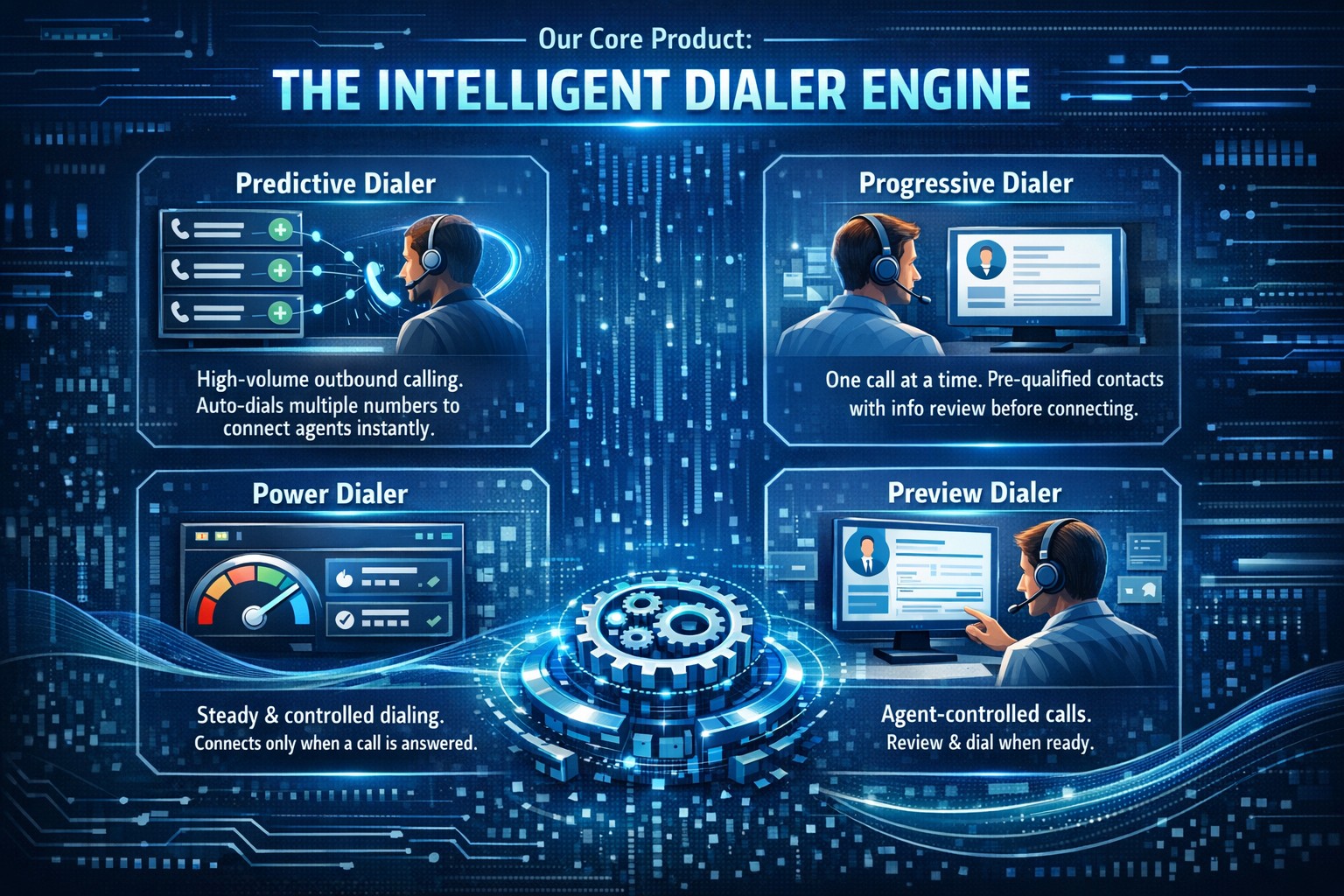
Types of Auto Dialers
1. Predictive Dialer
Uses algorithms to predict agent availability and dial multiple numbers.
2. Power Dialer
Dials one number per agent but eliminates manual effort.
3. Preview Dialer
Shows customer details before the call—perfect for personalized interactions.
🚀 The Real Impact
With the right auto dialer:
Agents talk more, wait less
Calls connect faster
Conversions increase
This is where efficiency meets revenue.
Section 4: 4 Features That Transform Your Support System
To truly upgrade your system, you need more than just a dialer.
You need a complete ecosystem.
📞 1. Intelligent Auto Dialer
This is your engine.
It ensures:
Instant call connections
Higher agent productivity
Reduced idle time
🎯 2. Smart IVR Routing
IVR (Interactive Voice Response) directs calls intelligently.
No more:
Wrong transfers
Confused customers
Instead:
Right agent
Right time
Right solution
📊 3. Real-Time Analytics
Data is power.
With dashboards, you can track:
Call performance
Agent efficiency
Customer satisfaction
This helps you make smarter decisions.
🔗 4. Seamless CRM Integration
Your CRM should work hand-in-hand with your dialer.
Benefits:
Complete customer history
Personalized conversations
Faster issue resolution
Section 5: How to Upgrade Your Support System (Step-by-Step)
Upgrading doesn’t have to be complicated.
Here’s a simple roadmap:
✅ Step 1: Onboard & Configure (Day 1)
Set up your system quickly.
Integrate tools
Train your team
Go live within hours
⚙️ Step 2: Set Up Smart Flows (Day 2)
Customize workflows based on your business needs.
IVR paths
Call routing
Automation rules
📈 Step 3: Go Live & Track KPIs (Week 1)
Start operations and monitor performance.
Focus on:
Response time
Call success rate
Agent productivity
🚀 Step 4: Scale Without Limits (Ongoing)
As your business grows:
Add more agents
Expand channels
Optimize workflows
No rebuilding required.
Section 6: Results You Can Actually Measure
This is where everything comes together.
Businesses that upgrade their support systems typically see:
📊 Key Metrics
3x faster response times
40% reduction in idle time
92% customer satisfaction
60% fewer manual tasks
💬 Real Impact
Happier customers
More efficient teams
Higher revenue
And most importantly—predictable growth.
Section 7: The Future of Customer Support
Customer support is no longer a cost center.
It’s a growth engine.
Businesses that win in 2026 and beyond will:
Automate intelligently
Personalize at scale
Use data to drive decisions
Auto dialers and smart systems are just the beginning.
AI, predictive analytics, and omnichannel support will define the future.
The question is:
👉 Will you adapt—or fall behind?
Conclusion: Time to Fix What’s Broken
Let’s be honest.
If your support system:
Feels slow
Lacks visibility
Relies heavily on manual work
Then it’s already costing you more than you think.
But the good news?
Fixing it is easier than ever.
With the right tools—especially auto dialers—you can:
Improve efficiency
Delight customers
Scale faster
Don’t wait until customers leave to take action.
Upgrade your customer support system today.
Because every missed call…
Is a missed opportunity.