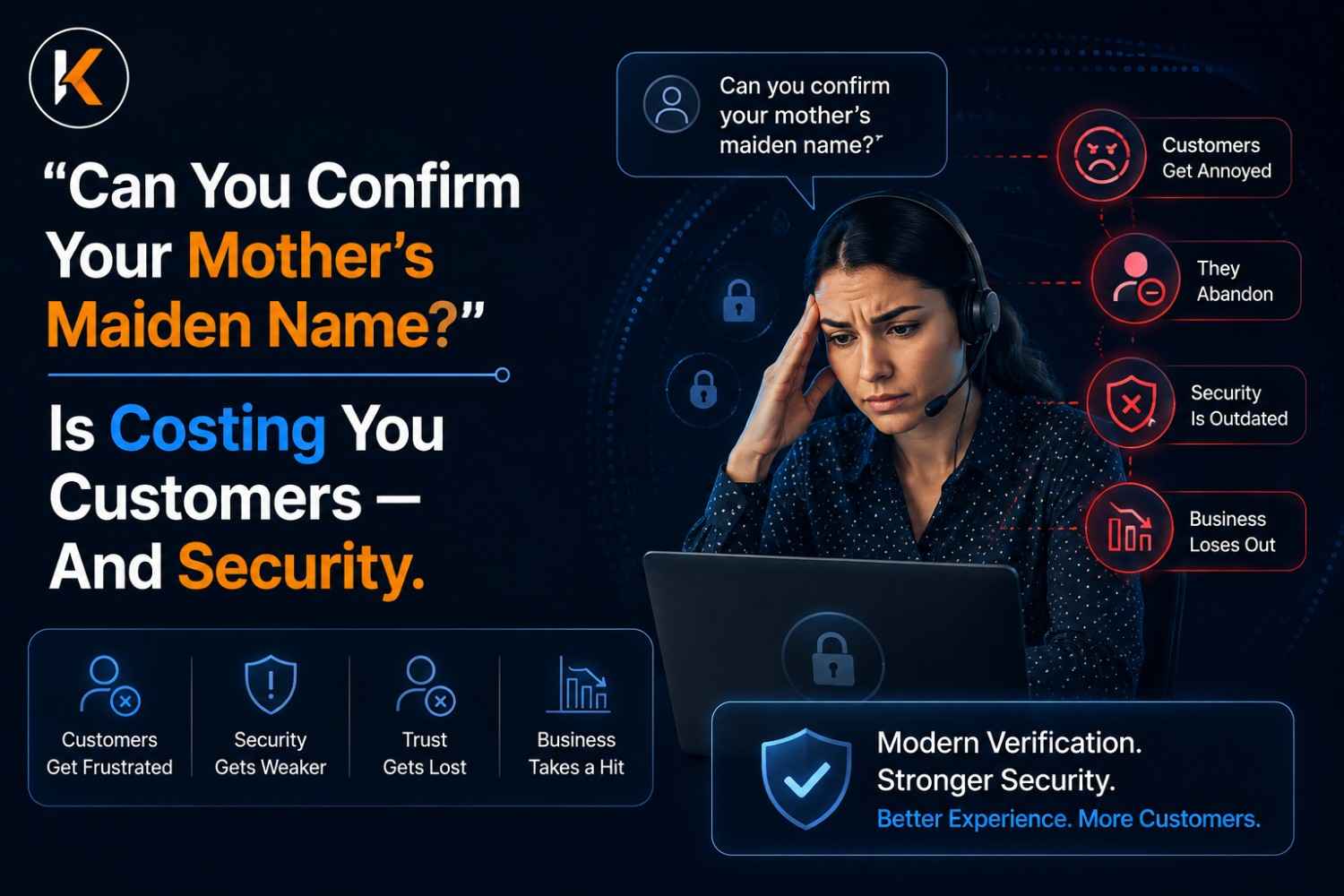
Every BFSI call starts the same way. Date of birth, registered mobile number, mother's maiden name, maybe an OTP if the agent is being careful. Ninety seconds gone before the actual conversation even starts — and none of it stops a fraudster who's done five minutes of research on the customer beforehand.
Security questions were built for a world where that information was hard to find. It isn't anymore. Voice biometrics closes that gap by authenticating the customer using something a fraudster can't easily fake: the physical and behavioral characteristics of their voice.
How it actually works
A voice biometric system builds a voiceprint from a customer's speech patterns — pitch, cadence, pronunciation, and dozens of other acoustic markers unique to how a person talks. This isn't recording their words; it's modeling the physical properties of their voice, the way a fingerprint models the ridges on a finger.
Two deployment models cover most use cases:
Active verification — during onboarding or account setup, the customer is asked to say a short phrase a couple of times, and that becomes their reference voiceprint for future calls.
Passive verification — the system builds and checks the voiceprint from natural conversation, with no scripted phrase required. The customer says "hi, I'm calling about my last transaction" and gets authenticated in the first few seconds, without ever knowing a check happened.
Passive verification is the one changing call center economics, because it removes the authentication step from the customer's experience entirely while making it harder to spoof than a knowledge-based question.
Why this is surfacing now
Two pressures are converging. Fraud has gotten more sophisticated — voice-cloning tools and readily available personal data have made knowledge-based security questions genuinely weak, not just inconvenient. At the same time, BFSI customers have gotten less patient with every extra ninety seconds spent proving who they are before their actual issue gets addressed, the same friction your IVR and AHT posts already flagged.
Voice biometrics is one of the few upgrades that improves both sides at once — faster verification and a harder target for fraud, instead of the usual security-versus-convenience tradeoff.
Where it fits with what you're already running
If you've deployed AI voice analytics for QA, or real-time agent assist for live call guidance, biometric authentication sits in the same audio pipeline. It's not a separate system bolted onto the call — it's another layer reading the same live audio stream your other AI tools already process, which keeps the infrastructure lift smaller than it sounds.
What to actually check before deploying
Enrollment friction: passive systems that build voiceprints from natural conversation over the first few calls create less friction than forcing every customer through an active enrollment step.
False rejection handling: no biometric system is perfect. There needs to be a clear fallback path — OTP or an agent-led manual check — for the small percentage of legitimate customers who get flagged.
Regulatory posture: voice data is sensitive. RBI and data protection compliance around biometric storage and consent needs to be locked down before rollout, not retrofitted after.
The tradeoff to be honest about
This isn't a plug-and-play feature — it needs enrollment volume before the false-accept and false-reject rates stabilize, and customers need clear consent and disclosure that their voice is being used this way. Done well, it's close to invisible to the customer and materially harder to defeat than anything knowledge-based. Done as a rushed bolt-on, it just becomes one more system throwing false rejections at your agents to clean up manually.
Ready to cut verification time without cutting security?
KRUDRA-CX works with BFSI and enterprise contact centers across India to bring voice-layer intelligence — from real-time assist to authentication — into the calling infrastructure you already run.
Book Free Demo → krudracx.com/book-for-demo
Talk to Sales → krudracx.com/contact