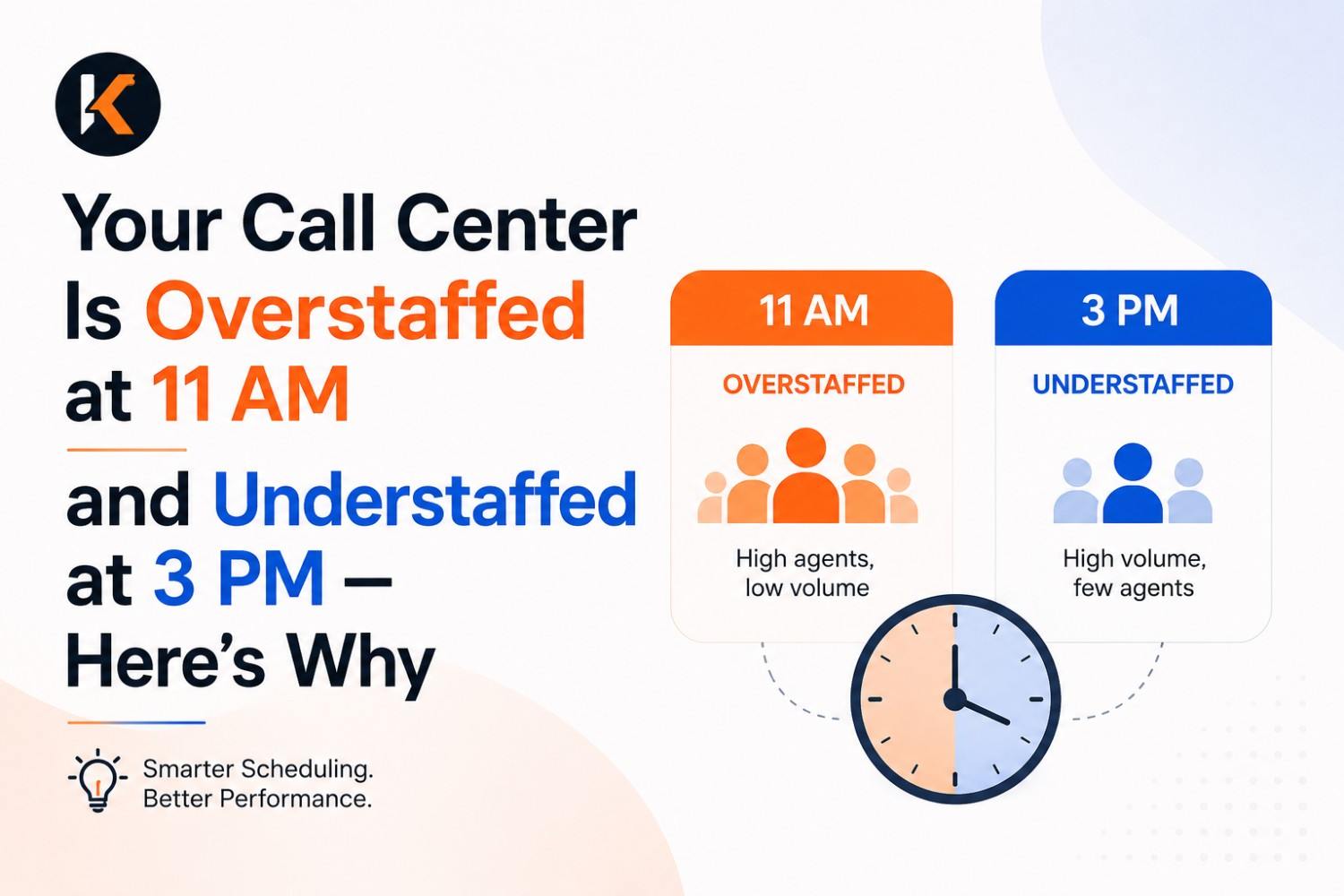
Walk any call center floor at 11 AM and you'll usually find agents sitting idle between calls. Walk the same floor at 3 PM and you'll find a queue backing up while agents on lunch breaks aren't back yet. Neither is a training problem or an agent problem. It's a scheduling problem — and most contact centers are still solving it with spreadsheets and gut instinct.
AI-powered workforce management (WFM) replaces that guesswork with actual demand forecasting — predicting when calls will come in, how long they'll take, and how many agents with which skills need to be on the floor at any given hour.
What it actually does
Volume forecasting — the system analyzes historical call patterns, seasonality, campaign schedules, and even external triggers like billing cycles or product launches, to predict call volume by hour, not just by day.
Skill-based scheduling — instead of scheduling generic headcount, it schedules the right mix of skills — agents trained on billing, agents trained on technical support, bilingual agents — matched against the specific queries expected in each time block.
Real-time adherence tracking — it flags in real time when actual staffing is drifting from the forecasted need, so a supervisor can pull someone off a lower-priority task before a queue backs up, not after.
Shrinkage-aware planning — breaks, training, meetings, and attrition are built into the schedule from the start, instead of being the reason the "planned" staffing never matches the actual staffing.
Why this matters more given what you've already covered
Your agent turnover post laid out the real cost of losing agents. What often gets missed is that a big share of avoidable attrition comes from scheduling itself — agents burning out during predictable peak-hour crunches, or getting demoralized sitting idle during slow blocks they didn't choose. WFM doesn't fix turnover on its own, but it removes one of the more controllable causes of it.
Same connection to your AHT obsession post — average handle time looks worse than it is when a queue is understaffed and agents are rushing calls to keep up, not because agents got slower. Fix the staffing curve, and the AHT numbers often correct themselves without a single coaching conversation.
Why 2026 is the inflection point
Two things changed. Forecasting models have gotten good enough to handle the messiness of real contact center data — seasonal spikes, marketing campaign surges, festival-season volume shifts — where older WFM tools needed clean, stable historical patterns to work at all. And staffing costs have become too significant a line item for most operations to keep managing manually, especially as teams scale past a few dozen agents across multiple shifts.
What to check before adopting a WFM system
Forecast accuracy over time: ask for accuracy benchmarks against real historical data, not vendor claims — a forecasting model that's off by 20% creates the same overstaffing/understaffing problem it's meant to solve.
Integration with your dialer and CRM: the system needs live call data to forecast accurately; a WFM tool running on stale exports is only marginally better than a spreadsheet.
Change management: schedules generated by an algorithm still need supervisor sign-off and agent buy-in — a system agents don't trust gets worked around, not followed.
The tradeoff to be honest about
AI-generated schedules are only as good as the historical data feeding them — a contact center with under a year of clean call data, or one going through major operational change, will get shakier forecasts early on. It gets more accurate with time and volume, not on day one.
Ready to stop guessing at your staffing curve?
KRUDRA-CX connects your call data directly into workforce planning — so your schedules match the calls that are actually coming in, not the ones you assumed would.
Book Free Demo → krudracx.com/book-for-demo
Talk to Sales → krudracx.com/contact