Introduction: The Most Undervalued Growth Engine in Business
Every business owner, marketer, and strategist talks about revenue. They obsess over acquisition costs, conversion funnels, ad spend, and sales pipelines. But ask most businesses what their single biggest driver of sustainable, compounding revenue is — and most will answer wrong.
It is not a viral campaign. It is not a new product launch. It is not a discount strategy.
It is customer satisfaction.
Not in the vague, feel-good sense of "making people happy." In the rigorous, measurable, data-backed sense of engineering experiences so consistently positive that your customers not only return — they bring others. They defend your brand. They become your most powerful sales force without ever receiving a commission.
This blog is a deep, evidence-based examination of why customer satisfaction is the most direct, compounding, and defensible path to long-term revenue. We will define what satisfaction actually means in commercial terms, explore the psychological and economic mechanisms behind it, dissect the data that makes the case irrefutable, and give you a strategic framework to turn satisfaction into your most powerful revenue lever.
By the end of this, you will not just understand customer satisfaction. You will see it differently — as the financial instrument it truly is.
Part 1: Defining Customer Satisfaction — Beyond the Survey Score
What Customer Satisfaction Actually Means
Customer satisfaction, at its most precise definition, is the degree to which a product or service meets or exceeds a customer's expectations at every point of interaction with a brand.
That definition carries three critical components worth unpacking individually.
1. "Degree to which" — it is a spectrum, not a binary.
Satisfaction is not something a customer either has or does not have. It exists on a continuum — from deeply dissatisfied to passively satisfied to genuinely delighted. Where a customer sits on that spectrum determines whether they churn, remain neutral, or become a loyal advocate. Most businesses treat satisfaction as a checkbox. The most successful businesses treat it as a dial they actively tune.
2. "Meets or exceeds expectations" — expectations are the real variable.
This is where most brands fundamentally misunderstand satisfaction. It is not about delivering something objectively excellent. It is about delivering something relative to what the customer expected. A budget hotel that delivers clean rooms, fast check-in, and a friendly front desk can achieve higher satisfaction scores than a five-star resort that fails to meet the elevated expectations it created with its pricing and marketing. Satisfaction is always contextual. It is always relational. It lives in the gap between promise and delivery.
3. "At every point of interaction" — the experience is holistic.
Satisfaction is not determined by a single moment. It is the cumulative result of every touchpoint — from the first ad a customer sees, to the onboarding experience, to the third customer support call, to the renewal reminder email. One exceptional interaction cannot cancel out three frustrating ones. But one terrible interaction can undo dozens of great ones. This is the negativity bias at work, and it is one of the most important psychological forces in customer experience design.
The Difference Between Satisfaction, Loyalty, and Delight
These three terms are often used interchangeably but they represent meaningfully different states — and different revenue outcomes.
Satisfaction is the baseline. A satisfied customer got what they paid for. They are unlikely to complain. They may return. But they are also not strongly attached. If a competitor offers a marginally better deal, a merely satisfied customer will consider it seriously.
Loyalty is the upgrade. A loyal customer has a preference for your brand that transcends pure transactional logic. They have built a history with you, developed some degree of trust, and feel that switching has both practical and emotional costs. Loyal customers are far less price-sensitive and far more forgiving of occasional failures.
Delight is the peak. A delighted customer has had their expectations not just met but meaningfully exceeded in a way that felt personal, surprising, or emotionally resonant. Delighted customers become advocates. They talk about you unprompted. They refer friends. They post on social media without being asked. They are, in commercial terms, your highest-value asset.
The revenue implication is significant. Satisfied customers may continue to buy. Loyal customers buy more, buy more often, and cost less to retain. Delighted customers do all of that and recruit new customers for free. Building a business that consistently moves customers from satisfied to loyal to delighted is, mathematically, one of the most powerful growth strategies available.
How Satisfaction Is Measured
Before satisfaction can be managed, it must be measured. The three dominant metrics in customer satisfaction measurement are:
Net Promoter Score (NPS): Customers are asked a single question — "How likely are you to recommend us to a friend or colleague?" — on a scale of 0 to 10. Those who answer 9 or 10 are Promoters. Those who answer 7 or 8 are Passives. Those who answer 0 to 6 are Detractors. NPS is calculated by subtracting the percentage of Detractors from the percentage of Promoters. A positive NPS is good. Above 50 is excellent. Above 70 is world-class.
Customer Satisfaction Score (CSAT): Customers rate a specific interaction or experience, typically on a scale of 1 to 5 or 1 to 10. CSAT is excellent for measuring satisfaction at individual touchpoints — after a support interaction, following a delivery, or immediately post-purchase. It is tactical where NPS is strategic.
Customer Effort Score (CES): Customers rate how easy it was to accomplish a specific task — resolve a problem, make a purchase, find information. Research from Gartner has found that reducing customer effort is one of the most powerful predictors of loyalty. The easier you make it for customers to do what they need to do, the more loyal they become. This is counterintuitive to many brands that invest heavily in delight but neglect friction.
Each metric captures a different dimension of the satisfaction landscape. The most sophisticated organisations use all three in combination — NPS to track overall brand health and loyalty trajectory, CSAT to optimise specific touchpoints, and CES to systematically eliminate friction from the customer journey.
Part 2: The Psychology of Satisfaction — Why Customers Feel What They Feel
Expectation Theory and the Satisfaction Gap
The academic foundation of customer satisfaction research rests on what scholars call the Expectation Disconfirmation Model, developed by Richard Oliver in 1980. The model is elegantly simple: customers form expectations before a purchase. After the experience, they compare reality to those expectations. If reality exceeds expectations, they experience positive disconfirmation — satisfaction or delight. If reality falls short of expectations, they experience negative disconfirmation — dissatisfaction or frustration. If reality matches expectations exactly, they experience simple confirmation — a neutral state that is neither particularly satisfying nor dissatisfying.
The practical implication for businesses is profound and often misapplied. Many brands respond to this model by trying to under-promise and over-deliver — setting low expectations so that reality can more easily exceed them. The problem is that expectations are also a key driver of purchase decisions. Customers will not choose you if your promises are too modest. The correct approach is to make precise, honest promises and then exceed them in the details — the quality of your packaging, the warmth of your customer service, the speed of your response, the thoughtfulness of your follow-up. Promise clearly. Deliver brilliantly.
The Peak-End Rule and Memory
Nobel Prize-winning psychologist Daniel Kahneman's research on the Peak-End Rule reveals something deeply important about how customers actually remember experiences. According to this principle, people do not remember the average of an experience. They remember two specific moments: the most emotionally intense moment (the peak, whether positive or negative) and the final moment (the end).
Everything in between matters far less than businesses assume. A customer who had a generally mediocre experience but received an unexpected, warm, thoughtful resolution to a problem at the end will remember it far more positively than a customer who had a uniformly acceptable experience with no memorable moment. This is why the way you handle complaints, the final impression you leave with an off-boarding email, and the quality of your delivery experience disproportionately shape satisfaction memory and future behaviour.
Smart brands engineer peaks deliberately. They identify moments in the customer journey where an unexpected gesture — a handwritten thank-you note, a proactive refund before the customer even asks, a birthday surprise, an upgrade for a loyal customer — creates a positive peak that anchors the entire memory of the experience in a positive light.
The Role of Trust in Sustained Satisfaction
Trust is the architecture within which satisfaction is built. Customers cannot be consistently satisfied by a brand they do not trust. And trust, once broken, requires extraordinary effort to rebuild — if it can be rebuilt at all.
Trust in a commercial context has three primary dimensions: competence trust (the belief that you can deliver what you promise), integrity trust (the belief that you will be honest and fair even when it costs you something), and benevolence trust (the belief that you genuinely care about the customer's wellbeing, not just the transaction).
Most brands work hard on competence trust. Far fewer invest adequately in integrity trust — the kind that is demonstrated when you proactively inform a customer of a defect rather than waiting for them to discover it, when you issue refunds without requiring the customer to fight for them, when your pricing is transparent rather than designed to confuse. And fewer still build genuine benevolence trust — the sense that you see the customer as a human being rather than a revenue unit.
Brands that achieve high scores across all three dimensions of trust consistently achieve the highest satisfaction scores and the most durable customer relationships.
Part 3: The Economic Architecture of Satisfaction — How It Becomes Revenue
Customer Lifetime Value and the Retention Multiplier
Customer Lifetime Value (CLV) is the total revenue a business can reasonably expect from a single customer account over the duration of the relationship. It is the most important number most small and medium businesses never calculate — and its relationship with customer satisfaction is direct, linear, and powerful.
Research consistently shows that even a small increase in customer retention produces a disproportionately large increase in revenue. Bain & Company, in research widely cited across business literature, found that increasing customer retention rates by just 5% can increase profits by 25% to 95%. That is not a typo. A 5% improvement in retention can nearly double profit.
The mechanism behind this is the mathematics of compounding loyalty. A retained customer does not just buy once more — they buy repeatedly over time, often with increasing frequency and basket size as their trust in your brand grows. Their acquisition cost becomes zero (you have already paid it). Their support cost often decreases as they become more familiar with your product. Their referral value compounds as they recommend you to others. The economics of retention are so dramatically superior to the economics of acquisition that any business choosing to invest in satisfaction over acquisition is, mathematically, making the correct capital allocation decision.
The Cost of Dissatisfaction — A Number Every Business Must Know
Most businesses calculate the cost of acquiring a customer. Almost none calculate the cost of losing one. This is a catastrophic blind spot.
The cost of a lost customer is not simply the revenue from their next purchase. It is the entire future stream of purchases they would have made. It includes the cost of replacing them with a new customer (typically 5 to 7 times more expensive than retaining an existing one, according to research from Frederick Reichheld of Bain & Company). It includes the cost of the negative word-of-mouth they generate — research from the White House Office of Consumer Affairs found that a dissatisfied customer tells an average of 9 to 15 people about their experience, and 13% of dissatisfied customers tell more than 20 people. In the age of social media, those numbers are almost certainly higher.
A single churned customer, properly accounted for, can represent a revenue loss that is 10 to 50 times the value of a single transaction. This makes customer satisfaction investment not a soft, optional expenditure on "experience" — it is a hard-nosed, return-on-investment calculation with a compelling business case.
The Advocacy Dividend — When Satisfied Customers Become Your Sales Force
Beyond retention lies advocacy — the state in which satisfied customers actively recruit new customers for you. The economic value of customer advocacy is one of the most underappreciated assets in business.
Word-of-mouth referrals from satisfied customers convert at dramatically higher rates than any paid acquisition channel. Nielsen research has consistently found that 92% of consumers trust recommendations from people they know above all other forms of advertising. Referred customers also tend to have higher lifetime values, lower churn rates, and are themselves more likely to refer others — creating a compounding advocacy loop that is extraordinarily difficult for competitors to replicate.
This is the advocacy dividend — the revenue you earn not from a customer's direct purchases but from the customers they bring to you. It cannot be bought. It cannot be faked. It is earned exclusively through consistently exceptional customer experiences that move people from satisfied to delighted. And once it begins compounding, it becomes one of the most powerful and defensible competitive advantages in any market.
Price Insensitivity — The Hidden Revenue Gift of High Satisfaction
High customer satisfaction does not just drive more purchases. It drives purchases at higher margins. This is one of the most financially significant but least discussed benefits of exceptional customer experience.
Research from Bain & Company and the Harvard Business Review has found that customers who have a strong, positive emotional relationship with a brand — which is the natural result of consistent satisfaction and trust — are significantly less price-sensitive than the average customer. They are less likely to comparison shop. They are more likely to pay a premium. And they are less susceptible to competitor promotions and discounts.
This means that high satisfaction directly expands your pricing power. It increases your gross margin. It reduces the competitive pressure on your pricing strategy. In markets where competitors are racing to the bottom on price, a brand with genuinely superior customer satisfaction can maintain premium pricing with confidence — because its customers are buying a relationship, not a commodity.
Part 4: The Strategic Framework — Engineering Satisfaction at Scale
Step 1: Map the Entire Customer Journey Without Assumptions
The foundation of any satisfaction strategy is a ruthlessly honest map of the customer journey — every touchpoint, every interaction, every moment where a customer forms an impression of your brand. This is not a marketing exercise. It is an operational intelligence exercise.
Most businesses have significant blind spots in their customer journey. They focus heavily on the purchase moment and the marketing funnel that precedes it, while systematically neglecting the post-purchase experience where the majority of satisfaction is actually formed and where the highest-value loyalty behaviours are triggered or lost.
A complete customer journey map should trace the customer experience from first awareness through consideration, purchase, onboarding, ongoing use, support interactions, renewal, and eventually advocacy or churn. At each stage, it should honestly assess the current experience from the customer's perspective — not as the business intends it, but as the customer actually receives it. Customer feedback, support ticket analysis, churn surveys, and session recordings are invaluable inputs here. Assumptions are dangerous. Data is your only reliable guide.
Step 2: Close the Feedback Loop with Urgency and Discipline
Measuring satisfaction is necessary but insufficient. What separates high-satisfaction organisations from low-satisfaction ones is not the sophistication of their measurement systems but the speed and discipline with which they act on what they learn.
The most powerful signal in satisfaction data is not the average score — it is the verbatim customer feedback, the specific complaints, the precise moments of friction and frustration that customers describe in their own words. This qualitative data, systematically collected and rigorously analysed, is a direct roadmap to the improvements that will move your satisfaction scores most meaningfully.
Closing the feedback loop also means responding to individual customers who have reported dissatisfaction. Research from Harvard Business Review found that customers who complain and have their complaint resolved quickly and satisfactorily become among the most loyal customers a business has — more loyal, in some cases, than customers who never experienced a problem at all. This is called the Service Recovery Paradox, and it is one of the most actionable insights in all of customer experience research. Every complaint is a recovery opportunity. Every recovery done well is a loyalty builder.
Step 3: Invest in Your People — Because Satisfaction Is Delivered by Humans
No satisfaction strategy survives contact with a disengaged, undertrained, or demoralised frontline team. Customer satisfaction is ultimately delivered by people — the sales representative who takes the time to understand the customer's actual need rather than just closing the deal, the support agent who treats every ticket with genuine care rather than minimum effort, the account manager who proactively reaches out rather than waiting for problems to escalate.
The research on the connection between employee satisfaction and customer satisfaction is unambiguous. Gallup has found that business units with highly engaged employees show 10% higher customer satisfaction scores, 20% higher sales productivity, and 21% higher profitability compared to those with low engagement. Employee experience and customer experience are not separate strategies — they are expressions of the same organisational culture. Brands that treat their employees exceptionally well tend, with remarkable consistency, to treat their customers exceptionally well too.
Step 4: Personalise at Scale — Because Generic Is the Enemy of Satisfaction
The modern customer's expectations have been shaped by platforms like Netflix, Spotify, and Amazon, which deliver experiences so personalised that generic, one-size-fits-all interactions now feel dismissive by comparison. Personalisation is no longer a luxury or a differentiator — it is an expectation. And failing to meet expectations is, by definition, a failure to satisfy.
Personalisation at scale does not require unlimited resources. It requires thoughtful data use, clear customer segmentation, and a commitment to making every communication and interaction feel relevant to the specific individual receiving it. This means using purchase history to inform recommendations, using support history to anticipate needs, using behavioural data to time communications optimally, and using language that reflects an understanding of where the customer is in their journey with your brand.
Even small gestures of personalisation — addressing a customer by name, referencing their last interaction, acknowledging a milestone in their relationship with your brand — have been shown to significantly increase satisfaction scores and emotional connection.
Step 5: Measure, Iterate, and Never Stop
Satisfaction is not a destination — it is a practice. Markets change. Customer expectations evolve. Competitors raise the bar. What delighted a customer last year may merely satisfy them this year and frustrate them next year. The brands that maintain exceptional satisfaction scores over time are the ones that treat measurement and iteration not as periodic exercises but as continuous operating rhythms.
Establish regular cadences for NPS and CSAT measurement. Review the data with the same rigour you apply to revenue reports. Assign accountability for satisfaction scores at the leadership level. Build improvement projects around the highest-impact satisfaction drivers identified in your data. And celebrate recovery stories — the moments when your team turned a dissatisfied customer into a loyal advocate — because these stories reinforce the culture that makes high satisfaction possible.
Part 5: Real-World Evidence — What the Data Tells Us
The case for customer satisfaction as a revenue driver is not theoretical. It is empirical, with decades of rigorous research across industries and business models pointing consistently in the same direction.
Companies with above-average customer satisfaction scores consistently outperform their competitors on revenue growth, market share, and profitability. The American Customer Satisfaction Index (ACSI), which has tracked satisfaction across major US industries since 1994, has found that companies with the highest satisfaction scores generate shareholder returns that outpace the S&P 500 index over time.
Forrester Research has found that customer experience leaders grow revenue 5.1 times faster than CX laggards. McKinsey & Company has found that companies with superior customer experience achieve revenue increases of 5% to 10% above their market while reducing costs by 15% to 25%. Temkin Group research has found that companies earning $1 billion annually can expect to earn an additional $700 million within 3 years of investing seriously in customer experience.
These are not soft outcomes. They are hard, audited, verified financial results. And they flow, in every case, from a consistent commitment to understanding and engineering customer satisfaction.
The brands most frequently cited in this research — Apple, Amazon, Chewy, Ritz-Carlton, USAA, Zappos — share a common characteristic. Customer satisfaction is not a department in these organisations. It is a core strategic value that shapes product development, hiring decisions, operational design, and executive accountability. It is, in every sense, a business model — and it is one of the most profitable business models ever proven at scale.
Conclusion: Satisfaction Is a Revenue Strategy, Not a Service Philosophy
The framing of customer satisfaction as a "service" or "support" function — as something separate from the core revenue engine — is one of the most costly strategic errors a business can make. It relegates to a cost centre what should be recognised as a profit driver. It treats as discretionary what is, in fact, foundational.
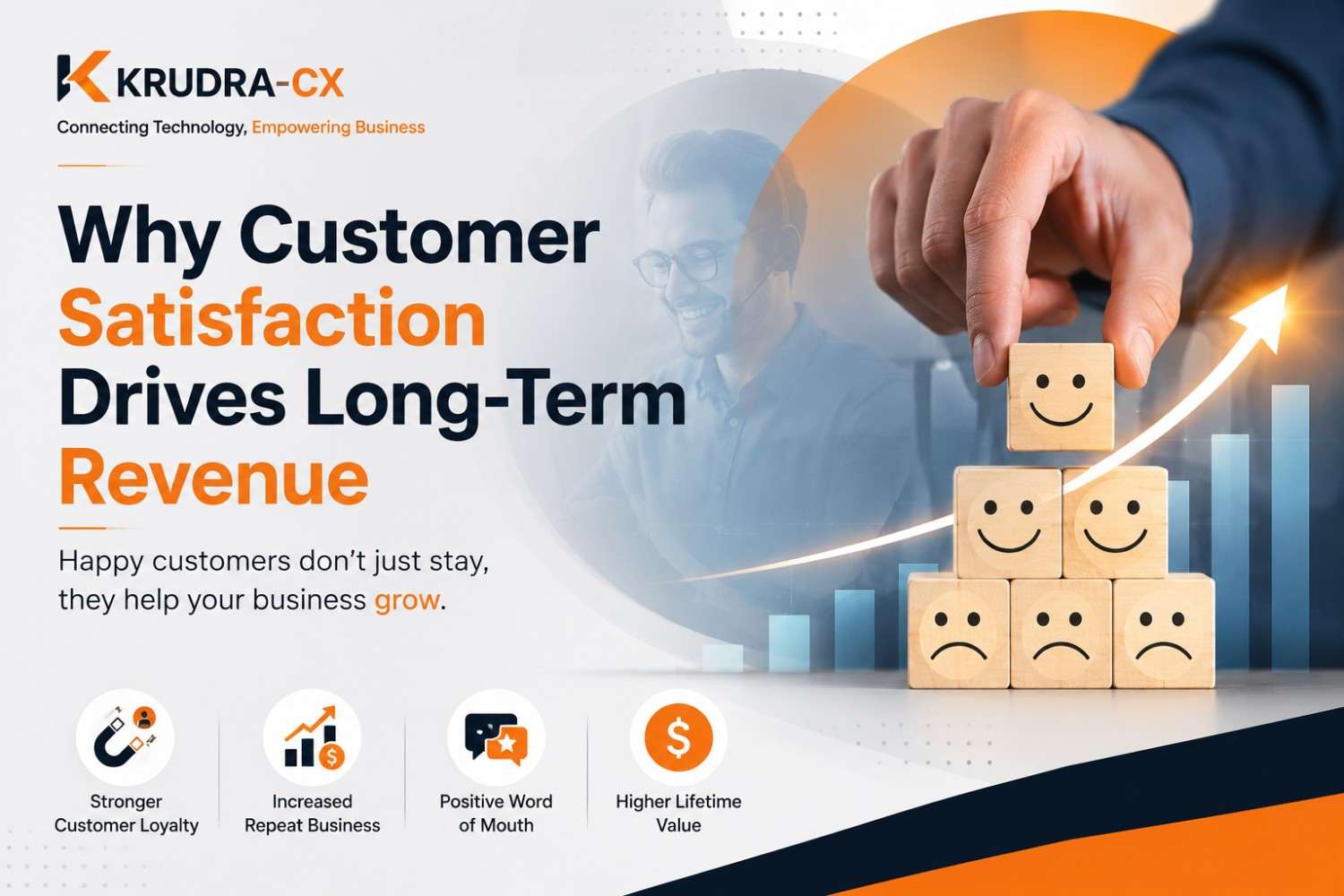
The evidence is overwhelming and consistent. Customer satisfaction directly drives retention. Retention drives lifetime value. Lifetime value drives profitability. Satisfied customers advocate for your brand, expanding your customer base without acquisition cost. Highly satisfied customers pay premium prices, protecting your margins. And the compounding nature of these effects means that every year you invest in satisfaction, the returns grow — while every year you neglect it, the compounding goes in the opposite direction, accelerating your vulnerability to churn, competition, and irrelevance.
The businesses that will win the next decade are not the ones with the most aggressive advertising budgets or the most sophisticated growth hacking strategies. They are the ones that earn and keep the trust of their customers so consistently, so reliably, and so meaningfully that those customers become their most powerful competitive moat.
Customer satisfaction is not a cost of doing business. It is the most powerful revenue investment you can make. And the time to make it is now.
Take the Next Step With Krudracx
You now understand the science. The question is: what will you do with it?
Most businesses read insights like these and nod in agreement — then return to the same patterns, the same generic customer interactions, the same reactive approach to satisfaction that keeps them perpetually vulnerable to churn and competition.
The brands that actually win are the ones that move from understanding to action — systematically, strategically, and with expert guidance.
That is exactly what Krudracx is built for.
Krudracx is a customer experience strategy platform designed to help ambitious businesses translate customer satisfaction principles into measurable revenue outcomes. Whether you are mapping your customer journey for the first time, implementing a feedback system that actually closes the loop, or building a loyalty architecture that turns satisfied customers into passionate advocates — Krudracx gives you the frameworks, tools, and strategic clarity to do it right.
Stop leaving revenue on the table. Start engineering the customer experiences that compound into sustainable growth.
→ Visit www.krudracx.com to explore how Krudracx can transform your customer satisfaction into your most powerful revenue engine. Your next loyal customer is waiting for the experience that earns them.
Krudracx — Where Customer Experience Becomes Competitive Advantage.