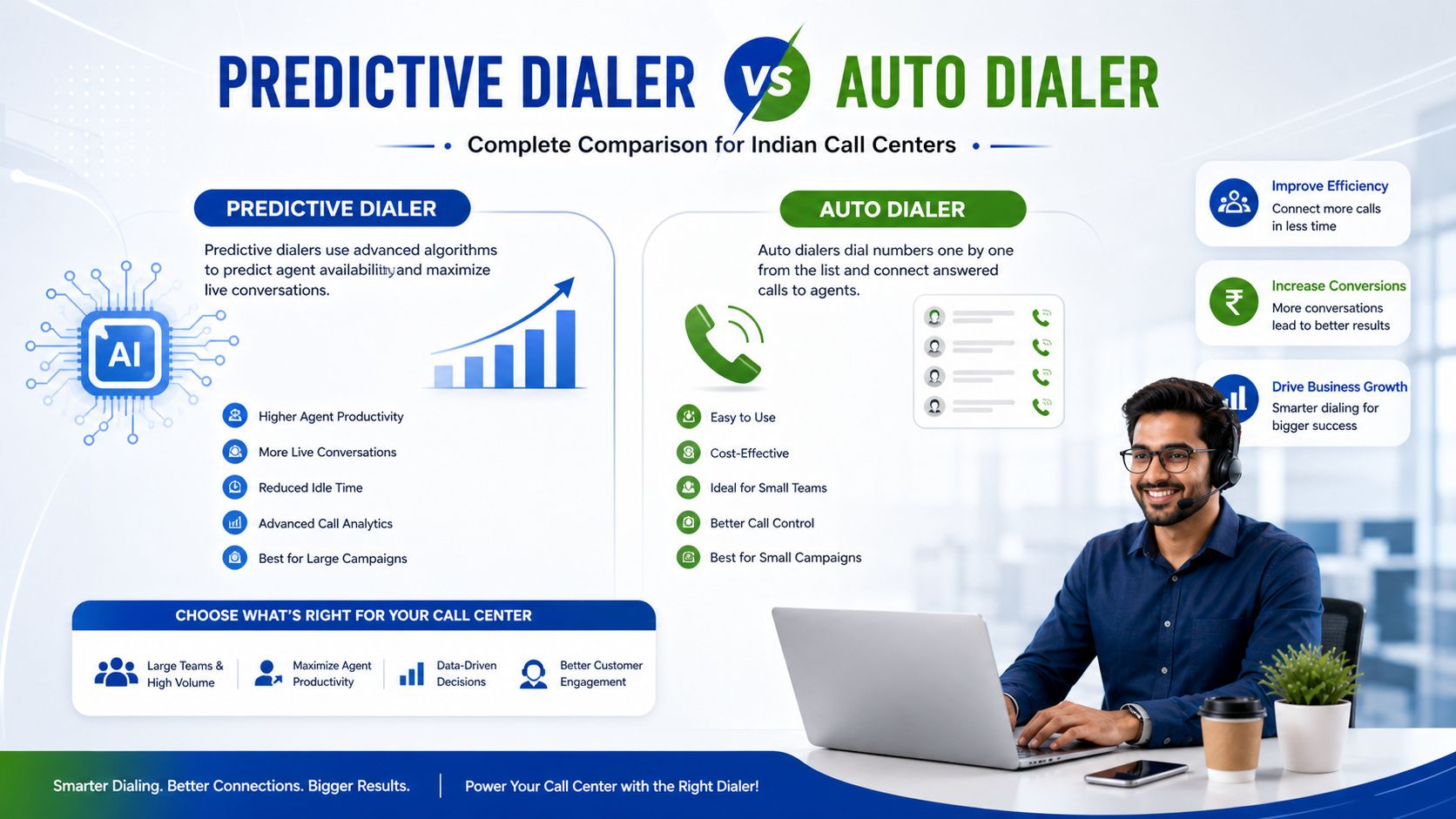
First, Let's Understand What Both of These Are .......
Before comparing them, it helps to have a clean, clear understanding of what each dialer actually does.
What Is an Auto Dialer?
An auto dialer is software that automatically dials phone numbers from a contact list without any agent having to manually dial. When a call connects and a real person answers, the system routes it to an available agent. When a call hits voicemail, a busy signal, or goes unanswered, the system moves to the next number automatically.
The term "auto dialer" is actually a broad category. It includes preview dialers, progressive dialers, power dialers, and predictive dialers. So technically, a predictive dialer is a type of auto dialer — but in everyday usage, when people say "auto dialer" they usually mean a progressive or power dialer, and "predictive dialer" refers specifically to the AI-powered version.
That is the distinction we will use throughout this guide.
What Is a Predictive Dialer?
A predictive dialer is the most advanced form of automated dialing. It uses algorithms and machine learning to dial multiple numbers simultaneously, and it constantly predicts when an agent is about to finish their current call so that a new connected call is ready for them the moment they are free.
The system is always making calculations in real time — average call duration, current agent availability, historical answer rates for specific time slots, drop rates — and adjusting its dialing pace accordingly. The goal is to keep every agent talking to a live person as close to continuously as possible.
That is the key difference in one sentence: a standard auto dialer dials when an agent is ready. A predictive dialer dials ahead of time and predicts when an agent will be ready.
How They Work Differently: A Side by Side Look
To really understand the difference, it helps to walk through what actually happens during a calling campaign with each system.
With a Standard Auto Dialer (Progressive Mode)
An agent finishes a call. The system detects that the agent is now free. It immediately dials the next number on the list. The agent waits a few seconds while the number rings. If someone answers, the call is connected. If not, the system moves on and dials the next number.
The agent is idle during the time the number is ringing. That gap — usually 10 to 30 seconds — adds up significantly over a full shift. But the advantage is that every time a call connects, an agent is guaranteed to be available for it.
With a Predictive Dialer
An agent is still in the middle of a call. The system looks at that agent's average call duration, sees that they typically wrap up in about 3 minutes, and notices they are already 2.5 minutes in. It starts dialing the next number now, before the current call ends.
By the time that agent wraps up their call and says goodbye, a new connected live person is already on the line waiting for them. The gap between calls shrinks from 20 to 30 seconds down to just 2 or 3 seconds. Across an 8-hour shift, that difference in idle time is massive.
The system is doing this simultaneously across all agents on the floor, constantly recalibrating based on what is actually happening in real time.
The Numbers: What the Productivity Difference Actually Looks Like
Let us put some real numbers on this because the difference is significant and it is worth understanding clearly.
A typical agent doing manual dialing handles somewhere around 40 to 60 calls per day. Their actual talk time — the time they are in live conversations — is roughly 25 to 35 minutes per hour.
With a standard progressive auto dialer, that same agent can handle 80 to 120 calls per day, with talk time increasing to around 35 to 45 minutes per hour. A solid improvement, and for many teams this is more than enough.
With a well-configured predictive dialer, the same agent can handle 150 to 200 calls per day, with talk time pushing up to 50 to 55 minutes per hour. That is close to the theoretical maximum for outbound calling — nearly every minute of an agent's shift is spent in a live conversation.
For a 10-agent team, the difference between a progressive dialer and a predictive dialer might be 300 to 400 additional conversations per day. For a 50-agent floor, that number becomes staggering.
Where Auto Dialer (Progressive) Wins
A standard progressive auto dialer is not the inferior option — it is often the right option. Here is where it genuinely outperforms predictive dialing.
When Your Team Is Small
Predictive dialing works best when there are enough agents to absorb the call volume it generates. The algorithm needs a reasonably large pool of agents to make accurate predictions about availability and call timing.
For teams of fewer than 10 to 15 agents, predictive dialing can actually cause more dropped calls and abandoned connections than it saves in idle time. A progressive auto dialer gives you consistent, clean performance without the complexity, and it scales perfectly for smaller operations.
When Call Quality Matters More Than Volume
Not every outbound call is about raw volume. If your team is calling warm leads, existing customers, or high-value prospects, the few extra seconds between calls is a worthwhile trade for ensuring every connection is clean and properly handled.
Dropped calls — where a customer picks up and hears silence or a disconnect — are not just annoying. In a B2B sales context or with premium clients, they can seriously damage your credibility. Progressive dialers virtually eliminate dropped calls.
When You Are in a Highly Regulated Industry
TRAI regulations in India set specific limits on how many abandoned calls a dialer can generate within a campaign. Predictive dialers, by their nature, occasionally dial a number that connects but has no agent available to take it — this is called an abandoned call or a dropped call.
Progressive dialers do not have this problem. Every connected call has an agent ready for it, which makes compliance straightforward and audit-proof.
When Your Agents Are Still Learning
A progressive dialer gives agents a few seconds between calls to breathe, review their notes, and mentally prepare for the next conversation. For new agents who are still building their confidence and speed, this buffer makes a real difference in call quality and reduces burnout.
Putting a brand new agent on a predictive dialer that fires calls at them continuously is a recipe for poor performance and fast turnover.
Where Predictive Dialer Wins
Now let us look at where predictive dialing genuinely earns its place — because for the right operation, there is no substitute.
When You Are Running a High-Volume Outbound Operation
If your call center's core job is to reach as many people as possible — insurance renewals, loan recovery, telecom campaigns, political outreach, survey completion — then predictive dialing is where you need to be.
The productivity gains at scale are simply too large to ignore. A 100-agent floor running on a predictive dialer versus a progressive dialer might generate 5,000 to 8,000 more conversations per day. That is not a marginal improvement — it is a fundamentally different level of output.
When Your Contact Lists Are Massive
If you are working through a contact list of 50,000 or 100,000 numbers, the speed at which you reach people matters enormously. Leads go cold. Timing windows close. Competitors are calling the same lists.
Predictive dialing lets you cover ground at a pace that simply is not possible with any other approach. You can run through a large list in a fraction of the time it would take with progressive dialing, while still connecting every answered call to a live agent.
When You Have Experienced, High-Performance Agents
Predictive dialing rewards skilled agents. Experienced agents who can jump into a conversation immediately, adapt quickly to whoever is on the other end, and maintain energy across a high volume of calls will thrive on a predictive dialer.
If you have built a team of strong performers, putting them on a predictive dialer is one of the fastest ways to dramatically increase your campaign output without adding headcount.
When Your Campaign Has a Tight Time Window
Sometimes you need to reach a large audience within a specific period — a flash sale, a limited-time offer, a regulatory deadline, an event reminder. Predictive dialing compresses the time required to cover your entire contact list, making it the right tool whenever speed of coverage is the priority.
The Dropped Call Problem: What You Need to Know
This is the single biggest concern with predictive dialers, and it deserves a clear, honest explanation.
Because a predictive dialer dials ahead of agent availability, there will occasionally be moments when more calls connect than there are agents to receive them. When this happens, the connected customer hears silence — or a click and a disconnect. This is a dropped call or an abandoned call.
Dropped calls create two problems. First, they are a poor customer experience. Being called, picking up, and hearing nothing is confusing and frustrating — especially if it happens more than once from the same number. Second, in India, TRAI regulations set a maximum abandoned call rate for automated dialing campaigns. Exceeding this rate can result in penalties.
Modern predictive dialers have gotten significantly better at managing this. Sophisticated algorithms keep abandoned rates very low — typically under 3 percent when the system is properly configured. But it is never zero, and it requires ongoing monitoring.
Progressive dialers, by contrast, have an abandoned call rate of essentially zero. Every connected call has an agent waiting for it.
This is not a reason to avoid predictive dialing — but it is a reason to choose your vendor carefully, ensure proper configuration, and monitor campaigns actively.
Key Features to Compare When Choosing
Beyond the dialing mode itself, here are the features that actually matter when you are evaluating auto dialer versus predictive dialer solutions for your call center.
DND Filtering
Both types should automatically filter numbers against India's DND registry before any call is placed. This is non-negotiable for compliance. If a vendor does not offer this as a standard feature, move on.
CRM Integration
The dialer should connect with your CRM so agents have full contact context on every call and outcomes are logged automatically. This applies to both dialer types — the difference is that with predictive dialing, the speed of call delivery makes good CRM integration even more critical because agents have less time to manually look up information.
Real-Time Supervisor Dashboard
Both types should offer a live dashboard for managers. With predictive dialing specifically, real-time monitoring is essential because the system is making constant decisions about dialing pace — supervisors need to be able to see and adjust campaign performance as it happens.
Adjustable Dialing Ratio
For predictive dialers, the ability to manually adjust the dialing ratio is important. During slower periods or when agent availability changes, you want to be able to dial more conservatively to keep abandoned rates in check.
Voicemail Detection
Both dialer types should accurately detect voicemails and either skip them or drop a pre-recorded message automatically. Poor voicemail detection leads to agents being connected to recordings instead of people — a significant waste of time.
Which One Should You Actually Choose?
Here is a straightforward guide based on your situation.
Choose a standard auto dialer (progressive) if your team has fewer than 15 agents, if you are calling warm or high-value leads, if you are in a heavily regulated industry, if your agents are newer and still developing their skills, or if call quality and customer experience are your primary concern over raw volume.
Choose a predictive dialer if your team has 15 or more agents, if you are running high-volume outbound campaigns, if your contact lists are large and need to be covered quickly, if your agents are experienced and high-performing, or if maximizing the number of conversations per day is your primary objective.
If you are genuinely unsure, start with a progressive auto dialer. It is simpler to configure, easier to manage, fully compliant, and will give your team a significant productivity boost without the complexity of predictive algorithms. You can always move to predictive dialing as your team grows and your operation matures.
How KRUDRA-CX Handles Both
KRUDRA-CX offers both progressive auto dialing and predictive dialing within the same platform, which means you are not locked into one approach. You can start with progressive dialing for smaller or newer campaigns and switch to predictive mode as your volume and team size grow — without changing systems or migrating data.
The platform includes automatic DND filtering, built-in CRM for full agent context on every call, a real-time supervisor dashboard, adjustable dialing ratios, and accurate voicemail detection. And because KRUDRA-CX is fully cloud-based, there is no hardware to install — your team can be live and dialing within a single day.
Book your free demo at krudracx.com and see both modes in action before making a decision.
The Bottom Line :-
Auto dialer and predictive dialer are not competing products — they are different tools for different stages of your call center's growth. The right choice depends on your team size, your campaign type, your compliance requirements, and the kind of experience you want to deliver to the people you are calling.
What matters most is that you stop relying on manual dialing. Whether you go progressive or predictive, the productivity improvement over manual calling is significant enough that every day you delay is a day of lost conversations, lost leads, and lost revenue.
Pick the one that fits where you are today. You can always upgrade as you grow.