Introduction: The Sale You Lost Before You Even Knew You Had a Lead
Somewhere in your CRM right now, there's a lead that filled out a form, clicked "Enquire Now," or requested a callback three hours ago. Nobody has called them yet. Maybe the lead landed in a shared inbox nobody checks regularly. Maybe it got assigned to an agent who was on another call. Maybe it's just sitting in a spreadsheet waiting for someone to notice it.
By the time your team calls back, that customer has already spoken to two other builders, two other online sellers, or two other service providers. And in real estate and e-commerce especially, the business that responds first — not the one with the better price, the nicer property, or the bigger discount — usually wins the deal.
This is the speed-to-lead problem, and it's quietly costing Indian businesses more revenue than almost any other operational gap in the sales funnel. It doesn't show up as a dramatic failure. It shows up as a slow, steady leak — leads that technically existed, technically got followed up on, but too late to matter.
At KRUDRA-CX, we've built lead management infrastructure for real estate developers, e-commerce brands, and lead-generation-heavy businesses across India. This guide walks through exactly why speed-to-lead matters so much, what breaks in most manual and semi-automated setups, and what a properly built lead management system actually does differently.
What Is a Lead Management System, Exactly?
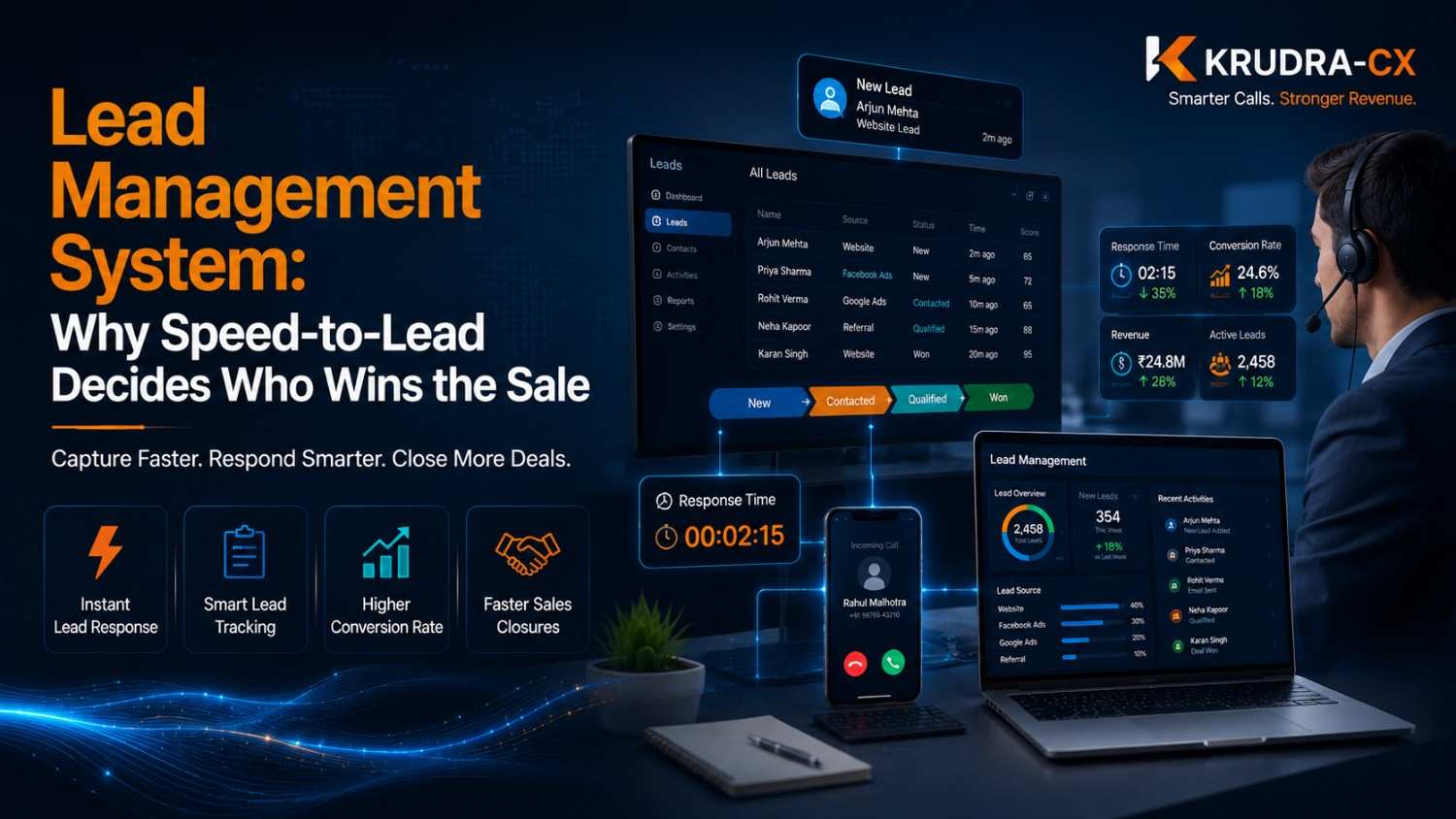
A lead management system is the software layer that sits between the moment a lead is generated — a form fill, a missed call, a WhatsApp enquiry, a walk-in registration — and the moment a salesperson actually engages with that lead. Its job is to capture, qualify, distribute, prioritize, and track leads automatically, so no enquiry falls through the cracks and every lead reaches the right agent at the right time.
This is different from a basic CRM in one crucial way: a CRM stores and organizes contact data. A lead management system actively routes and prioritizes it in real time, the moment it enters the system — often before a human has even looked at it.
A properly built lead management system typically handles:
- Lead capture across every channel — website forms, landing pages, missed calls, IVR, WhatsApp, social ads, portals like 99acres or Housing.com for real estate, or marketplace enquiries for e-commerce.
- Automatic lead scoring — ranking leads by intent signals like budget range, page visited, time spent, or previous interaction history.
- Instant assignment — routing each lead to the right agent based on territory, product line, availability, or workload, within seconds of capture.
- Follow-up automation — triggering call, SMS, or WhatsApp reminders if a lead isn't contacted within a defined window.
- Full funnel tracking — visibility into every stage from first contact to site visit, negotiation, and closure (or cart, checkout, and purchase for e-commerce).
Why Speed-to-Lead Matters More Than Almost Anything Else
There's a well-documented pattern across sales research globally, and it holds just as strongly in the Indian real estate and e-commerce markets: the odds of qualifying and converting a lead drop sharply with every passing minute after that lead is generated. A lead contacted within the first five minutes is dramatically more likely to convert than the same lead contacted an hour later. By the time a day has passed, that same enquiry has often already been closed by a competitor, or the buyer has simply lost the urgency that made them reach out in the first place.
Here's why this hits real estate and e-commerce especially hard:
In real estate, a buyer researching a property is almost always talking to multiple builders or brokers simultaneously. A site visit enquiry isn't a casual browse — it's an active buying signal, often with real money and real urgency behind it. If your sales team takes hours to call back, the buyer has likely already scheduled a site visit with a competitor who called within minutes.
In e-commerce, a customer who abandons a cart or requests a callback about a high-value item (electronics, furniture, appliances) is comparison shopping across multiple sellers in real time, often across multiple browser tabs. A callback that comes six hours later is competing against a purchase that may have already happened.
In both cases, the product, the price, and the brand often matter less at this specific moment than one simple factor: who responded first with genuine, relevant follow-up.
What Actually Breaks in Manual and Semi-Automated Lead Handling
Most businesses don't lack leads. They lack a system that gets those leads to the right person fast enough. Here's where the breakdown typically happens:
1. Leads land in a shared inbox or spreadsheet.
Multiple channels feed leads into disconnected places — one inbox for website forms, another for WhatsApp, a spreadsheet for portal leads. Nobody owns the job of checking all of them constantly, so leads sit unassigned for hours.
2. Manual assignment creates delay and bias.
A sales manager manually looking at a lead list and deciding who gets which lead is inherently slow, and often ends up favoring certain agents over others regardless of actual availability or fit.
3. No follow-up trigger when a lead goes cold.
An agent gets a lead, tries once, doesn't reach the customer, and moves on to the next task. Without an automated reminder, that lead often never gets a second attempt — even though follow-up research consistently shows most conversions happen after multiple touchpoints, not the first call.
4. No visibility into what's actually happening.
Sales managers often don't know how many leads are sitting unassigned, how long the average first-response time is, or which agents are converting well versus which ones are letting leads go cold — until it shows up in the monthly numbers, by which point the damage is already done.
5. Channels don't talk to each other.
A customer who enquires via WhatsApp, then calls the helpline, then fills a website form is often treated as three separate leads instead of one prioritized, well-informed follow-up — leading to a disjointed, frustrating experience that actively damages conversion instead of helping it.
What Changes With a Proper Lead Management System
Leads get assigned in seconds, not hours.
The moment a lead enters the system — regardless of channel — it's automatically routed to an available, appropriately matched agent, with zero manual intervention required.
Every agent gets a prioritized worklist, not a random pile.
Instead of agents guessing which lead to call first, the system surfaces the highest-intent, most time-sensitive leads at the top, based on scoring logic tied to real signals like budget, source, and recency.
Follow-up happens automatically when it's needed.
If a lead hasn't been contacted within a set window, or hasn't responded after the first attempt, the system triggers a reminder, a re-assignment, or an automated WhatsApp/SMS nudge — so leads don't quietly go cold.
Every channel feeds one unified lead record.
Whether a customer enquires via a landing page, a missed call, or a WhatsApp message, it's tracked as one continuous journey, giving agents full context instead of a fragmented, repetitive conversation.
Managers get real-time visibility.
Live dashboards show first-response time, lead-to-conversion rates by agent, unassigned lead counts, and funnel drop-off points — turning lead management from a monthly post-mortem into a daily, correctable process.
The net effect across real estate and e-commerce deployments is consistent: first-response time drops from hours to minutes, more leads actually get a genuine follow-up attempt instead of falling through the cracks, and conversion rates rise — not because the leads themselves changed, but because they're finally being worked the way they should have been all along.
Real Estate: What This Looks Like in Practice
A prospective buyer fills out an enquiry form on a project's landing page at 11:40 AM, asking about a 3BHK in a specific budget range. Within seconds, the lead is scored based on budget fit and project interest, and instantly assigned to the sales executive covering that project and territory — not whichever executive happens to be free, but the one best matched to close that specific enquiry.
The executive's dashboard immediately surfaces this lead at the top of their worklist, flagged as high-intent. They call within minutes. If the call isn't picked up, the system automatically schedules a follow-up reminder and triggers a WhatsApp message with project details, so the buyer has something to engage with even before the next call connects.
Compare that to the alternative — the same enquiry sitting in a spreadsheet until someone manually reviews it that afternoon, by which point the buyer has already booked a site visit elsewhere.
E-Commerce: What This Looks Like in Practice
A customer browsing a high-value product — say, a furniture set or a home appliance — abandons their cart but leaves a callback request. In a manual setup, that request might sit in a queue for hours before an agent gets to it, by which time the customer has often already purchased the same product from a competing seller who called back within the hour.
With an integrated lead management system, that abandoned-cart signal is treated as a high-intent lead the moment it's generated. It's scored, routed to an available sales or support agent instantly, and the agent's screen shows full context — the exact product, the cart value, any previous browsing history — so the follow-up call feels informed and relevant rather than generic, dramatically increasing the odds of recovering that sale.
What to Look for When Choosing a Lead Management System
If you're evaluating options for your real estate or e-commerce business, here's what actually matters:
1. True multi-channel capture.
The system should pull leads automatically from every source you use — website, landing pages, portals, WhatsApp, missed calls, social ads — into one place, without manual data entry.
2. Real-time, rule-based assignment.
Look for configurable rules — territory, budget range, product category, agent workload — not just simple round-robin assignment that ignores context.
3. Built-in follow-up automation.
The system should nudge agents (or the lead directly, via WhatsApp/SMS) automatically when a follow-up window is missed — this is where most manual processes silently fail.
4. Integration with your dialer and CRM.
Lead management shouldn't exist in isolation. It needs to connect directly with your calling system and CRM so agents can go from lead assignment to first call without switching tools or re-entering data.
5. Real-time reporting for managers.
First-response time, conversion rate by source and agent, and unassigned lead counts should be visible live — not compiled into a report days later.
6. Fast, hardware-free deployment.
Especially for growing real estate and e-commerce businesses, the system should be cloud-based and quick to set up, scaling as your lead volume grows without a lengthy re-platforming process.
Conclusion: The Fix Isn't More Leads. It's Faster, Smarter Follow-Up on the Ones You Already Have
Most real estate and e-commerce businesses don't have a lead generation problem — they have a lead response problem. Marketing is doing its job, ads are bringing in enquiries, and forms are getting filled. The revenue is leaking somewhere between the moment that lead lands and the moment someone actually picks up the phone.
A proper lead management system closes exactly that gap — routing every lead to the right person in seconds, prioritizing the ones that matter most, and making sure nothing sits unattended long enough for a competitor to get there first.
If your team is still working leads out of a shared inbox or spreadsheet, the leads you're losing every week are almost certainly larger than they appear on a monthly report — because a lead that goes cold rarely shows up as a loss. It just quietly disappears.
KRUDRA-CX builds exactly this kind of lead management infrastructure — fully integrated with dialer and CRM systems, live in 24 hours, with no hardware and no setup fee — for real estate developers, e-commerce brands, and lead-generation businesses across India.