Introduction: The Complaint That Never Actually Got Closed
A customer messages your WhatsApp business number about a delayed order. No response for a few hours, so they call your support line instead. The agent who picks up has no idea a WhatsApp message was ever sent — there's no record of it on their screen. They log a fresh complaint, promise a callback, and move on. Two days later, frustrated, the customer emails support directly, repeating the same complaint a third time, because as far as they can tell, nobody is actually working on it.
From the business's side, this looks like three separate, mildly annoying interactions. From the customer's side, it looks like something far worse: nobody is listening, and nobody owns the problem. That customer doesn't just churn on this one order — they quietly stop trusting the brand altogether, and they rarely say why. They just stop buying, stop booking, and start recommending a competitor instead.
This is the hidden cost of fragmented complaint handling, and it's one of the most underestimated retention problems in Indian travel and e-commerce businesses today. It doesn't show up as a dramatic failure on a dashboard. It shows up as a slow erosion of repeat customers, quietly, one unresolved complaint at a time.
At KRUDRA-CX, we've built ticketing infrastructure for businesses handling high complaint volumes across multiple channels — from e-commerce brands managing order and delivery disputes to travel companies handling booking changes, refunds, and itinerary issues. This guide breaks down why fragmented complaint handling is so damaging, what a proper unified ticket system actually fixes, and what to look for if you're evaluating one.
Why This Problem Is Worse in Travel and E-Commerce Specifically
Every industry deals with customer complaints, but travel and e-commerce have a particular combination of characteristics that make fragmented complaint handling especially costly.
High emotional stakes, low patience. A delayed flight, a cancelled hotel booking, or a wrong item delivered right before a trip or event isn't a minor inconvenience — it's often tied to real plans, real money, and real stress. Customers in this state have very little tolerance for repeating themselves or waiting without updates.
Multiple touchpoints by default. A single travel booking might involve a WhatsApp confirmation, a call to a booking agent, an email itinerary, and an in-app chat — all from the same company, often through different teams. An e-commerce order similarly spans app notifications, WhatsApp delivery updates, a customer care number, and email confirmations. Complaints naturally scatter across whichever channel the customer happens to reach for in the moment.
Time-sensitive resolution windows. A complaint about a hotel booking three days before check-in has a very different urgency than a general product feedback ticket. Without a system that flags and prioritizes based on actual urgency, time-sensitive complaints often get buried under routine ones simply because they arrived later.
High switching ease. Both industries face intense competition, and switching costs for the customer are close to zero. A traveler frustrated with unresolved support doesn't hesitate to book the next trip with a different platform. An e-commerce shopper doesn't think twice before ordering the same product from a competing seller next time. Retention in both industries depends heavily on how well complaints are handled, not just on price or selection.
What Actually Happens Without a Unified Ticket System
Most businesses aren't ignoring complaints on purpose. The damage happens structurally, through gaps in how complaints are captured and tracked:
1. Every channel is its own silo.
WhatsApp complaints live in one inbox, call complaints get logged (or don't) in a call log, email complaints sit in a shared mailbox, and in-app messages live in yet another system. No single person or system has visibility across all of them for a given customer.
2. The same complaint gets logged multiple times.
When a frustrated customer reaches out through a second or third channel because the first went unanswered, most businesses treat it as a brand-new issue rather than recognizing it as an escalation of an existing one — wasting agent time and making the customer repeat themselves.
3. There's no clear ownership.
Without a formal ticketing structure, complaints often fall into a gap where no specific agent or team is accountable for closing them. Everyone assumes someone else is handling it.
4. SLAs exist on paper, not in practice.
Many support teams have informal targets — "respond within 4 hours," "resolve within 24 hours" — but without a system actively tracking and flagging breaches, these targets quietly slip, especially during high-volume periods like sale seasons or peak travel months.
5. Managers have no visibility into what's actually happening.
Without centralized tracking, a support manager often has no reliable way to know how many complaints are open, how old the oldest unresolved ticket is, or which agents are falling behind — until customer complaints start showing up publicly on social media or review platforms.
6. Repeat complaints go unnoticed.
If the same customer complains three times about the same issue across three channels, without a unified system there's no way to spot that pattern — and no way to recognize a customer who's on the verge of churning until it's already too late.
What a Proper Unified Ticket System Actually Does
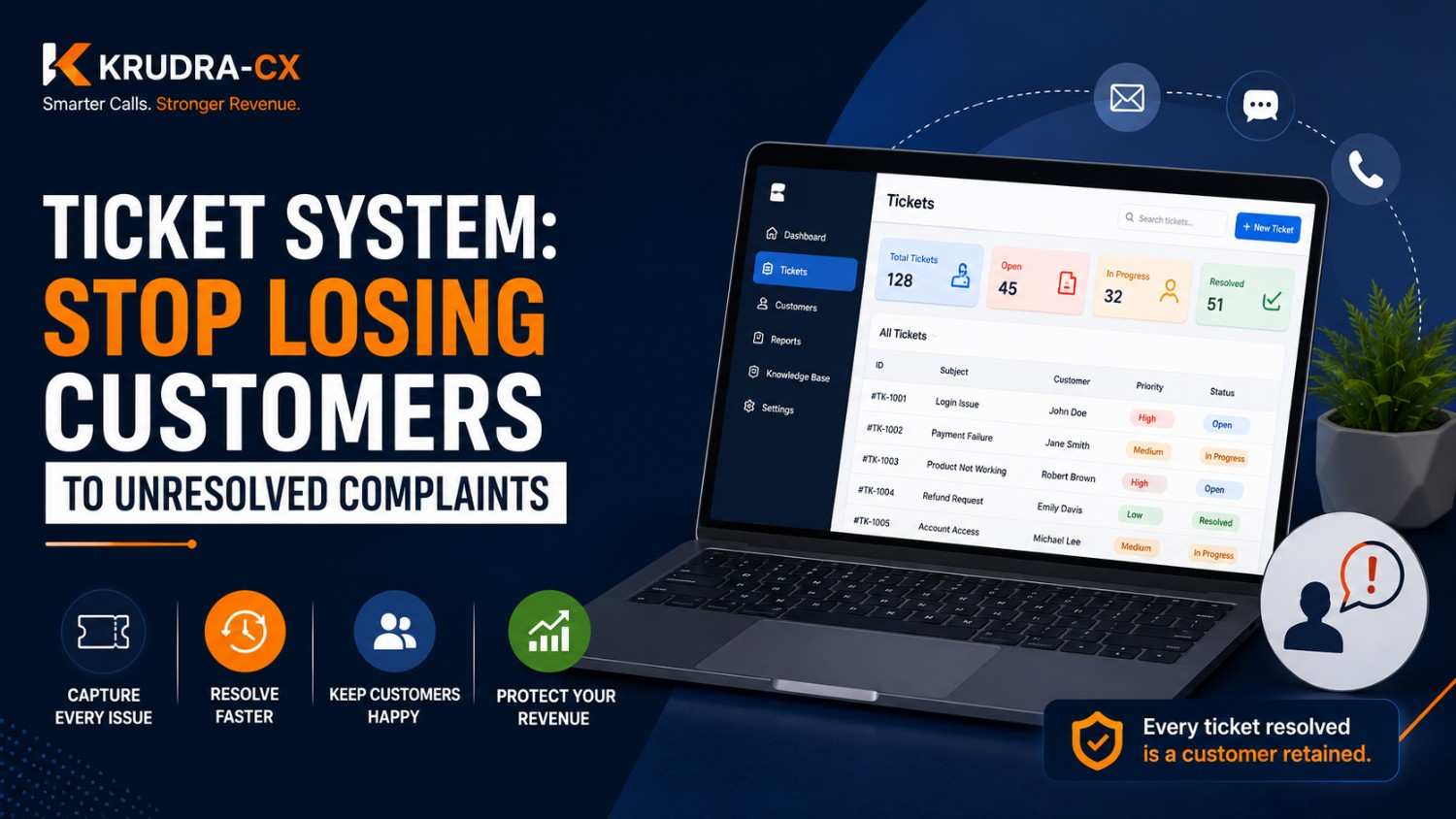
A well-built ticket system solves this by treating every customer interaction — regardless of channel — as part of one continuous, trackable thread. Here's what changes:
Every complaint becomes a single, traceable ticket.
Whether the customer reaches out via WhatsApp, call, email, or in-app chat, the system recognizes it as the same customer and links it to the existing open ticket instead of creating a duplicate — giving the next agent full context instantly, without the customer repeating themselves.
Automatic SLA tracking and escalation.
Every ticket gets a resolution clock based on its priority level. As a ticket approaches its SLA deadline, the system automatically flags it, and if it breaches, it escalates to a supervisor — turning a soft, easily-missed target into an enforced operational standard.
Priority-based routing.
Not every complaint is equally urgent. A ticket system can automatically flag time-sensitive issues — a booking departing in six hours, a delivery due today — and surface them above routine, non-urgent tickets, so agents work on what matters most first.
Full interaction history in one view.
Agents see the complete history of a customer's interactions — every channel, every previous ticket, every resolution — before they respond, allowing for genuinely informed, empathetic follow-up instead of a cold restart every time.
Real-time dashboards for managers.
Support leads get live visibility into open ticket counts, average resolution time, SLA breach rates, and agent workload — allowing them to catch problems building up in real time, rather than discovering them after a customer has already churned or posted a public complaint.
Pattern detection across repeat complaints.
Because every interaction is logged against the same customer record, it becomes far easier to spot a customer who's raised the same or related issue multiple times — flagging them for proactive, senior-level attention before they walk away for good.
Travel: What This Looks Like in Practice
A traveler messages a travel platform's WhatsApp number about a flight delay affecting a connecting booking, three hours before departure. In a fragmented setup, this might sit unanswered while the customer, growing anxious, also tries calling the support line.
With a unified ticket system, the WhatsApp message is immediately logged as a high-priority ticket — flagged automatically because of the imminent travel date — and routed to an available agent with full context: booking details, previous interactions, and loyalty status. If the customer also calls in the meantime, the agent picking up that call sees the existing open ticket immediately, avoiding a confusing, repetitive conversation, and can pick up exactly where the WhatsApp thread left off.
The SLA clock on this ticket is tighter than a routine feedback ticket, because the system recognizes the urgency — ensuring it doesn't get buried under a queue of lower-priority tickets logged earlier in the day.
E-Commerce: What This Looks Like in Practice
A customer's order arrives with a damaged item. They report it through the app's chat support first, then, after a day without a clear update, call customer care directly. In a fragmented system, the call center agent has no visibility into the chat complaint and starts the process over — asking for order details and photos the customer already provided.
With a unified ticket system, the call is automatically linked to the existing open ticket. The agent sees the damaged item report, any photos already submitted, and the current resolution status instantly — allowing them to give the customer a real update rather than restarting the process. If the resolution (replacement, refund, or return pickup) is taking longer than the platform's committed SLA, the system flags it automatically for supervisor review before the customer has to escalate it themselves.
What to Look for When Choosing a Ticket System
If you're evaluating ticketing software for a travel or e-commerce operation, here's what genuinely matters:
1. True multi-channel unification, not just multi-channel presence.
Many tools claim to support WhatsApp, call, and email, but what matters is whether they merge these into one ticket per customer issue — not just three separate logs sitting in the same dashboard.
2. Configurable, enforced SLAs.
Look for systems where SLA rules can be set by ticket type or urgency, and where breaches trigger automatic escalation — not just a report that gets reviewed after the fact.
3. Priority and urgency logic.
The system should support rule-based prioritization, so time-sensitive tickets (an imminent flight, a same-day delivery issue) automatically surface above routine ones.
4. Integration with your CRM and calling system.
A ticket system that's disconnected from your customer data and dialer forces agents to work across multiple disconnected tools, slowing down every interaction. Integration matters more than any single standalone feature.
5. Real-time reporting, not end-of-day summaries.
Support managers need to see open ticket volumes, SLA risk, and agent workload as it's happening, so they can rebalance and intervene before a backlog builds up.
6. Fast, hardware-free deployment.
Especially for growing e-commerce and travel businesses with seasonal spikes, the platform should be cloud-based and quick to configure — able to scale up support capacity during peak sale or travel seasons without a lengthy setup process.
Conclusion: Retention Isn't Lost in One Big Failure — It's Lost in Small Unresolved Ones
Customer churn in travel and e-commerce rarely comes from one dramatic failure. It comes from a slow accumulation of small, unresolved frustrations — a complaint that got logged three times, a promised callback that never came, a resolution that took a week longer than it should have. Each one, on its own, looks minor. Together, they quietly convince a customer that they're not worth the follow-through, and they don't come back.
A unified ticket system doesn't just organize complaints — it closes exactly this gap. Every interaction becomes part of one traceable thread, every SLA becomes something actually enforced rather than aspirational, and every manager gets the real-time visibility needed to catch problems before they turn into lost customers.
If your support operation is still juggling WhatsApp, calls, and email as separate, disconnected channels, the customers you're quietly losing every month are almost certainly more than your dashboards currently show — because a churned customer rarely files a formal complaint about why they left. They just stop coming back.
KRUDRA-CX builds exactly this kind of unified ticketing infrastructure — fully integrated with CRM and dialer systems, live in 24 hours, with no hardware and no setup fee — for travel companies and e-commerce brands managing high-volume, multi-channel customer support across India.
Every unresolved complaint is a customer quietly walking away. Don't let a scattered inbox decide your retention numbers.
👉 Book a free KRUDRA-CX demo today and see how a unified ticket system catches every complaint — before your customer has to complain twice.
🔗 [www.krudracx.com/book-for-demo]