Most call centers operate under a shared pressure: handle more calls, keep costs down, hit the numbers. But somewhere between the dashboards and the shift schedules, two types of operations emerge. One just survives. The other actually performs.
The gap between them is rarely about budget. It's not always about technology either. It usually comes down to a handful of decisions — about culture, process, and how seriously leadership takes the details that most managers wave off as "soft stuff."
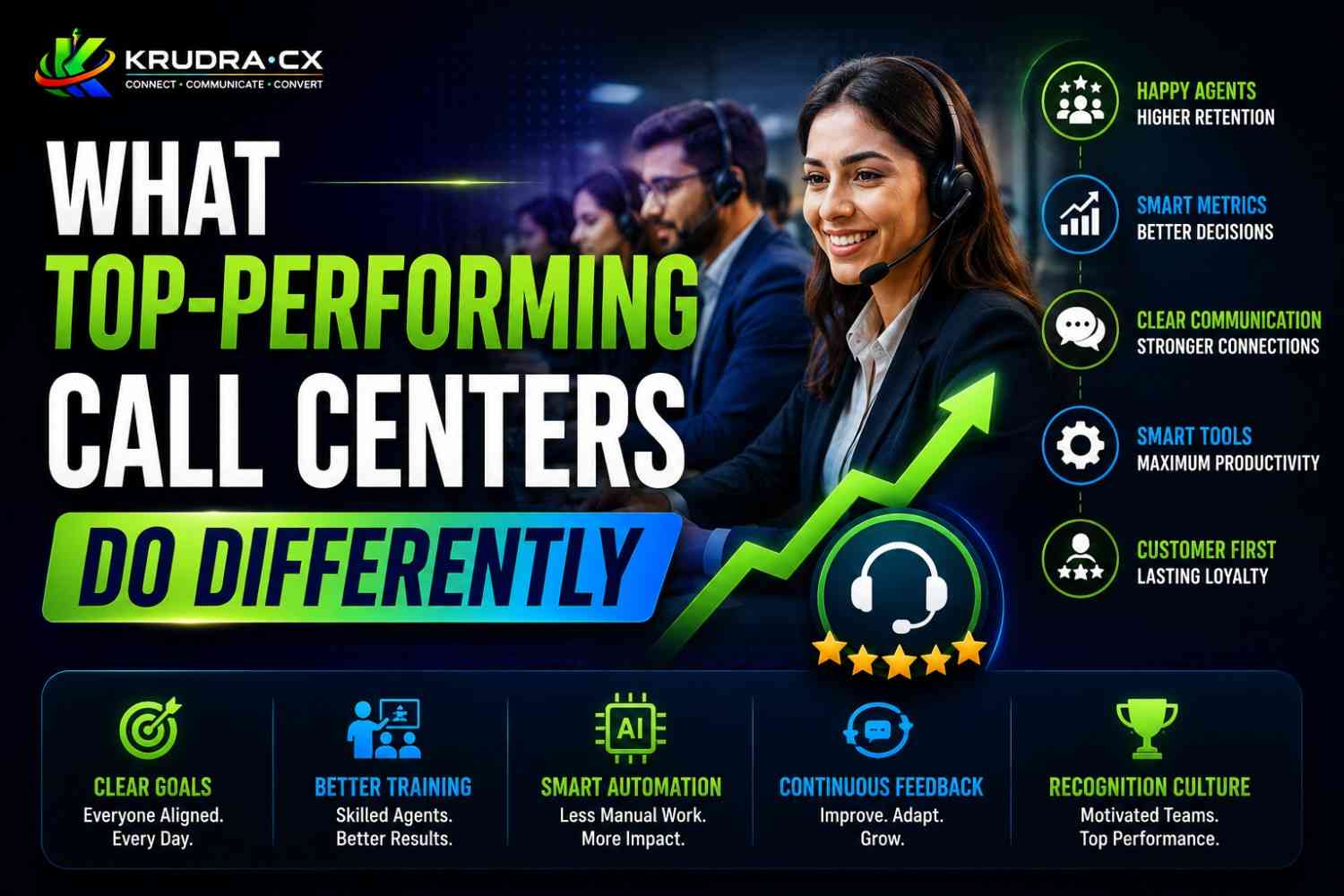
Here's what the top-performing call centers actually do differently.
They Treat Agent Experience as a Business Strategy
This is the one most operations teams get backwards. They focus entirely on the customer experience while treating agents like a cost center to be optimized. The result is high turnover, patchy service, and a customer experience that's inconsistent no matter how polished the script.
High-performing call centers understand that the agent experience directly shapes the customer experience. When agents feel supported, informed, and fairly treated, it shows up in every call. When they don't, it shows up there too.
This means managers who actually coach instead of just monitoring metrics. It means recognizing good work in a way that doesn't feel like a performance. It means giving agents real authority to resolve issues without escalating everything up the chain. Customers can tell the difference between an agent who is empowered and one who is reading from a flowchart with no room to move.
Turnover in call centers is brutal industry-wide. Top performers invest in fixing the conditions that drive it, not just filling seats faster.
Their Quality Assurance Actually Improves Performance
In most call centers, QA is a compliance exercise. Someone listens to a sample of calls, fills out a scorecard, and sends it to the agent. The agent reads it. Maybe they agree with it, maybe they don't. Nothing changes.
Top-performing centers treat QA as a coaching tool, not a report card.
The difference is in how feedback is delivered and what happens afterward. Evaluations are tied to specific behaviors, not general impressions. Coaches work with agents on the actual moments in the call where things could have gone differently. There's a follow-up process, not just a sent email.
The best centers also calibrate regularly. This means supervisors and QA evaluators score the same calls independently, then compare results. It catches inconsistency before it becomes a culture problem. If one supervisor scores calls 20 points higher than another, the scoring means nothing. Consistent standards require regular maintenance.
Some operations also build in peer review or agent self-evaluation. When agents score their own calls before seeing the official evaluation, it builds self-awareness faster than top-down feedback alone.
They Know Their Numbers, But They Know What the Numbers Mean
Every call center tracks Average Handle Time, First Call Resolution, CSAT, and occupancy. This is table stakes. The difference is that top performers don't just monitor these numbers. They understand the relationships between them.
For example: pushing AHT down without looking at FCR is one of the most common ways call centers accidentally make their service worse. Agents rush calls, issues go unresolved, and the same customers call back. Handle time looks good. Everything else suffers.
High performers track these metrics in relation to each other. They notice when FCR drops after a new policy change. They notice when CSAT scores diverge between agent cohorts. They ask what's causing the divergence before assuming it's just a people problem.
They also know which metrics actually connect to customer loyalty versus which ones just make the operation feel in control. Not every contact center metric predicts whether a customer stays or leaves. The best teams are honest about that.
They Handle the First Call Like It's the Only Call
First Call Resolution is one of the most important metrics in contact center operations, and also one of the most commonly faked. When agents are rewarded for closing tickets quickly, they find ways to close them quickly whether or not the issue is actually solved.
Top-performing centers design their systems to make genuine resolution easier, not just faster. This includes giving agents access to real account history instead of partial data. It includes knowledge bases that are actually up to date (a rarer thing than it sounds). It includes escalation paths that don't require the customer to repeat themselves to three different people.
There's also a mindset difference. Average centers think about handling the call. Top centers think about finishing the customer's problem. That sounds like a small distinction but it changes what agents do at the end of a call. Do they confirm the issue is resolved? Do they flag anything that might cause a callback? Do they have the tools to proactively tell the customer what comes next?
The customers who call back repeatedly are expensive to serve and increasingly frustrated. The centers that break that cycle do it by taking the first call more seriously.
Their Onboarding Actually Prepares Agents for Real Calls
Most call center onboarding trains agents for a version of the job that doesn't quite exist. New hires learn the ideal call flow in a controlled environment, then hit the floor and discover that real customers don't follow the script.
Top performers close that gap deliberately. Training includes realistic call simulations with difficult scenarios — not just the easy ones. New agents shadow experienced ones before going live and debrief on what they observed. The first weeks on the floor include close support, not just sink-or-swim independence.
There's also a difference in what gets trained. The best operations don't just train process. They train judgment. How do you handle a customer who is upset but also wrong? What do you do when the system is slow and the customer is losing patience? How do you stay calm on a call where you genuinely don't know the answer?
These situations happen constantly. Training that never addresses them produces agents who freeze or default to scripted apologies that don't help anyone.
Good onboarding is expensive. But replacing an agent who washes out in month two because they weren't prepared costs more.
They Build Knowledge Management Into the Operation
Call center knowledge bases are often described as helpful and experienced as a nightmare. Outdated information. Articles that contradict each other. Search functions that return fifteen results for a basic question. Agents who stop checking the KB and just ask a colleague because it's faster.
High-performing centers invest in knowledge management as an operational priority, not an afterthought. This means someone owns it. Updates happen on a defined schedule. Agents can flag when something is wrong and see the fix. The structure makes it quick to find information during a live call without losing the thread of the conversation.
When the knowledge base is reliable and easy to use, several things happen. New agents get up to speed faster. Experienced agents handle a wider range of issues. Consistency improves because everyone is working from the same information. Escalations drop.
The centers that neglect this usually know it's a problem. They also usually have something more urgent to deal with. The top performers treat knowledge management as directly connected to performance, not separate from it.
Their Culture Handles Escalations Without Drama
Every call center deals with escalations. The question is how.
In low-performing operations, escalations are a sign that something went wrong. Agents are reluctant to escalate because it feels like admitting failure. Supervisors are pulled away from other work to handle calls that could have been resolved earlier. Customers wait while the organization works out internally who should deal with them.
High performers treat escalations as a normal part of the operation, designed in rather than worked around. Agents know clearly what they can resolve and what they should escalate. They know how to hand off a call without making the customer feel like they're being passed around. Supervisors are trained specifically in de-escalation, not just issue resolution.
The cultural piece matters here. When agents aren't penalized for escalating appropriately, they do it earlier and more cleanly. The customer experience is better and the resolution rate goes up.
They Use Technology to Help Agents, Not Replace Their Judgment
A lot of call center technology is sold as a solution to problems that are actually people or process problems. Supervisors buy automation and AI tools hoping they'll fix issues that better training and clearer processes would address more directly.
Top-performing centers use technology more carefully. They automate what genuinely should be automated — routine transactions, password resets, appointment scheduling, FAQ responses. This frees agents for the calls that actually need a human: complex problems, emotionally charged situations, anything where judgment matters.
They also use real-time tools that support agents during calls rather than just monitoring them afterward. Access to customer history at the moment it's relevant. Prompts that surface relevant information based on what the customer is saying. Workflows that reduce how much an agent has to navigate while also managing a conversation.
The distinction between tools that help agents and tools that surveil them is real, and agents notice it. Platforms that make the work easier build trust. Platforms that exist mainly to generate performance data to be used against agents do something else.
They Take Customer Feedback Seriously
CSAT surveys are standard. Acting on them is less common.
High performers close the loop between customer feedback and operational change. This means someone is responsible for reviewing feedback patterns, not just reporting the scores. When feedback points to a specific issue — a process that consistently confuses customers, a product problem generating repeat contacts, a script that's landing badly — something gets changed.
They also understand that survey response rates and survey accuracy are different things. A 10% response rate on a post-call survey represents a specific type of customer. Building a complete picture of the customer experience requires more than one data source.
The best centers combine survey data with call recordings, callback rates, and direct agent observations. Agents are often the earliest signal that something has changed in what customers are experiencing. Operations that treat agents as information sources, not just labor, catch problems before they show up in the numbers.
They Plan Capacity Like It Matters
Workforce management is the operational discipline that doesn't get enough credit. When it's done well, customers don't wait long, agents aren't burned out from being chronically understaffed, and the center operates at a sustainable pace. When it's done poorly, everything else suffers regardless of how well the other pieces are working.
Top-performing centers invest in workforce management as a core function. Forecasting is based on real volume patterns, not last year's average. Scheduling accounts for the variation in call complexity throughout the day. Intraday adjustments happen when the actual volume diverges from the forecast, which it always does to some extent.
The centers that get this right tend to have lower agent burnout, lower turnover, and more consistent service levels. The centers that get it wrong often believe they have a performance problem when they actually have a staffing and scheduling problem.
They Develop Their People With Somewhere to Go
Call center work has a reputation as a dead-end job. In some operations, that reputation is accurate. In top performers, it isn't.
The difference is visible in how roles are structured and how performance is recognized. High-performing centers have clear paths from agent to senior agent to team lead to supervisor. They promote from within as a default, not an exception. They invest in development for people who show potential rather than waiting for those people to leave for a better opportunity somewhere else.
This matters operationally because experienced agents are more valuable than the industry often admits. An agent in their second or third year handles calls differently than a new hire. They read customer situations faster. They know the product deeply. They have judgment that can't be trained in the first month.
When organizations treat agents as interchangeable, they lose that experience constantly. The centers that hold onto good people build institutional knowledge that shows up in service quality in ways that are hard to quantify but easy for customers to feel.
The Pattern Underneath All of It
If you look at what separates high-performing call centers from average ones, there's a consistent thread: they take the details seriously that everyone else treats as secondary.
The knowledge base. The calibration process. The escalation culture. The onboarding. The career paths. None of these are flashy. None of them show up in a vendor demo. But they're what make the metrics move in the right direction over time rather than oscillating around the same mediocre average.
The organizations that get this tend to have leadership that has spent time on the floor, or at least close enough to it to know what actually matters. They're skeptical of solutions that promise to fix performance without addressing the underlying conditions that are producing poor performance. And they treat the people doing the work as the primary asset — not as a problem to be engineered around.
That's a different philosophy than most contact center operations run on. It's also why the gap between good and average in this industry is so persistent.
Ready to Close That Gap ?
If your call center is hitting the same walls — inconsistent quality, high turnover, metrics that look fine until you dig one level deeper — the issue usually isn't effort. It's the system.
At KrudraCX, we work with contact center teams to build the operational foundation that makes sustained performance possible. That means practical improvements to quality assurance, knowledge management, agent development, and workforce processes — not generic frameworks, but work that fits how your operation actually runs.
If you're serious about building a call center that performs consistently, not just occasionally, reach out to us at krudracx.com. Let's talk about where you are and what's worth fixing first.