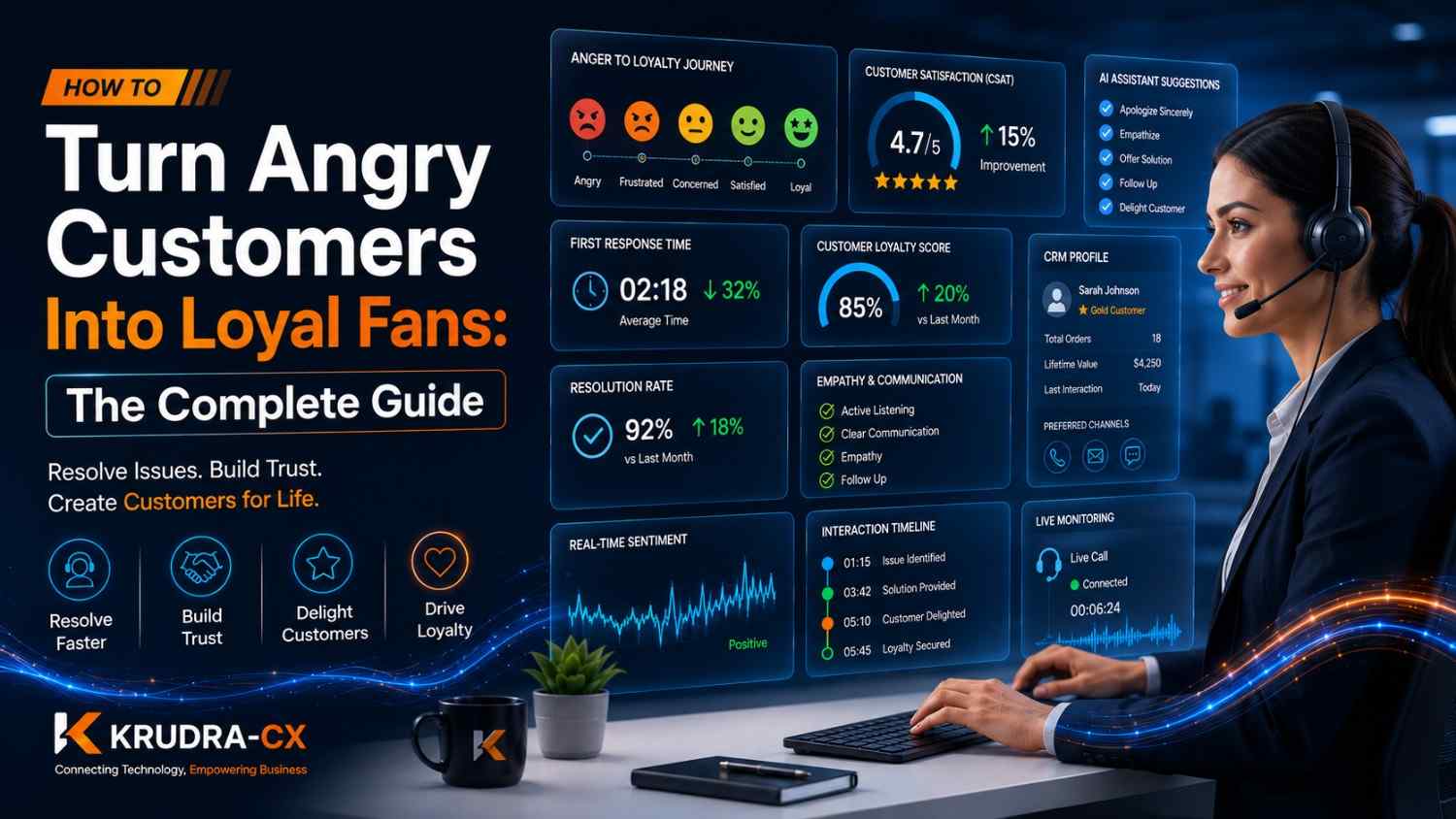
Introduction: The Hidden Opportunity in Customer Anger
Every business owner dreads the angry customer call. The raised voice, the frustration, the threat to "take my business elsewhere." But here's what most companies get wrong: an angry customer isn't a lost customer — they're an opportunity in disguise.
Research across the customer service industry consistently shows one thing: customers who complain and get their issue resolved well often become more loyal than customers who never had a problem at all. This is called the "service recovery paradox," and it's one of the most underused growth levers in business today.
At KrudraCX, we've seen this play out across hundreds of contact centers using our cloud-based dialer and CX platform. The businesses that master complaint handling don't just retain customers — they turn them into brand advocates who refer new business.
This guide breaks down exactly how to do that: the psychology behind customer anger, the step-by-step framework for de-escalation, real tactics your agents can use today, and how the right technology stack makes all of this scalable.
Section 1: Why Customers Get Angry (It's Rarely About the Product)
Before you can fix anger, you need to understand its root cause. In most cases, customer anger isn't really about the broken product or delayed delivery — it's about three deeper feelings:
1. Feeling Ignored
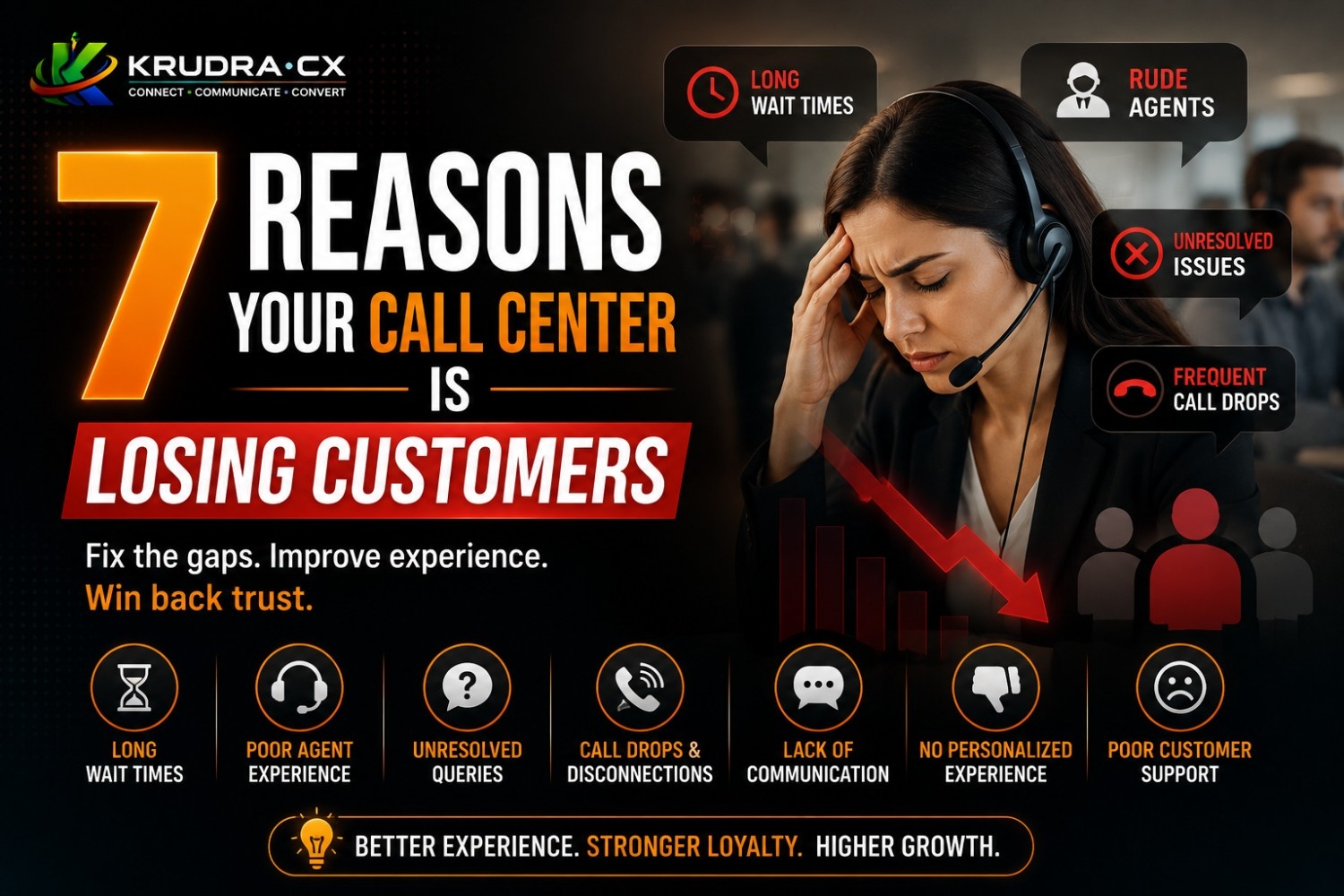
Customers who can't get a quick response feel invisible. Long hold times, unanswered emails, and bounced-around calls all send one message: "you don't matter to us."
2. Feeling Powerless
When customers can't get a clear answer or a path to resolution, they feel out of control. This powerlessness often manifests as anger because anger is a way of reclaiming control.
3. Feeling Disrespected
Broken promises, being talked down to, or having their time wasted — these all register as disrespect, which triggers a much stronger emotional reaction than the original issue itself.
Understanding this is critical because it changes your entire response strategy. You're not just solving a technical problem — you're addressing an emotional wound.
Section 2: The Cost of Getting It Wrong
Before diving into solutions, it's worth understanding the stakes:
- Unhappy customers tell significantly more people about bad experiences than good ones — negative word-of-mouth spreads faster and further.
- A large share of customers who have a negative experience will switch to a competitor, and many will do so after just one bad interaction.
- Acquiring a new customer costs far more than retaining an existing one, making every angry customer interaction a high-stakes retention moment.
- On social media and review platforms, one poorly handled complaint can influence hundreds or thousands of potential customers.
The math is simple: your complaint-handling process isn't a cost center. It's a revenue protection and growth mechanism.
Section 3: The L.E.A.R.N. Framework for De-escalating Angry Customers
Here's a practical, agent-friendly framework we recommend to every KrudraCX client for training their teams:
L — Listen Without Interrupting
Let the customer vent completely before responding. Interrupting, even to offer help, often escalates anger because it feels dismissive. Silence on your end signals attention, not weakness.
E — Empathize Genuinely
Use language that validates their feelings: "I understand why this would be frustrating" or "You're right to be upset about this — let's fix it." Avoid scripted-sounding phrases; customers can tell when empathy is genuine versus performative.
A — Apologize Without Excuses
A real apology doesn't come with a "but." Say "I'm sorry this happened" — not "I'm sorry, but our system was down." Excuses shift focus away from the customer's experience and back onto your company's problems, which reignites frustration.
R — Resolve with Ownership
Take clear ownership of the next steps. Don't say "someone will get back to you" — say "I am personally going to make sure this is fixed by [specific time]." Ownership converts anxiety into trust.
N — Nurture the Relationship After Resolution
The most overlooked step. A follow-up call or message a few days later — checking if the fix held — is what separates a company that "handled a complaint" from one that "built loyalty."
Section 4: Scripts and Language That Actually Work
Instead of: "That's not our policy."
Say: "Let me see what I can do within our guidelines to make this right for you."
Instead of: "You'll need to contact another department."
Say: "I'm going to personally connect you with the right person and stay on the line to make sure you don't have to repeat yourself."
Instead of: "I understand your frustration." (overused, sounds robotic)
Say: "If I were in your position, dealing with this delay, I'd be frustrated too — let's get this sorted right now."
Instead of: "This has never happened before."
Say: "This isn't the experience we want for you, and I'm going to make sure it's fixed."
Small language shifts like these dramatically change how customers perceive your intent — from defensive to genuinely helpful.
Section 5: The Role of Technology in Scaling Great Complaint Handling
Great intentions fail without the right systems. Here's where most contact centers lose the battle against customer anger — not in training, but in infrastructure:
1. Call Routing Delays
If an angry customer has to explain their issue three times across three transfers, you've made the problem worse, not better. Smart IVR and skill-based routing ensure complaints go directly to trained agents or senior staff on the first attempt.
2. Missing Context
Agents without access to a customer's history — past complaints, purchase records, previous promises made — end up repeating mistakes. A unified CRM-integrated dialer system means every agent sees the full picture instantly.
3. Slow Follow-Through
Promises like "we'll call you back" often get lost. Automated callback scheduling and disposition tracking ensure no promise to a customer is ever forgotten.
4. No Visibility for Managers
Supervisors need real-time alerts when a call is escalating so they can step in before it's too late. Live call monitoring and whisper/barge features allow managers to support agents in the moment.
This is exactly the gap KrudraCX's cloud contact center platform is built to close — combining intelligent call routing, CRM integration, real-time supervisor tools, and automated follow-up workflows so that de-escalation isn't dependent on individual agent skill alone, but is built into your operational backbone.
Section 6: Turning Resolved Complaints into Loyalty (And Referrals)
Resolving the issue is only step one. Here's how top-performing brands convert that resolution into long-term loyalty:
Follow Up Proactively
A short call or message days later asking "how has everything been since we fixed this?" shows customers they're not forgotten the moment the ticket closes.
Offer a Goodwill Gesture
This doesn't need to be expensive — a discount, extended support, or a small upgrade signals you value the relationship beyond the transaction.
Ask for Feedback, Not Just Reviews
Instead of immediately asking for a 5-star review, ask "what could we have done better throughout this experience?" This builds trust and often leads to more authentic, positive reviews organically later.
Turn Them Into Case Studies
Customers who had an issue resolved exceptionally well are often your most powerful advocates — because their story includes both a real problem and a real solution, which is far more persuasive than a customer who never had an issue.
Section 7: Common Mistakes That Turn Angry Customers into Lost Customers
- Making the customer repeat their story across multiple agents or departments
- Over-scripting responses so agents sound robotic instead of human
- Failing to set realistic timelines for resolution, leading to a second wave of anger
- Not empowering frontline agents to make small decisions without needing manager approval for every exception
- Closing tickets without confirmation that the customer is actually satisfied
Each of these mistakes is fixable with a combination of better training and better systems — which is why the two need to work together, not in isolation.
Conclusion: Anger Handled Well Is a Growth Strategy
Angry customers aren't your enemy — they're giving you a direct, honest signal about where your business can improve, and a chance to prove your value when it matters most. Companies that master this turn a moment of crisis into their strongest source of loyalty, referrals, and long-term revenue.
The businesses that win aren't the ones who never make mistakes. They're the ones who respond to mistakes in a way customers never forget — for the right reasons.
🚀 Ready to Build a Contact Center That Turns Complaints into Loyalty?
KrudraCX gives your team the tools to resolve issues faster, route angry customers to the right agent instantly, and never let a promise fall through the cracks — all from one powerful cloud platform.
Don't let poor call routing and missing context cost you your next loyal customer.
👉 Book a free demo with KrudraCX today and see how our smart dialer, CRM integration, and real-time supervisor tools can transform your customer recovery process into your biggest competitive advantage.