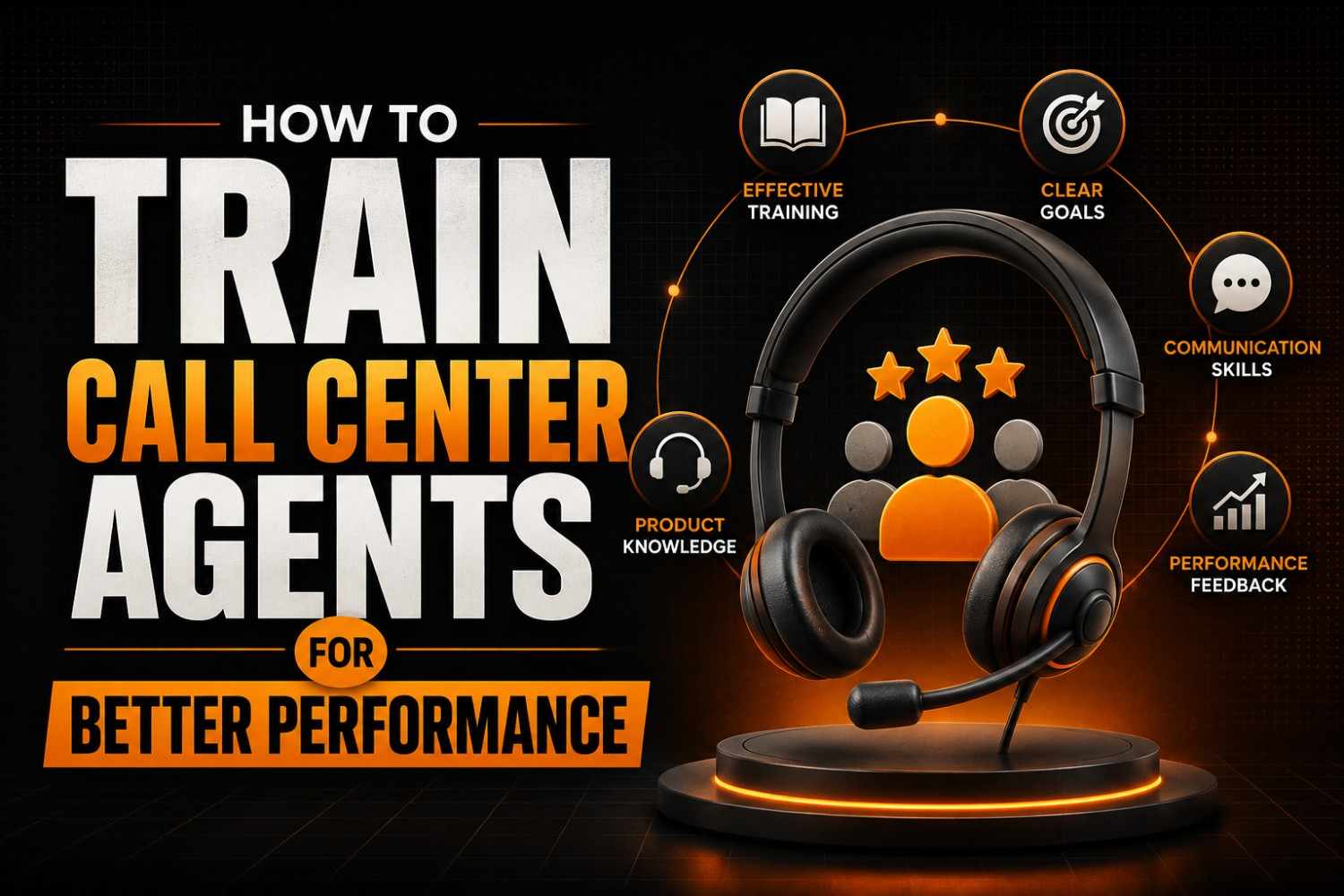
Your call center is only as good as the people answering the phones. No matter how advanced your dialer software or CRM system is, the agent on the other end of the call determines whether a customer stays, upgrades, complains, or churns. Yet most businesses treat agent training as a one-time onboarding event — and then wonder why their CSAT scores stay flat and attrition stays high.
The numbers don't lie:
- 86% of customers leave after just 2 bad service experiences
- $1.6 trillion is lost annually due to poor customer service (US alone)
- Customers are 4x more likely to churn over bad service than price or product
- 73% of customers say the agent experience directly drives their buying decisions
The good news? Agent performance is not a fixed trait. It is a product of deliberate, ongoing training. Here's exactly how to build a training program that actually moves the needle.
1. Start With a Performance Baseline — Not Assumptions
Before designing any training program, you need to know where your agents actually stand. Too many managers skip this step and build training around what they think agents struggle with — which is often wrong.
Run a proper performance audit. Pull data on your top performers vs. bottom performers and identify exact gaps. Look at:
- Average Handle Time (AHT) — are some agents taking 3x longer on the same call types?
- First Call Resolution (FCR) — how often do agents solve the issue on first contact?
- CSAT and NPS scores — what are customers saying about specific agents?
- Call recordings and transcripts — what language patterns separate top vs. average performers?
- Transfer rates — are agents passing calls they should be owning?
Segment your agents into tiers: high performers, mid-tier, and struggling. Your training strategy for each group will be different. High performers need advanced skills and leadership tracks. Mid-tier agents need targeted gap work. Struggling agents need structured mentorship.
Pro tip: Don't rely on gut feel. Use your auto dialer and call analytics data to pull objective metrics before designing a single training module.
2. Build a Structured Onboarding Program — Not Just a Week of Shadowing
Most call centers onboard agents by having them shadow a senior agent for a few days and then throwing them on the floor. This is one of the fastest ways to burn new hires out and set them up for failure.
A proper onboarding program should span at least 4–6 weeks:
Week 1–2: Product, Process, and Systems Fluency Agents cannot handle queries confidently if they don't know the product inside out. Cover the company's products, pricing, policies, escalation procedures, and the CRM and dialer software they'll use daily. Do not rush this phase. An agent fumbling with software during a live call is a CSAT disaster waiting to happen.
Week 3–4: Communication and Call Handling Skills Soft skills training begins here — tone of voice, active listening, empathy, objection handling, de-escalation, and how to structure a call from greeting to resolution. Use role-play scenarios heavily. Written handbooks don't build muscle memory — practice does.
Week 5–6: Supervised Live Calls With Real-Time Coaching Agents take real calls with a supervisor listening in. Feedback is given immediately after each call — not at the end of the day, not in a weekly review. Immediate feedback creates faster learning loops and prevents bad habits from forming.
3. Use Call Recordings as Your Most Powerful Training Tool
If you're not using call recordings for training, you're leaving your biggest coaching asset on the table.
Call recordings give you a real, unfiltered picture of what actually happens during customer interactions. Use them to:
- Create a "best call library" — recordings of top agents handling difficult situations with excellence. Play these in team training sessions so everyone can hear what great looks like.
- Run call autopsies on poor-performing calls — break down exactly what went wrong and what should have been said instead.
- Identify consistent patterns in failed calls — if 30% of your agents are struggling with the same objection, that's a training gap, not an individual problem.
- Coach with specifics — "At 2:14 in this call, when the customer said X, here's a better way to respond..."
The most effective call centers build training modules directly from their own call data — not from generic scripts written by someone who hasn't spoken to a customer in years.
4. Train for Emotional Intelligence — Not Just Scripts
Script-following robots don't build customer loyalty. Agents who can read a customer's emotional state and respond with the right tone — confident, empathetic, patient, or firm — are the ones who turn frustrated callers into loyal customers.
EQ training for call center agents should cover:
- Active listening: Not just hearing words — understanding what the customer is actually feeling and what they really need. Train agents to summarize what they've heard before jumping to solutions.
- Tone management: The same sentence lands completely differently depending on tone. Role-play exercises help agents practice delivering difficult news, saying no, or holding firm on policy without sounding robotic or cold.
- De-escalation techniques: Every agent will face an angry caller. Train them on specific language patterns that defuse tension — validating the customer's frustration without accepting blame, redirecting toward solutions, and knowing when to offer escalation.
- Resilience and self-regulation: Call center agents absorb a lot of negative energy. Without training on how to mentally reset between calls, emotional fatigue sets in fast — leading to burnout and high attrition.
Key insight: Research from Harvard Business Review shows that emotional exhaustion is the single biggest driver of call center turnover. EQ training isn't just about customer experience — it protects your agents too.
5. Implement Continuous Coaching — Not Just Annual Reviews
The biggest mistake in call center training is treating it as an event rather than a process. A 3-day workshop every six months does almost nothing for sustained performance improvement.
High-performing call centers run coaching as a continuous rhythm:
- Daily huddles (10–15 min): Quick team stand-ups to share wins, flag common issues from the previous day, and set the tone for the shift.
- Weekly 1-on-1 coaching sessions: Supervisors review specific call recordings with individual agents and work on one or two targeted improvement areas. Not a performance review — a growth conversation.
- Monthly skills workshops: Deeper-dive sessions on specific competencies — objection handling, upselling, de-escalation — with role-play and group discussion.
- Quarterly performance reviews with development plans: Connecting training to career pathways. Agents who see a future in the organization perform better and stay longer.
6. Gamify Performance to Drive Engagement
Training works best when agents are engaged — and engagement drops fast when the environment feels monotonous. Gamification is one of the most underutilized tools in call center performance management.
Effective gamification strategies include:
- Leaderboards for key metrics like FCR rate, CSAT score, or calls resolved per hour — displayed in real time on team dashboards.
- Points-based reward systems where agents earn points for hitting targets, mentoring peers, or completing skill modules.
- Team challenges where groups compete on collective metrics — this builds team culture and peer accountability simultaneously.
- Streak rewards for consistency — acknowledging agents who hit their targets for 30, 60, or 90 consecutive days.
The goal is not to create unhealthy competition — it's to make the daily grind feel like progress.
7. Train Agents to Use Your Tech Stack — Fully
One of the most overlooked performance gaps in call centers is poor technology utilization. Agents who don't know how to use their auto dialer, CRM, or call disposition tools efficiently waste minutes on every call — which compounds into hours of lost productivity per agent per week.
Technology training should cover:
- Navigating the CRM quickly to pull up customer history before the first word is spoken.
- Using auto dialer features like recording, transfer, hold, and callback scheduling without fumbling.
- Logging call notes and disposition codes accurately in real time.
- Using knowledge base tools during live calls without putting customers on long holds.
Run timed simulations. The agents who know their tools deeply handle calls faster, more confidently, and with fewer errors.
8. Create a Culture of Psychological Safety
None of the strategies above will work at scale if your culture makes agents afraid to make mistakes or ask questions. Psychological safety is the invisible foundation of a high-performance team.
Build it deliberately:
- When an agent makes an error, coach them privately and constructively — never publicly shame performance in front of peers.
- Normalize raising a hand when you don't know something. Reward intellectual honesty over bluffing through a call.
- Celebrate improvement, not just top performance. An agent who moved from the bottom quartile to average deserves recognition just as much as your top closer.
- Make it safe to give upward feedback. Agents who feel heard by their supervisors are significantly more engaged and less likely to quit.
9. Measure What Matters — And Tie Training to Outcomes
Your training program is only as good as the results it produces. Track these key metrics before and after every training initiative:
| Metric | What it measures |
|---|---|
| FCR Rate | % of issues solved on first contact without callbacks |
| AHT | Total time per call including hold and wrap-up |
| CSAT | Direct post-call customer satisfaction score |
| Attrition Rate | Monthly agent turnover — a leading indicator of team culture health |
If your training is working, FCR goes up, AHT comes down, CSAT improves, and attrition slows. If none of these are moving after 60–90 days, your training program needs to be redesigned — not just repeated louder.
10. Invest in Self-Service Learning and Micro-Training
Modern call center agents don't want to sit through 2-hour sessions during their shift. The most effective learning happens in micro-formats — short, focused, on-demand modules accessible between calls.
Build a self-service learning library that includes:
- 5-minute video modules on specific skills — how to handle a billing dispute, how to open a warm transfer, how to close a complaint call on a positive note.
- Quick-reference scripts and objection-handling playbooks accessible inside the CRM.
- A peer-contributed "what worked" repository where top agents share their approaches.
- Weekly "training byte" emails or Slack messages with one tactical tip agents can implement immediately.
Final Thought: Training Is a Revenue Strategy
Every percentage point improvement in FCR reduces repeat call volume. Every improvement in CSAT increases customer lifetime value. Every agent you retain instead of replacing saves you 3–4 months of recruitment and onboarding costs.
Training is not an HR checkbox — it's a direct driver of revenue, retention, and reputation. The call centers that win in the next decade will be the ones that treat agent development as a core business strategy, not an afterthought.
Ready to transform your call center's performance?
Krudracx gives your team the tools they need — intelligent auto dialing, real-time call analytics, seamless CRM integration, and performance dashboards — so your training translates directly into measurable results.
Book a free demo with Krudracx today and see the difference the right platform makes. → www.krudracx.com | DM us "DEMO" to get started