Introduction: The Silent Revenue Leak in Collections
Every collections team in India is fighting the same invisible battle. It isn't the borrower who refuses to pay. It isn't the compliance paperwork. It's something far more mundane, and far more expensive — wasted dial time.
Picture a typical recovery agent's day. They pull up a list of 300 accounts. They start dialing manually, one number at a time. Some numbers ring out. Some go to voicemail. Some are switched off. Some are picked up by someone who isn't the borrower. By the time the agent actually reaches the right person — the one who can actually make a payment decision — they've burned 60% of their shift on numbers that were never going to convert.
Multiply that across a 50-agent collections floor, and you're not looking at a productivity problem. You're looking at a revenue problem. Every idle minute between calls is a minute that account stays overdue, a minute that recovery targets slip further away, and a minute that NPA (non-performing asset) numbers creep closer to the red zone that keeps CFOs and compliance heads up at night.
This is exactly the gap predictive dialer technology was built to close. And in 2026, as RBI scrutiny on recovery practices tightens and recovery teams are asked to do more with leaner headcount, the gap between banks running on manual or basic auto-dialing and those running on true predictive dialing is becoming impossible to ignore.
At KRUDRA-CX, we've built and deployed dialer infrastructure for public sector banks, private banks, NBFCs, and BPO-run collection agencies across India. This guide breaks down exactly how predictive dialer technology transforms a collections operation — the mechanics, the metrics, the compliance angle, and what to actually look for before you commit to a platform.
What Is a Predictive Dialer, Really?
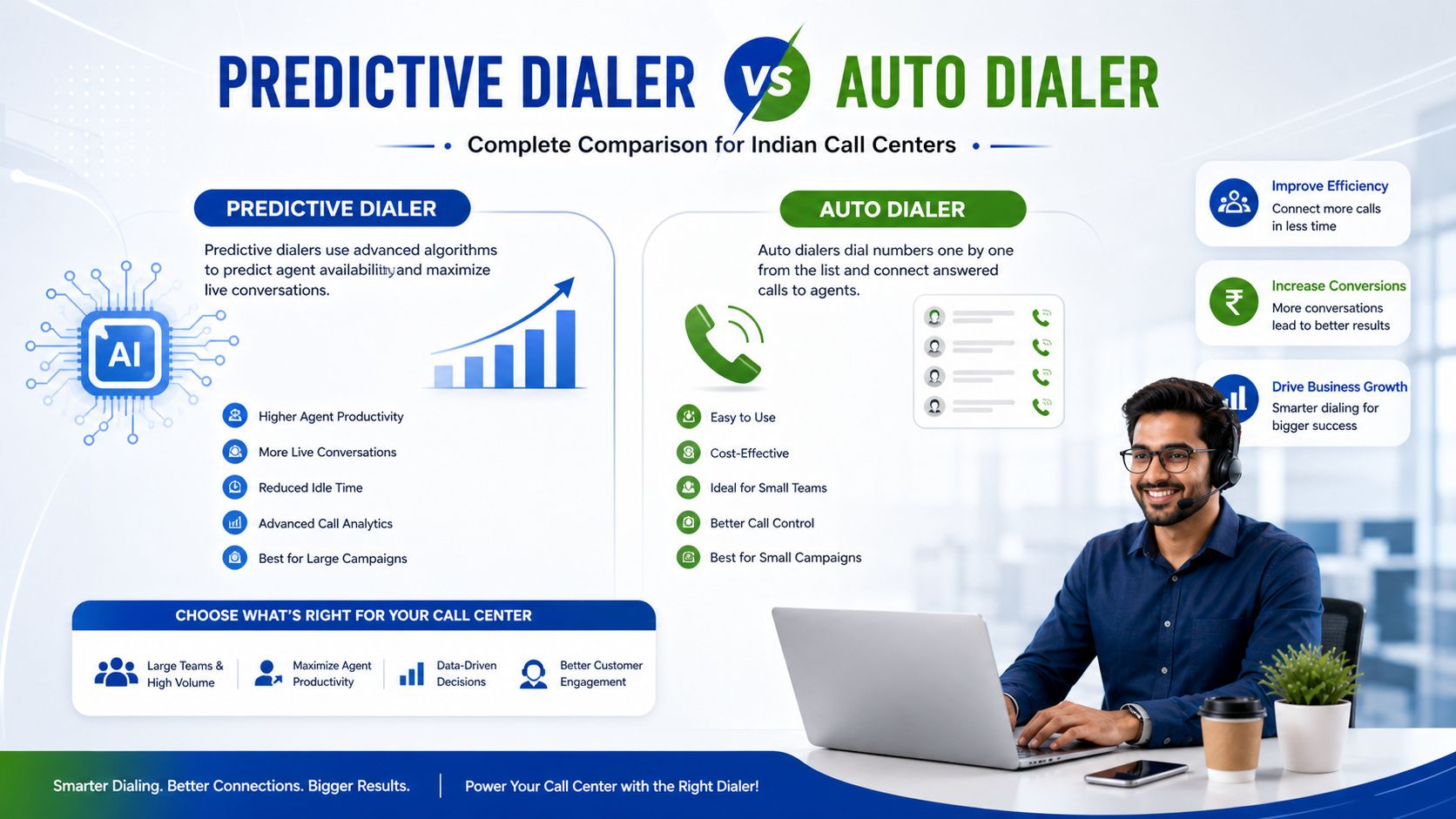
A predictive dialer is an automated outbound calling system that uses statistical algorithms to dial multiple numbers simultaneously — before an agent is even free — based on predictions about agent availability, average call duration, and historical answer rates. The moment a call is answered by a live person, the system instantly routes that connected call to the next available agent. Calls that go unanswered, hit voicemail, or reach a busy signal are automatically filtered out and never reach an agent's screen at all.
This is fundamentally different from:
- Manual dialing — where an agent dials every number by hand, absorbing 100% of unanswered call time as dead time.
- Preview dialers — where an agent sees account details before dialing, allowing for more context but still requiring manual initiation on every call.
- Basic auto dialers — which dial numbers automatically in sequence but don't intelligently predict agent availability, often leading to either agent idle time or abandoned calls when too many connect at once.
Predictive dialing sits at the top of this stack because it's the only model that actively optimizes for the one thing collections teams are measured on: talk time with the right person, per hour, per agent.
Why Collections Teams Specifically Need Predictive Dialing
Customer support and sales teams benefit from smart dialing too, but collections has a few characteristics that make predictive dialer technology almost non-negotiable:
1. Contact rates are naturally low.
Borrowers who are behind on payments are, unsurprisingly, less likely to pick up calls from numbers they don't recognize. Industry data across Indian NBFCs shows right-party contact (RPC) rates on overdue accounts often sitting well below 30% on manual dialing. A predictive dialer doesn't fix borrower behavior, but it does mean your agents spend zero time listening to rings, voicemail greetings, and "the number you are calling is currently switched off" messages.
2. Recovery windows are time-sensitive.
An account that's 30 days overdue is a very different conversation than one that's 90 days overdue. The faster your team can cycle through a call list and re-attempt unreached numbers at different times of day, the more accounts you catch in the earlier, more recoverable stage of delinquency.
3. Headcount is expensive, and margins are thin.
Collection agencies and in-house recovery teams operate on tight cost-per-recovery economics. A predictive dialer that lifts agent talk time from, say, 20 minutes per hour to 40+ minutes per hour effectively doubles agent output without doubling headcount.
4. Compliance requirements are strict and getting stricter.
RBI's Fair Practices Code and various NBFC recovery guidelines place real limits on when and how often a borrower can be contacted. Manual processes make this hard to enforce consistently across hundreds of agents. Automated systems can build these rules directly into the dialing logic.
The Real Numbers: What Changes When You Switch
Based on deployments across banking and NBFC collections floors, here's the pattern that shows up consistently when teams move from manual or basic auto-dialing to a properly configured predictive dialer:
Agent talk time increases significantly. When agents aren't burning time on unanswered calls, busy signals, and voicemail, the proportion of their shift spent in live conversation with a contactable party rises sharply — often the single biggest lever in the entire recovery funnel.
Calls per agent per day multiply. Where a manual-dialing agent might complete 60–80 calls in a shift, a predictive-dialer-supported agent on the same account list can realistically work through several times that volume, because the system is doing the dialing and filtering in the background.
Right-party contact rates improve. Smarter retry logic — attempting numbers at different times of day based on historical answer patterns — means more accounts get reached instead of sitting untouched after a single failed attempt.
Cost per recovered account drops. More conversations per agent per hour, spread across the same fixed salary cost, mechanically lowers the cost of recovering each rupee.
Recovery cycle time shortens. Faster, more frequent contact attempts mean accounts move through the collections funnel — first reminder, negotiation, payment plan, closure — in fewer calendar days.
None of this requires borrowers to become more willing to pay. It's pure operational efficiency: getting your existing agents in front of the right conversations, faster, more often.
Compliance: The Part Most Dialer Vendors Get Wrong
Recovery calling in India isn't the Wild West it used to be. RBI guidelines, NBFC-specific recovery codes, and increasing consumer complaint scrutiny mean a collections floor can't just dial as hard and as often as technically possible. This is where a lot of generic, imported dialer software falls short — it's built for US-style debt collection compliance (TCPA, FDCPA) and bolted onto Indian operations without accounting for local regulatory nuance.
A dialer built for Indian BFSI collections needs to support:
- Call frequency capping — automatically preventing agents (or the system) from exceeding permitted contact attempts per account per day or week.
- Time-window restrictions — blocking outbound calls outside RBI-recommended calling hours.
- Full call recording and audit trails — every call logged, timestamped, and retrievable in a format auditors and RBI inspectors can actually work with.
- DND and consent management — automatic scrubbing against Do Not Disturb registries and consent status.
- Escalation and complaint logging — a clean paper trail if a borrower disputes the manner or frequency of contact.
This is precisely why our public sector and private bank clients — including institutions that cannot risk a single compliance misstep — chose infrastructure with BFSI-grade compliance built into the dialing engine itself, not layered on as an afterthought.
What to Look for Before You Choose a Predictive Dialer for Collections
If you're evaluating vendors, here's the checklist that actually matters for a collections use case specifically — not generic call center feature lists.
1. Real predictive logic, not just auto-dialing rebranded.
Ask vendors directly how their pacing algorithm calculates dial ratios. If they can't explain how it adjusts in real time based on agent availability and answer rates, it's likely a basic auto dialer with a marketing upgrade.
2. Native CRM and loan management system integration.
Your dialer needs to pull live account data — outstanding amount, days past due, previous contact history, promised-to-pay dates — directly into the agent's screen the second a call connects. Disconnected systems mean agents fumbling for context while a borrower is on the line, which kills conversion.
3. Configurable compliance rules.
Contact frequency caps, calling windows, and DND scrubbing shouldn't require a developer ticket to adjust. Compliance and recovery policies change; your system should flex with them.
4. Real-time dashboards for supervisors.
Recovery managers need live visibility into connect rates, agent utilization, and campaign performance — not next-day reports. Course-correcting a campaign mid-day (re-prioritizing a segment, pulling agents off an underperforming list) is only possible with real-time data.
5. Uptime guarantees you can actually hold someone to.
A dialer going down for even a few hours on a collections floor doesn't just cost that day's calls — it pushes every account further into delinquency. Look for a documented uptime SLA, not a verbal promise.
6. Fast, hardware-free deployment.
Legacy on-premise dialer systems can take weeks to install and configure. Cloud-based predictive dialers should be live within days, with no hardware procurement holding up your rollout.
7. Scalability without re-platforming.
Whether you're running 20 agents or scaling to 200 during a recovery push, the platform should scale with a configuration change — not a full system migration.
A Realistic Rollout Path
For teams considering the switch, the transition doesn't need to be disruptive. A typical rollout looks like:
Week 1 — Setup and Integration: Dialer connects to your existing CRM or loan management system, account lists are imported, and compliance rules (calling windows, frequency caps, DND lists) are configured.
Week 1–2 — Pilot Campaign: A subset of agents run a live predictive dialing campaign on a defined account segment, with close monitoring of connect rates, abandonment rates, and agent feedback.
Week 2–3 — Full Rollout: Once pacing ratios are tuned and agents are comfortable with the workflow, the full collections floor migrates over, typically alongside real-time dashboards for supervisors.
Ongoing — Optimization: Pacing algorithms, retry schedules, and call scripts get refined based on live performance data — this is where the compounding gains show up over subsequent months.
This is close to the exact path our banking and NBFC clients have followed, several of which scaled from double-digit to 200+ agent operations without touching a single piece of on-premise hardware.
Beyond the Numbers: What This Means for Your Team
There's a human side to this that's easy to overlook in a conversation about dialing ratios and compliance rules. Recovery agents have one of the hardest jobs in financial services — repeatedly initiating difficult conversations, often with people under real financial stress. When half their shift is spent listening to dead air and voicemail beeps instead of actually talking to people, it's not just inefficient. It's demoralizing.
Predictive dialing, done right, changes the texture of that job. Agents spend their energy on conversations that matter — negotiating payment plans, resolving disputes, actually recovering money — instead of the mechanical grind of manual dialing. Managers get clean, real-time visibility instead of chasing spreadsheets. And compliance teams get an audit trail instead of anxiety.
Conclusion: Recovery Is a Systems Problem, Not Just an Effort Problem
The instinct in a lot of collections floors, when recovery numbers dip, is to push agents harder — longer hours, higher call targets, more pressure. But if the underlying dialing system is still forcing agents to manually work through unanswered numbers, switched-off phones, and voicemail boxes, more effort just means more wasted effort.
The teams pulling ahead in 2026 aren't necessarily working harder. They're running on infrastructure that eliminates the dead time between conversations, keeps every call compliant by design, and gives supervisors the real-time visibility to steer campaigns as they happen.
If your collections floor is still dialing manually — or running on a basic auto dialer that isn't truly predictive — the gap between where you are and where a modern, BFSI-grade predictive dialer can take you is larger than most teams realize, and closing it doesn't require a lengthy, disruptive migration.
KRUDRA-CX has built and deployed exactly this kind of infrastructure for some of India's largest banks and NBFCs — live in 24 hours, no hardware, no setup fee, with compliance and audit trails built into the core of the system rather than bolted on.
Ready to see what a predictive dialer built for Indian collections compliance actually looks like in action?
👉 Book a free demo with KRUDRA-CX today and see how fast your recovery numbers can move.