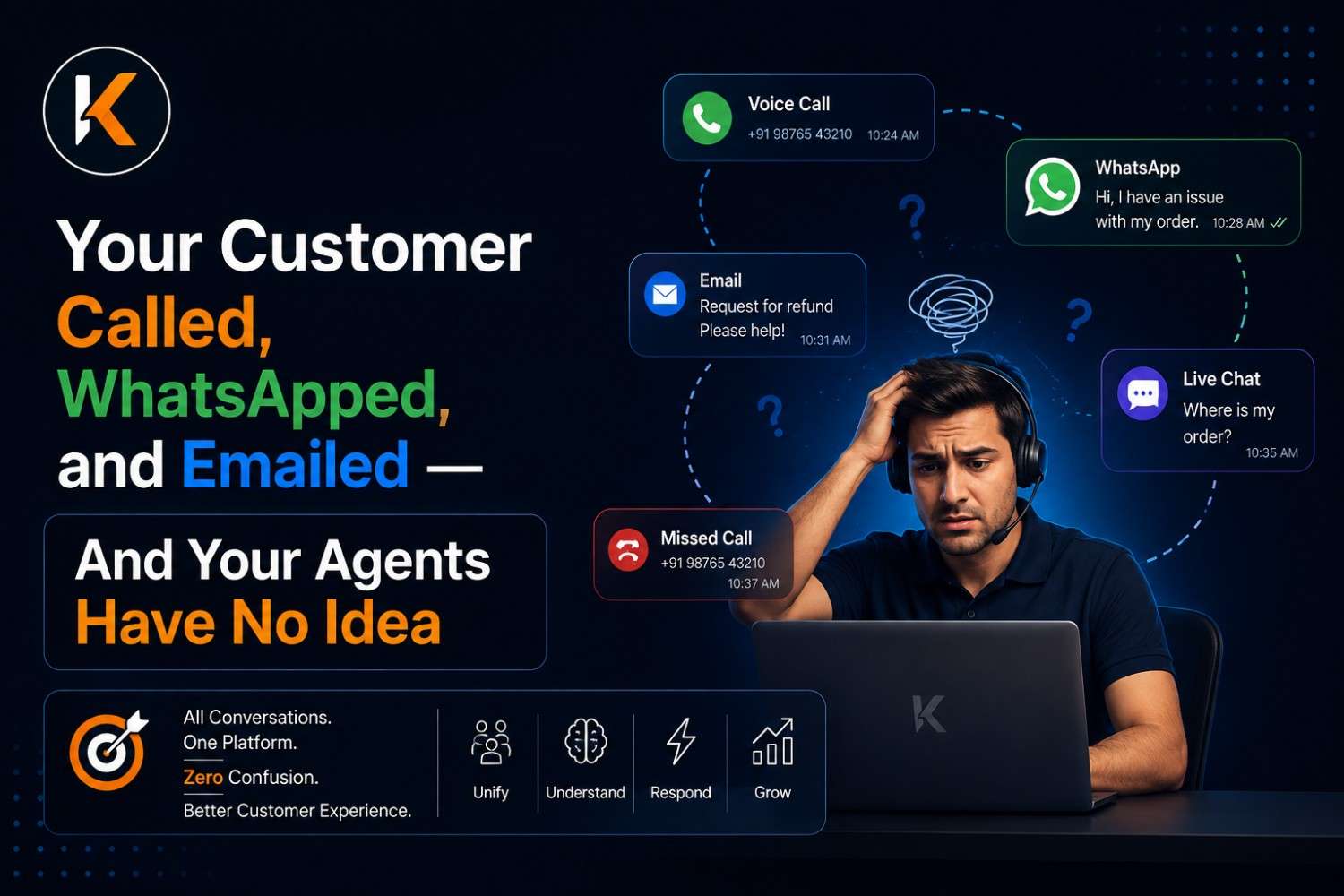
A customer calls in about a delayed order. The agent resolves it, or thinks they did. Two hours later, the same customer messages on WhatsApp, frustrated, repeating the entire issue from scratch — because the WhatsApp agent has no record the call ever happened. Different queue, different screen, zero context carried over.
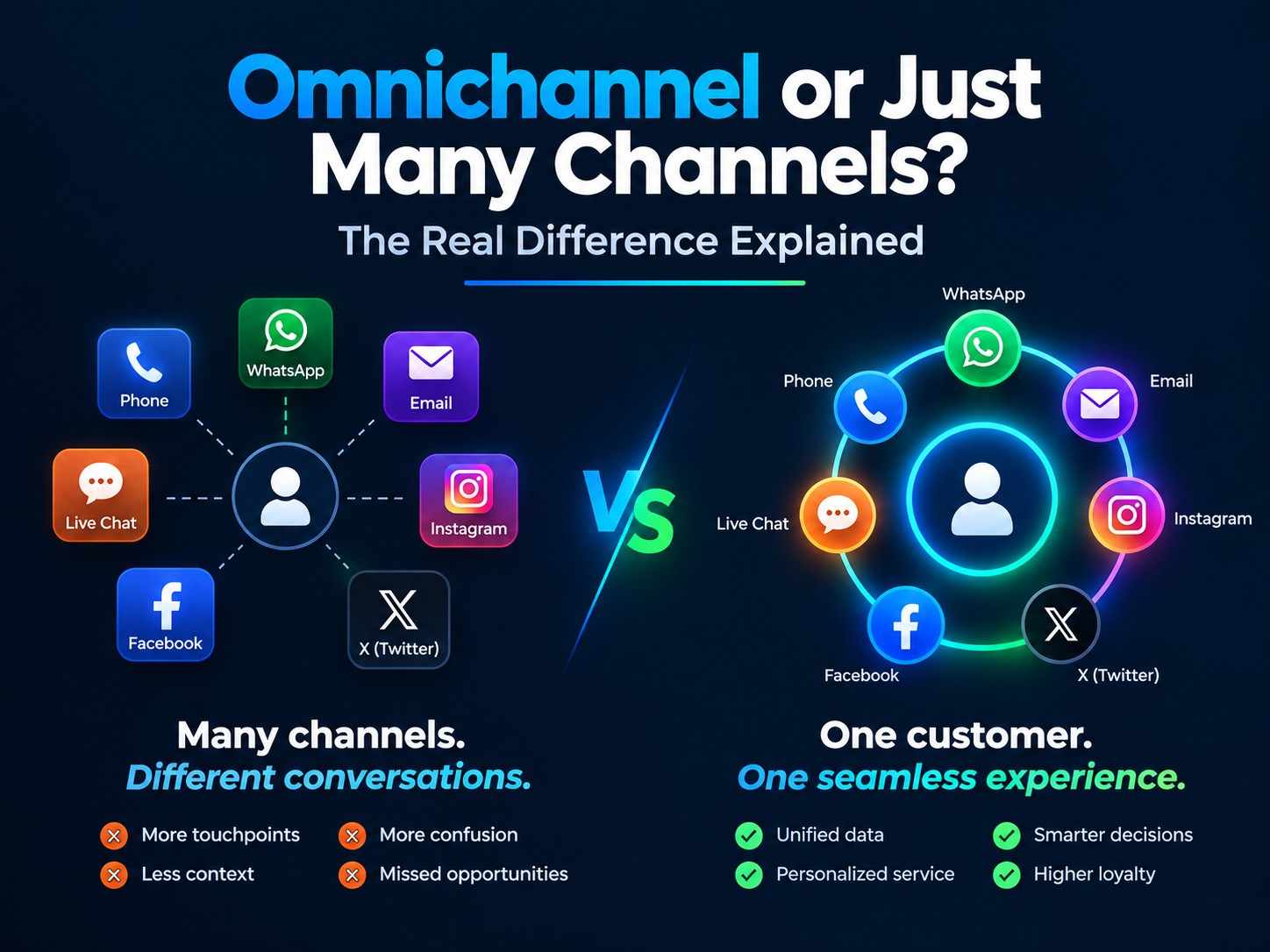
This is the default state of most Indian contact centers today, even ones running solid cloud calling infrastructure. Calls live in the dialer. WhatsApp lives in a separate business app or a bolted-on tool. Email lives in a shared inbox. Three teams, three histories, one very annoyed customer who feels like they're starting over every time they switch channels.
What omnichannel actually means — not the buzzword version
It doesn't mean "we support calls and WhatsApp." Almost everyone does that now. It means every interaction — call, WhatsApp, chat, email — writes to the same customer timeline, and any agent picking up the next interaction sees the full history before they say hello.
Concretely, that looks like:
One customer profile — call logs, WhatsApp threads, and email history sit under a single record, not three disconnected systems an agent has to check manually.
Channel handoff without repetition — if a call escalates to WhatsApp for sending documents or images, the WhatsApp thread opens already knowing what the call covered.
Consistent resolution tracking — a ticket opened on a call and closed via WhatsApp still counts as one resolved interaction, not two disconnected ones that break your resolution-rate reporting.
Why this is the trending shift right now
WhatsApp Business API adoption among Indian SMBs and enterprises has accelerated hard through 2026 — customers now expect to text a business the way they text a friend, then jump on a call only when something needs a human voice. Businesses that treat WhatsApp as a bolted-on afterthought are seeing exactly the symptom described above: repeated context, slower resolution, and agents who look uninformed through no fault of their own.
Your recent posts on the customer support funnel and AHT obsession both point at the same underlying issue — resolution speed customers actually feel, not just the metric you report internally. Omnichannel is the infrastructure fix underneath both of those problems. You can't shorten effective resolution time if every channel switch resets the clock to zero.
The real cost of skipping this
It's not just customer irritation. Fragmented channels mean your QA and analytics only ever see a partial picture — a call scored as "resolved" that actually needed two more WhatsApp messages to actually close looks like a clean win in your reporting when it wasn't one for the customer.
What to check before you consolidate channels
Data continuity: confirm your CRM can actually merge identities across a phone number, a WhatsApp number, and an email address reliably — mismatches here are the most common failure point.
Agent workflow: one unified screen beats three open tabs. If agents still have to manually cross-reference, you've built omnichannel reporting without omnichannel service.
Handoff rules: decide which interactions escalate from chat/WhatsApp to a live call automatically, so customers aren't stuck in a channel that isn't solving their problem.
Ready to bring calls, WhatsApp, and chat under one system?
KRUDRA-CX connects your calling infrastructure with the channels your customers already use — so every agent sees the full conversation, every time.
Book Free Demo → krudracx.com/book-for-demo