Why 1-in-100 Call Sampling Is a Compliance Risk: The Shift to AI-Powered Quality Assurance in 2026
Ask any quality assurance (QA) manager at a mid-size call center how many of their agents' calls they actually review, and the honest answer is usually somewhere between 1% and 10%. In practice, that means a QA team listens to one call out of every 100 an agent makes — and builds coaching plans, compliance reports, and performance scores off that tiny sample.
For most of the industry's history, this wasn't a choice. It was a constraint. A human QA analyst can realistically review 15-20 calls a day. If your call center handles 10,000 calls daily, you'd need over 500 analysts working full-time just to review every call once. So sampling became the default — not because it was accurate, but because it was the only thing that scaled.
In 2026, that constraint has effectively disappeared. AI-powered QA — speech-to-text transcription, sentiment analysis, and automated compliance flagging applied to every single call — has moved from an experimental pilot in a handful of enterprise contact centers to a standard, deployable feature. And for businesses in regulated sectors like banking, insurance, and lending, the gap between "we review 2% of calls" and "we review 100% of calls" isn't just an efficiency story. It's a compliance and risk story.
The Problem With Sample-Based QA
Sample-based QA has three structural weaknesses that no amount of process discipline can fully fix:
It's not representative. A QA analyst who reviews 10 calls a week for an agent handling 300 calls a week is seeing roughly 3% of that agent's actual customer interactions. If an agent is consistently polite on the calls that get reviewed but cuts corners on the other 97%, sample-based QA will never catch it — not because the process is broken, but because the math doesn't allow for it.
It's reactive, not preventive. By the time a sampled call reveals a compliance issue — a missed disclosure, an aggressive collections script, a mishandled complaint — the damage is often already done. The customer has already hung up. If it was a regulatory violation, the exposure already exists. QA built on sampling can only tell you what already went wrong in the calls it happened to catch, not what's going wrong right now across the calls it isn't reviewing.
It creates a two-tier workforce. Agents talk. Within weeks of a new hire joining, most teams develop an informal understanding of which call types tend to get pulled for QA review — inbound service calls more than outbound collections calls, for example, or calls flagged by keyword triggers. Human nature does the rest. Behavior on covered call types improves; behavior on uncovered call types drifts.
None of this is a knock on QA teams. It's a limitation of the tool they've been given. A stopwatch can't measure a marathon by timing the first 200 meters.
What Changed: AI Moved From Pilot to Production
The technical building blocks for full-coverage QA — automatic speech recognition (ASR), natural language processing (NLP), and sentiment analysis — have existed for several years. What changed heading into 2026 is accuracy and cost. Speech-to-text accuracy for accented, code-switched, and regional-language speech (a real factor for Indian call centers handling Hindi-English mixed conversations) has improved enough to be usable at production scale, not just in English-only, single-accent environments. At the same time, the cost of running these models per call has dropped to the point where analyzing 100% of call volume is now cheaper than paying a QA team to sample 5% of it.
Industry data backs this shift. Nearly all contact centers now report using some form of AI in their operations, and the center of gravity has moved from "should we pilot this?" to "how do we scale it responsibly?" Interaction analytics — the practice of turning every call into structured, searchable data — is increasingly viewed by CX and IT leaders as one of the most valuable data assets an organization has, with many pushing to feed it into enterprise-wide dashboards rather than keeping it siloed inside a QA team's spreadsheet.
For BPOs and in-house contact centers alike, this reframes what QA is for. It's no longer just a coaching tool for agents. It's becoming a real-time signal source for compliance, customer sentiment, and operational risk.
How AI-Powered QA Actually Works
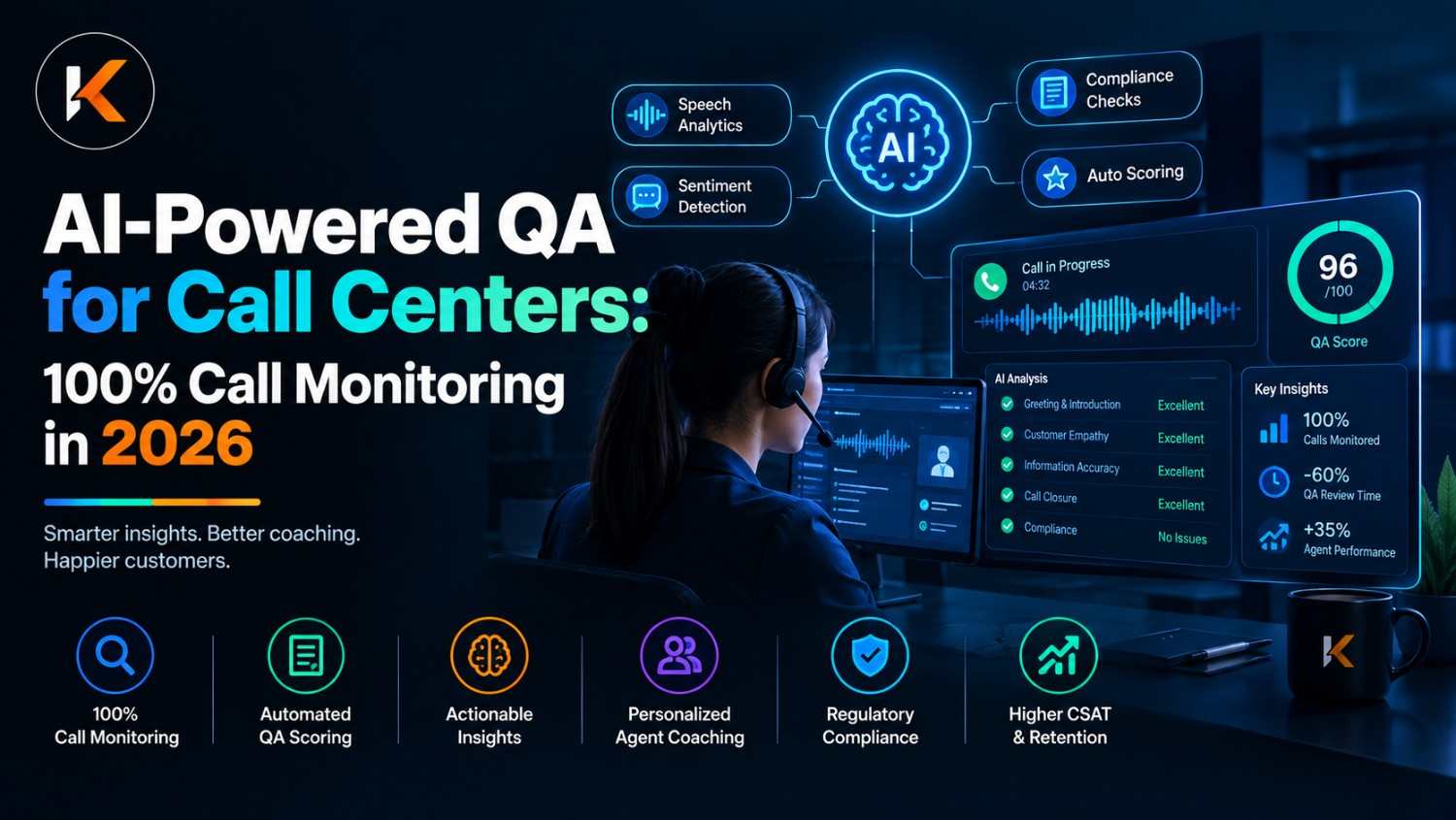
At a practical level, AI QA systems do four things that sample-based human review cannot do at scale:
1. Transcribe every call automatically. Every conversation — inbound, outbound, collections, sales, support — is converted to searchable text in near real time, instead of existing only as an audio file nobody will ever listen to.
2. Score against a consistent rubric, every time. Instead of a human analyst applying a QA checklist with natural variation from one reviewer to the next, an AI model applies the same scoring criteria — greeting compliance, required disclosures, tone, resolution confirmation — identically across every call and every agent.
3. Flag compliance risks the moment they happen. Missed regulatory disclosures, prohibited language in collections calls, DND (Do Not Disturb) violations, or aggressive tone can be flagged within minutes of the call ending, not discovered three weeks later during a sample audit — or worse, during a regulatory inspection.
4. Surface sentiment and intent, not just words. Modern systems don't just check whether an agent said the right words. They analyze tone, hesitation, escalation patterns, and customer sentiment shifts during the call — the kind of nuance that used to require an experienced human ear.
The output isn't a replacement for human QA managers — it's a filter. Instead of a QA team randomly sampling calls and hoping they catch problems, the AI system surfaces the calls that actually need a human's attention: the ones with compliance flags, negative sentiment spikes, or unusual patterns. Human reviewers spend their time where it matters instead of spreading thin across a random 2% slice.
Why This Matters Specifically for BFSI in India
For banks, NBFCs, insurers, and collections agencies operating in India, this shift isn't optional in the way it might be for a retail customer service line. A few reasons this hits differently in BFSI:
Regulatory exposure is real and specific. Collections calls, loan recovery communications, and outbound sales calls in financial services are subject to scrutiny around disclosure requirements, DND compliance, and fair-practice code adherence. When a regulator or an internal audit asks "can you show us what was said on this call," the honest answer for most sample-based QA operations is "only if we happened to review it" — and for 97-98% of calls, they didn't.
Audit readiness becomes a differentiator, not a checkbox. Contact centers that can produce a clean, exportable, fully-indexed record of every customer interaction — not just the 2% that got manually reviewed — turn what used to be a multi-day audit scramble into a query that takes minutes. That's a genuine operational advantage when RBI-adjacent compliance reviews or internal audits happen on short notice.
Collections calls carry outsized reputational risk. A single aggressive or non-compliant collections call that goes unreviewed and later surfaces in a complaint or a social media post can do more brand damage than months of good service. Full-coverage QA means that risk gets caught internally, before it becomes external.
Multilingual, code-switched speech needs purpose-built models. Indian call centers routinely handle calls that move between Hindi, English, and regional languages within a single conversation. Off-the-shelf, English-only AI QA tools frequently underperform in this environment — which is exactly why AI QA solutions built with Indian-language and code-switching support in mind deliver meaningfully better results than generic international tools retrofitted for the Indian market.
100% Coverage vs. Sample-Based QA: What Actually Changes
It's worth being concrete about what shifting to full-coverage AI QA changes in practice, versus what sample-based QA has always delivered:
- Coverage: Sample-based QA reviews roughly 1-10% of calls. AI-powered QA reviews 100%, with human attention directed at the calls it flags as needing review.
- Speed: A compliance issue caught by sample-based QA might surface weeks after the call happened. AI QA can flag it within minutes.
- Consistency: Human reviewers vary in how strictly they apply a scoring rubric. AI applies the same criteria identically, every time.
- Agent coaching: Sample-based feedback is built on a handful of calls and can feel arbitrary to agents ("why did you pick that one call?"). Full-coverage data lets coaching be grounded in genuine patterns across an agent's entire call volume.
- Audit response time: Sample-based QA means most audit requests require manually searching call logs and hoping the relevant call was one of the ones reviewed. Full-coverage QA means every call is already transcribed, scored, and searchable.
None of this means human QA managers become unnecessary. If anything, their judgment becomes more valuable — freed from the grind of randomly sampling calls, they can spend their time coaching agents on the patterns the AI surfaces, refining scoring criteria, and handling the genuinely ambiguous calls that still need a human ear.
What to Look for When Evaluating an AI QA System
Not all "AI-powered QA" claims are equal. A few things worth checking before committing to a platform:
- Does it support Indian languages and code-switching, or is it an English-only model with a translation layer bolted on?
- Does it integrate with your existing dialer and CRM, or does it require a separate standalone workflow that agents and QA managers have to context-switch into?
- Can compliance rules be customized to your specific regulatory requirements, rather than shipping with a generic, one-size-fits-all rubric?
- Is scoring transparent and auditable — can you see why a call was flagged, not just that it was?
- Does it scale with call volume without a corresponding increase in cost, since the entire point is moving away from the cost structure of manual sampling?
How KRUDRA-CX Approaches This
KRUDRA-CX's platform is built around the reality that BFSI call centers in India need compliance-grade call monitoring that works across the Hindi-English mixed conversations that make up most real-world call volume — not a QA tool designed for a different market and retrofitted after the fact. Full call logging, exportable audit trails, and real-time visibility into every conversation are built into the platform rather than treated as a bolt-on reporting layer, which is exactly the foundation full-coverage AI QA needs to sit on top of.
The Bigger Picture
The shift from sample-based to full-coverage QA is part of a broader pattern in contact center technology in 2026: AI moving from "interesting pilot" to "operational default." The organizations that will benefit most aren't necessarily the ones with the flashiest AI rollout — they're the ones with clean call data, solid compliance foundations, and a QA process built to actually use what full call coverage reveals.
For a BFSI call center, the question isn't really "should we adopt AI-powered QA." It's closer to: when a regulator, an auditor, or an unhappy customer asks about a specific call, do you want your honest answer to be "we can pull that up in two minutes," or "let us check if that was one of the 2% we happened to review"?
Ready to move from sample-based QA to full call coverage? See how KRUDRA-CX gives you compliance-grade call monitoring built for the way Indian BFSI teams actually talk to customers.
Book a free demo at www.krudracx.com.