Every business that picks up a phone to talk to a customer is running on some kind of telephony infrastructure — whether they think about it or not. For decades, that infrastructure meant a locked room full of PBX hardware, a maze of copper wiring, and an IT vendor on speed dial for when something inevitably broke. Today, that entire setup can be replaced by a login screen and an internet connection.
That shift — from physical, on-premise phone systems to cloud-hosted communication platforms — is what we call cloud telephony. And while the pitch often sounds like a generic "modernize your business" line, the actual savings are specific, measurable, and often much larger than business owners expect. This isn't about vague efficiency gains. It's about real numbers: fewer people needed to run the same call volume, fewer dollars spent on hardware that depreciates the moment it's installed, and fewer hours lost to downtime, misrouted calls, and manual reporting.
Let's break down exactly where those savings come from — not in theory, but in the actual day-to-day mechanics of running a business phone system.
The Real Cost of Traditional Phone Systems (That Nobody Talks About)
To understand what cloud telephony saves, you first have to understand what a traditional system actually costs — and most of that cost is hidden in places business owners don't think to look.
Capital expenditure on hardware. A traditional PBX (Private Branch Exchange) system requires physical servers, telephone lines, handsets, wiring, and often a dedicated room with cooling and power backup. For a mid-sized call center with 50 seats, this hardware investment alone can run into lakhs of rupees before a single call is made. And hardware doesn't last forever — most on-premise systems need a full refresh every 5-7 years, meaning that capital cost isn't a one-time hit, it's a recurring one.
Installation and maintenance labor. Someone has to install this system, and someone has to keep it running. That usually means a contract with a telecom vendor or an in-house IT resource whose time is partially or fully consumed by phone system upkeep — patching software, replacing failed components, troubleshooting line issues. That's a salary or a service contract that exists purely to keep the phones working, not to grow the business.
Line rental and long-distance charges. Traditional systems are tied to physical phone lines, and every line has a rental cost. Long-distance and international calls are billed at a premium because they route through traditional carrier networks with per-minute charges that add up fast for any business making outbound sales calls or supporting customers across regions.
Downtime costs. When a traditional PBX fails — and hardware does fail — the business is offline until a technician arrives to fix it. For a sales team, that means missed calls and missed revenue. For a support team, that means abandoned queues and frustrated customers. Every hour of downtime has a real cost, even if it doesn't show up as a clean line item on the balance sheet.
Scaling friction. Need to add 10 more agents next quarter? With a traditional system, that means new physical lines, new handsets, new desk setups, and often a multi-week lead time. Growth becomes a procurement project instead of a business decision.
None of this is exaggerated — it's simply what happens when your communication infrastructure is tied to physical equipment sitting in a specific room. Cloud telephony removes the room entirely.
What Actually Changes With Cloud Telephony
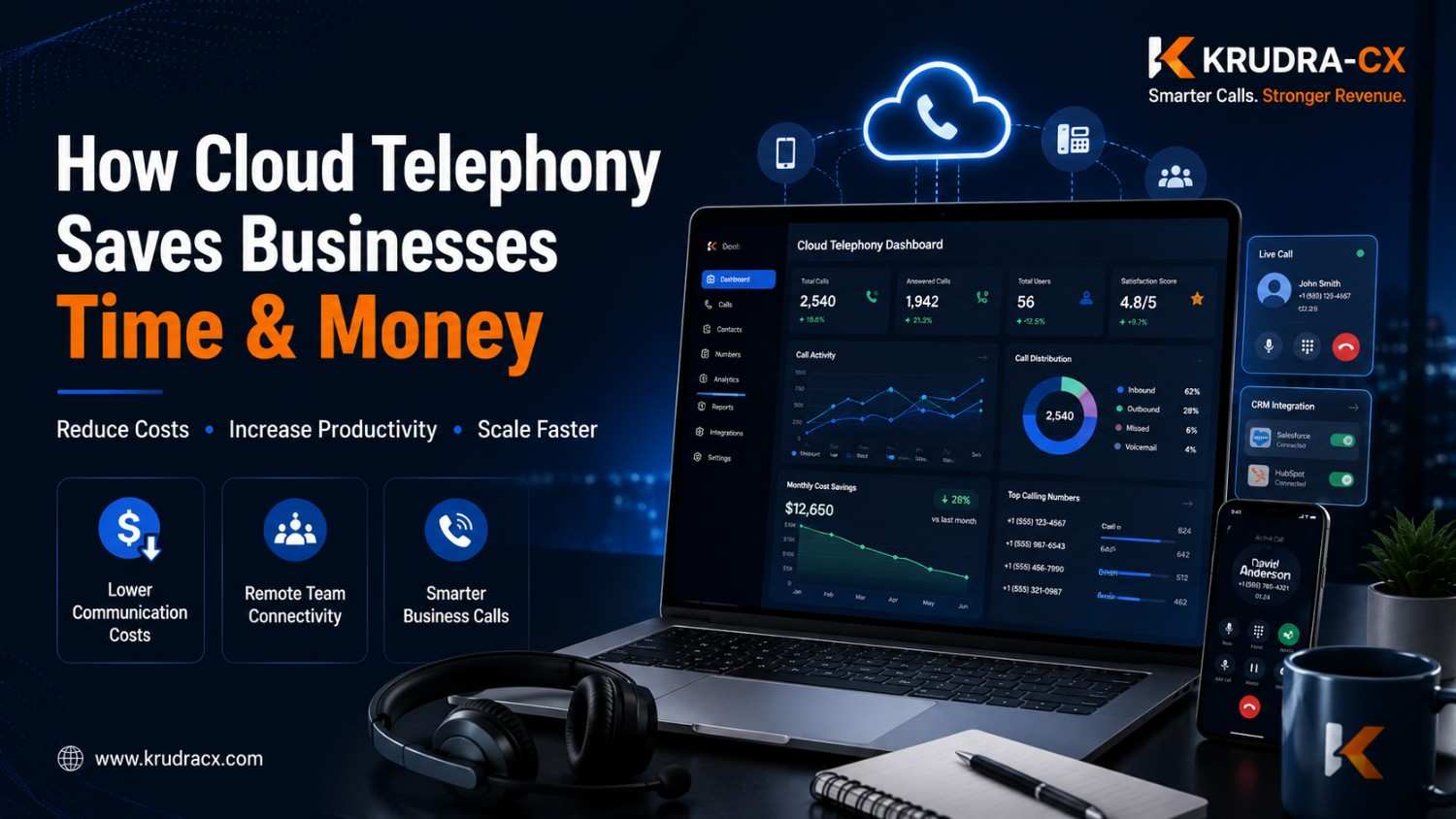
Cloud telephony — sometimes called hosted VoIP or cloud-based calling — moves your entire calling infrastructure onto servers managed by a provider and delivers it to your team as a service. Agents make and receive calls through a laptop, a softphone app, or a browser tab, using the internet instead of physical phone lines. Everything that used to be hardware becomes software: call routing, IVR menus, call recording, voicemail, call queues, and reporting all live inside a dashboard instead of a server rack.
This single architectural shift is what unlocks the time and money savings, and it plays out across five concrete areas.
1. Zero Hardware Investment, Predictable Monthly Cost
With cloud telephony, there's no PBX box to buy, no server room to maintain, no bulk of handsets to purchase upfront. Most providers charge a per-agent, per-month subscription, which converts a large unpredictable capital expense into a small predictable operating expense. A business can budget for calling costs the same way it budgets for any SaaS tool — a fixed number that scales up or down with headcount.
This matters enormously for cash flow, especially for growing businesses. Instead of spending a large sum upfront and hoping the system lasts long enough to justify the cost, a business pays only for what it's actively using, month to month.
2. Instant Scalability Without Procurement Delays
Adding a new agent on a cloud system is a matter of creating a new login, not ordering new equipment. A call center scaling from 20 seats to 60 seats during a hiring push can do so in the same afternoon, not over several weeks of hardware procurement and installation. The reverse is also true — if a business needs to scale down, it simply removes seats from the subscription instead of sitting on unused hardware.
This kind of elasticity is particularly valuable for businesses with seasonal spikes — think e-commerce support teams during festive sales, or outbound sales teams ramping up before a quarter-end push. Cloud telephony lets staffing match demand in near real time.
3. Lower Call Costs, Especially for Long-Distance and International Calling
Because cloud telephony routes calls over the internet (VoIP) rather than traditional carrier lines, per-minute costs — especially for long-distance and international calls — are dramatically lower. For businesses that support customers across states or countries, or that run outbound sales campaigns to markets outside their home region, this alone can represent a significant chunk of monthly savings.
Many cloud telephony providers also bundle unlimited or high-volume calling plans, removing the anxiety of a growing phone bill every time the sales team makes an extra hundred calls in a good week.
4. Reduced IT and Maintenance Overhead
There's no server to patch, no wiring to repair, no on-site technician needed for routine maintenance. The provider handles uptime, security updates, and infrastructure reliability as part of the service. This frees up internal IT resources — whether that's a dedicated employee or a portion of someone's time — to focus on work that actually moves the business forward instead of keeping phone lines alive.
It also means far less downtime. Cloud providers typically operate with redundant infrastructure across multiple data centers, so a single point of failure doesn't take the entire phone system offline. For a business, that translates directly into more calls answered, fewer leads lost to a "system down" moment, and a support queue that doesn't collapse during peak hours.
5. Built-In Features That Used to Cost Extra
Traditional systems often required buying add-on modules for things like call recording, IVR (interactive voice response) menus, call analytics, or CRM integration — each with its own licensing cost and setup complexity. Cloud telephony platforms typically bundle these as standard features inside the subscription.
That means a business gets:
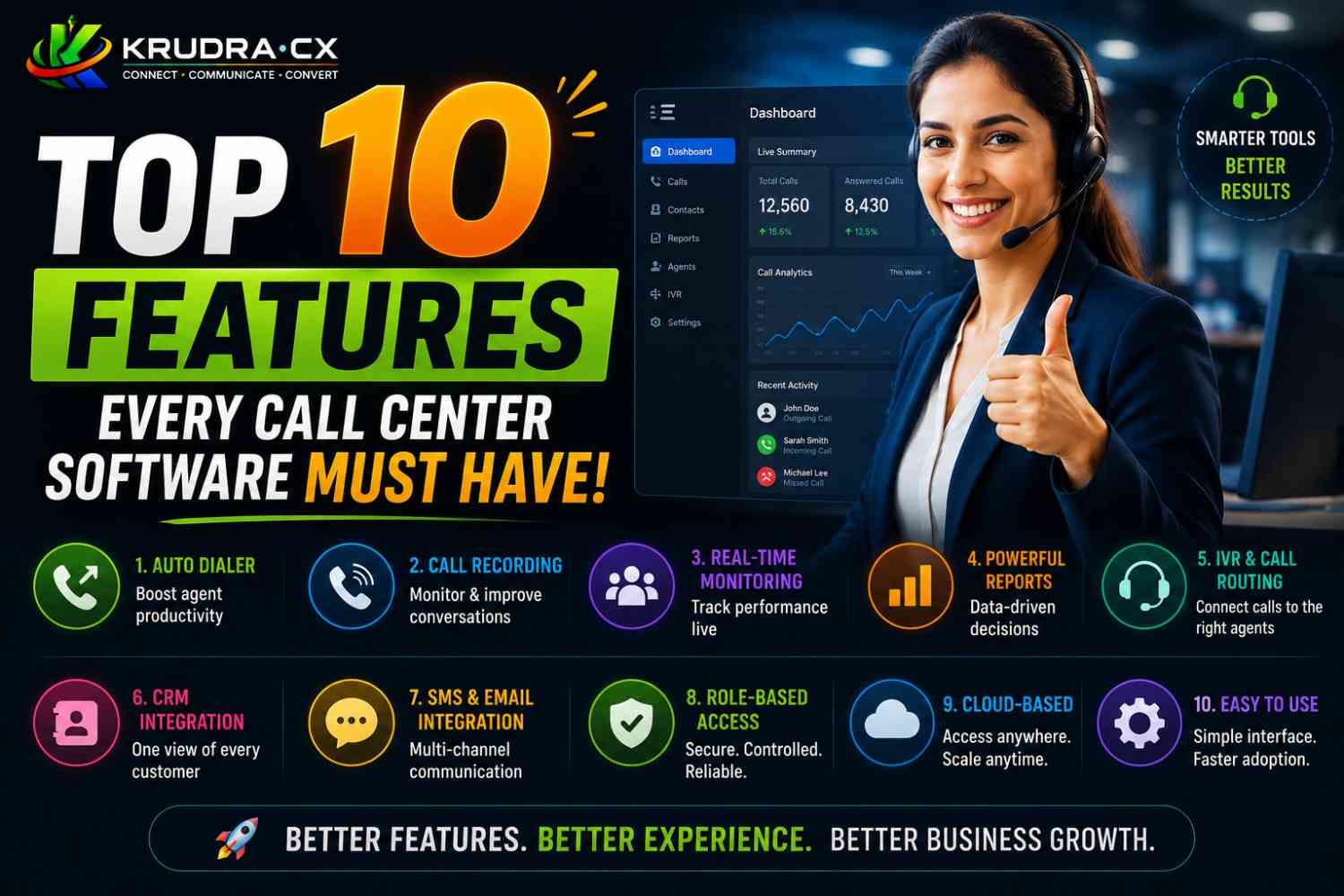
- Automated IVR routing, so calls reach the right department without a human operator manually transferring every call.
- Call recording and monitoring, useful for training, quality assurance, and dispute resolution — without a separate recording device or storage system.
- Real-time analytics dashboards, showing call volume, average handle time, missed call rates, and agent performance — data that used to require manual log compilation or a separate reporting tool.
- CRM and helpdesk integration, so call activity automatically syncs with sales or support records instead of requiring an agent to manually log every call.
Each of these used to be a separate cost center. Bundled into a single cloud platform, they become part of the base value — which is where a large chunk of the "money saved" actually comes from. It's not just cheaper calling; it's cheaper everything that used to sit around calling.
Where the Time Savings Actually Show Up
Cost savings get most of the attention, but the time savings compound just as much — often more, because time saved by a team is time that gets reinvested into revenue-generating work.
Faster agent onboarding. A new agent on a cloud system logs into a browser-based dashboard and is ready to take calls the same day, instead of waiting for a desk phone to be provisioned and wired. For businesses with high agent turnover — common in sales and support — this alone can save days of ramp-up time per hire.
Automated call routing eliminates manual transfers. Instead of a receptionist or operator manually redirecting every incoming call, IVR and skill-based routing send callers directly to the right team or agent. That's not just faster for the customer — it removes an entire manual task from someone's day.
Centralized reporting removes manual data compilation. Managers no longer need to pull call logs from multiple sources or manually track agent performance in spreadsheets. Real-time dashboards show call volume, wait times, and conversion rates instantly, which means decisions get made faster and with better data.
Remote and hybrid work becomes frictionless. Because cloud telephony only requires an internet connection, agents can work from home, from a branch office, or from a laptop while traveling — without any change to how calls are routed or recorded. This eliminates the time and cost of maintaining separate systems for in-office and remote staff, and it means a business isn't geographically limited when hiring talent.
Faster issue resolution. When something breaks in a cloud system, it's typically resolved by the provider's infrastructure team, often before the business even notices an issue. Compare that to a traditional system, where a hardware fault might mean hours or days of waiting for a technician visit.
Put together, these aren't small, incremental improvements — they represent structural time savings that scale with the size of the team. The bigger the call center, the more hours are being saved every single day.
A Realistic Before-and-After
Consider a business running a 30-seat support and sales team on a traditional on-premise PBX. Under that setup, the business is likely paying for physical phone lines, a maintenance contract, periodic hardware refreshes, and an IT resource partially dedicated to keeping the system running. Scaling to 45 seats during a growth phase means new equipment, new lines, and a multi-week setup timeline. International outbound calls to prospects abroad are billed at premium per-minute rates. Reporting on team performance means pulling data manually from the PBX system and compiling it into spreadsheets every week.
Move that same team to a cloud telephony platform, and the picture changes substantially. Hardware costs disappear, replaced by a predictable monthly subscription. Scaling to 45 seats happens by adding seats to the account — no procurement delay. International calling costs drop because calls route over the internet instead of premium carrier lines. Managers get real-time dashboards instead of manual weekly reports. And when an agent needs to work remotely, they simply log in from home with no infrastructure change required.
None of this is a hypothetical improvement — it's the operational reality of moving from physical to cloud infrastructure, and it's why cloud telephony adoption has accelerated so sharply across sales and support-heavy businesses in the past several years.
Cloud Telephony Isn't Just Cheaper — It's a Different Operating Model
The core shift to understand is this: cloud telephony doesn't just make an old system cheaper to run. It replaces the entire operating model. A traditional phone system is a fixed asset that a business owns and maintains. A cloud telephony platform is a flexible service that a business subscribes to and scales as needed.
That distinction matters because it changes how a business thinks about its own communication infrastructure. Instead of a phone system being a sunk cost that gets upgraded every few years, it becomes a living part of the business's tech stack — connected to the CRM, feeding data into sales and support analytics, and scaling in real time with the business's actual needs.
For sales teams, that means every call is logged, tracked, and tied to a lead record automatically. For support teams, that means every customer interaction is recorded, searchable, and measurable. For leadership, that means visibility into call center performance without waiting for someone to compile a report.
This is the real reason cloud telephony saves businesses time and money — not because it's a cheaper phone, but because it's a fundamentally more efficient way to run the communication layer of a business.
The savings from cloud telephony aren't abstract. They show up as lower upfront capital costs, lower per-minute call charges, reduced IT overhead, faster scaling, less downtime, and dramatically less manual work for managers and agents alike. For a growing sales or support team, these savings compound month over month — and the businesses that make the switch early are the ones that end up with leaner operations and faster-moving teams than their competitors still tied to hardware in a server room.
If your business is still running calls through a traditional phone system, the question isn't really whether cloud telephony would save time and money — the mechanics above make that clear. The real question is how much time and money is being lost every month by waiting to make the switch.
Ready to see what your business could save? Don't let outdated phone infrastructure quietly drain your team's time and your company's budget every single month. Switch to KrudraCX's cloud-based calling platform and give your sales and support teams the speed, flexibility, and cost efficiency they need to actually compete. Book a free demo with KrudraCX today and see exactly how much your business stands to save — before your competitors get there first.