
Introduction
Customer support has quietly become one of the fastest-moving battlegrounds for artificial intelligence. Just a few years ago, "customer service AI" meant a clunky chatbot that could barely understand a misspelled word. Today, AI systems resolve complex, multi-step problems, understand context and emotion, and work alongside human agents in real time. The pace of change isn't linear — it's exponential. Companies that were experimenting with AI pilots in 2023 are now running fully AI-integrated support operations in 2026. If you're still thinking of AI in customer support as "a chatbot on the website," you're already behind.
This blog breaks down exactly how AI is reshaping customer support — from the technology driving the shift, to real-world applications, to what it means for businesses, agents, and customers alike.
1. Why Customer Support Was Ripe for AI Disruption
Brief: Customer support is a high-volume, repetitive, data-rich function — exactly the kind of environment where AI thrives.
In detail:
Traditional customer support has always faced the same core problems: long wait times, inconsistent answers, agent burnout, and the sheer cost of scaling a human workforce. Support teams handle thousands (sometimes millions) of repetitive queries — password resets, order status checks, billing questions — that don't require deep human judgment but still eat up enormous time and budget.
At the same time, every support interaction generates data: transcripts, tickets, sentiment signals, resolution times. This makes support one of the most measurable, structured functions in a business — ideal training ground for machine learning models. Combine massive repetitive workloads with rich structured data, and you get the perfect storm for automation. AI didn't "invade" customer support; it was inevitable that it would land here first, before more nuanced domains like law or medicine.
2. From Scripted Bots to Generative AI: The Real Shift
Brief: The leap from rule-based chatbots to generative AI models is the single biggest reason support is changing so fast.
In detail:
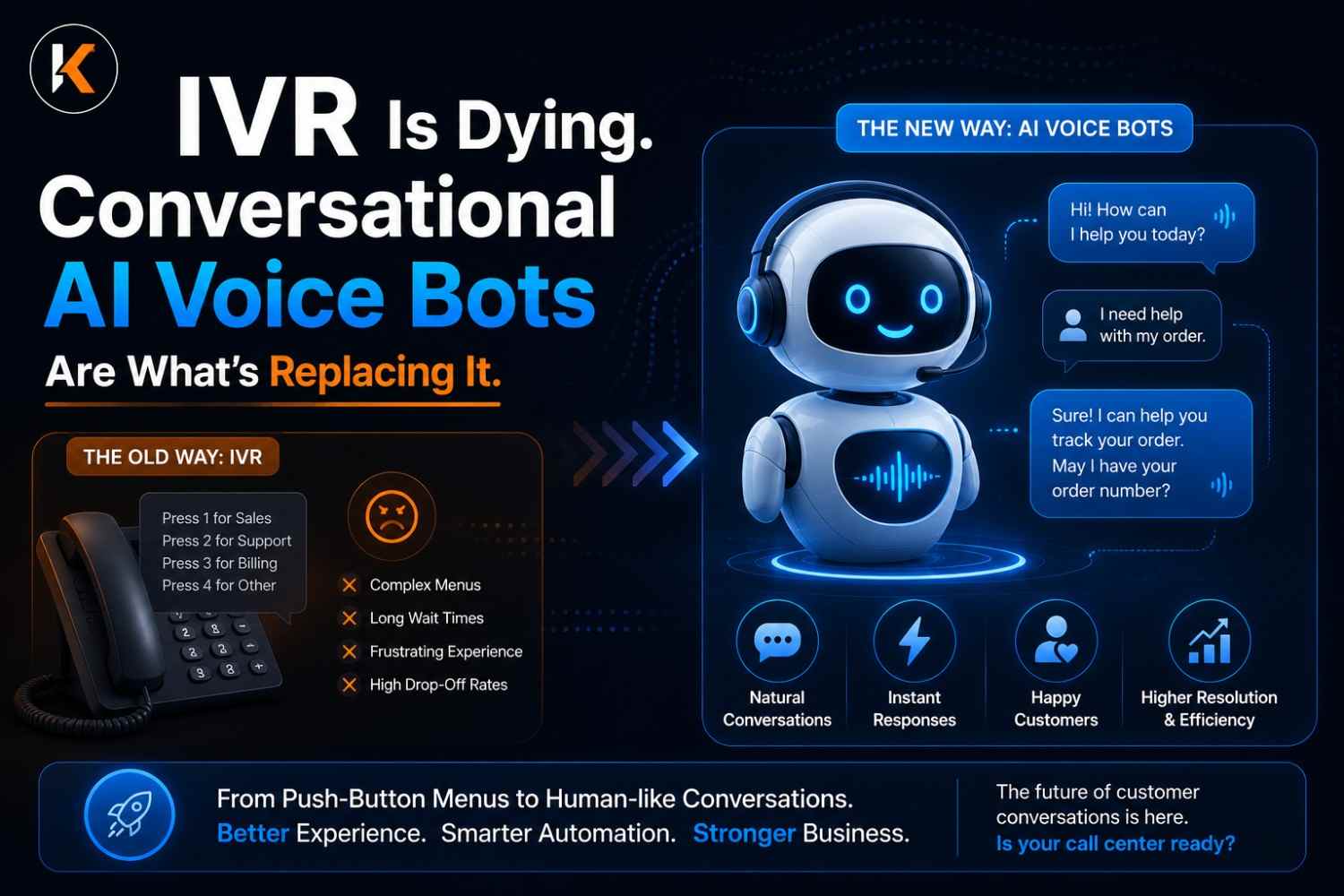
Older chatbots relied on decision trees — "If the customer says X, respond with Y." These systems broke the moment a customer phrased something unexpectedly. They couldn't improvise, and they definitely couldn't understand nuance.
Generative AI — powered by large language models — changed everything. These systems don't just match keywords; they understand intent, context, and even tone. A modern AI support agent can:
- Understand a vague or poorly worded complaint and figure out what the customer actually needs
- Pull information from multiple internal systems (order history, account data, previous tickets) to give a personalized answer
- Generate a natural, human-sounding response instead of a robotic, templated one
- Handle follow-up questions within the same conversation without losing context
This is the difference between a bot that says "I don't understand, please rephrase" and one that says "It looks like your package was delayed due to a weather issue in transit — I've gone ahead and applied a $10 credit to your account for the inconvenience." That shift — from scripted to reasoning — is why the change feels so sudden. It's not incremental improvement; it's a different category of technology.
3. AI-Powered Self-Service Is Becoming the First Line of Support
Brief: Customers increasingly solve their own problems using AI — often without ever talking to a human.
In detail:
Self-service used to mean a static FAQ page or a search bar that rarely returned useful results. Now, AI-driven self-service tools act more like a knowledgeable assistant than a search engine. Customers can type or speak a question in natural language — "Why was I charged twice this month?" — and get an accurate, personalized answer instantly, often pulling real account data to explain the specific charge.
This matters because customer expectations have shifted. People don't want to wait on hold or dig through help center articles. They want instant, accurate answers, and they're increasingly comfortable getting them from AI — as long as it actually works. Studies across the industry consistently show that a large share of consumers prefer resolving simple issues themselves if the process is fast and accurate, reserving human interaction for complex or emotionally sensitive issues.
For businesses, this means the "front door" of support is no longer a phone tree — it's an AI system that filters, resolves, and only escalates what truly needs a human.
4. Real-Time Agent Assist: AI as a Co-Pilot, Not a Replacement
Brief: AI isn't just replacing agents — it's making human agents dramatically more effective.
In detail:
One of the most underrated shifts in customer support is "agent assist" technology — AI tools that work alongside human agents during live interactions. While a customer is chatting or on a call, the AI listens in real time and:
- Suggests the most relevant response or knowledge base article
- Summarizes long conversation histories so agents don't have to read through pages of past tickets
- Flags compliance risks (e.g., an agent about to say something that violates policy)
- Detects customer sentiment and alerts a supervisor if frustration is escalating
- Auto-fills forms and after-call summaries, saving agents from tedious admin work
This changes the role of a support agent from "information retriever" to "relationship manager and decision-maker." Agents spend less time searching for answers and more time actually solving problems and handling nuanced, emotionally charged situations — the interactions where human empathy genuinely matters.
Companies report that agent assist tools can cut average handle time significantly while improving first-contact resolution, because agents are spending their mental energy on the customer, not on hunting through internal systems.
5. Predictive and Proactive Support: Fixing Problems Before They Happen
Brief: AI is shifting support from reactive to proactive — solving issues before the customer even notices.
In detail:
Traditionally, support is reactive: something goes wrong, the customer complains, and a human fixes it. AI is flipping this model. By analyzing usage patterns, transaction data, and behavioral signals, AI systems can predict problems before they escalate.
Examples of this in action:
- A telecom company's AI detects a customer's device signal patterns suggest an outage is coming and proactively messages them before they call in confused
- An e-commerce platform's AI notices a shipment is delayed and automatically sends the customer an apology and a discount code before they ask
- A SaaS company's AI notices a user is repeatedly failing at the same step in onboarding and triggers a helpful, contextual tip
This proactive layer completely changes the customer experience. Instead of "customer discovers problem → complains → waits → gets help," it becomes "AI detects problem → resolves or informs → customer barely notices." This is a fundamentally different relationship between businesses and customers, and it's only possible because AI can process massive amounts of behavioral data in real time — something no human team could do manually.
6. Sentiment and Emotion Detection: Support That Understands How You Feel
Brief: AI can now detect frustration, urgency, and emotional tone — not just the words being said.
In detail:
Modern AI support tools go beyond parsing text for keywords; they analyze tone, word choice, punctuation, and even response timing to gauge emotional state. A customer typing in all caps with short, clipped sentences is flagged differently than one asking a calm, curious question.
This has practical consequences:
- Frustrated or high-risk customers can be automatically routed to senior human agents instead of being left in a queue
- AI can adjust its own tone — becoming more empathetic and less transactional when a customer seems upset
- Businesses get aggregate emotional data across thousands of conversations, revealing systemic issues (e.g., "sentiment drops sharply whenever customers mention our new pricing plan")
This emotional intelligence layer is what separates today's AI support from the robotic systems of the past. It's not just about resolving tickets faster — it's about making customers feel heard, which has a massive impact on loyalty and retention.
7. Omnichannel AI: One Brain Across Every Channel
Brief: AI is unifying support across chat, email, voice, and social media into one seamless experience.
In detail:
Customers today contact businesses through many channels — live chat, email, phone, social media DMs, WhatsApp, and more. In the past, each channel often had separate systems, meaning a customer might have to repeat their issue three times across three platforms.
AI is solving this by acting as a unified layer across every channel. The same AI system that handles a website chat can pick up a phone call transcript, connect it to a customer's email thread, and reference their social media complaint — all with full context, no repetition needed. Voice AI, in particular, has advanced dramatically: natural-sounding AI voice agents can now handle phone support conversations that are difficult to distinguish from a human agent, complete with natural pauses, tone shifts, and interruption handling.
This omnichannel consistency used to require massive integration work and still often failed. AI-native platforms are increasingly built to solve this by default, which is a major reason adoption is accelerating so quickly — the technology finally matches how customers actually behave.
8. The Economics: Why Businesses Are Moving Fast
Brief: The financial incentives for adopting AI in support are enormous, which is accelerating adoption speed.
In detail:
Customer support is typically one of the largest operational cost centers for consumer-facing businesses. Labor costs, training costs, turnover (support has notoriously high attrition), and infrastructure add up fast. AI offers a rare combination: lower cost per interaction AND, when implemented well, improved customer satisfaction.
Some of the economic drivers pushing businesses toward faster AI adoption:
- Cost reduction: AI can resolve a large share of simple tickets without human involvement, cutting cost per resolution significantly
- 24/7 availability: No overtime pay, no time zone gaps, no holiday staffing shortages
- Scalability: AI can handle sudden spikes in demand (product launches, outages, holiday seasons) without needing to hire and train temporary staff
- Reduced agent turnover costs: By automating the most tedious, repetitive queries, human agents handle more meaningful work, which improves job satisfaction and reduces the brutal turnover rates common in call centers
- Faster resolution = higher retention: Speed and accuracy in support strongly correlate with customer loyalty and reduced churn
These aren't small, marginal gains — for many companies, AI adoption in support is now a board-level priority because the ROI is measurable and fast, unlike many other AI investments across the business.
9. The Human Side: What Happens to Support Agents?
Brief: AI is reshaping — not eliminating — the human role in support, but the transition brings real challenges.
In detail:
It's natural to ask: does this mean support jobs are disappearing? The honest answer is more nuanced. Entry-level, repetitive-query roles are shrinking as AI absorbs that volume. But new roles are emerging:
- AI trainers and prompt specialists who fine-tune how AI responds
- Escalation specialists who handle only the most complex, emotionally sensitive, or high-stakes cases
- AI quality auditors who review AI conversations for accuracy, bias, and tone
- Customer experience strategists who use AI-generated insights to improve products and policies
The overall shape of support teams is shifting: fewer, more skilled agents handling higher-value work, supported by AI for everything routine. This is a real disruption for the industry — especially in regions where large call centers are major employers — and it requires thoughtful workforce transition planning, not just cost-cutting.
10. The Risks and Challenges Nobody Should Ignore
Brief: Rapid AI adoption in support isn't risk-free — accuracy, trust, and over-automation are real concerns.
In detail:
Despite the momentum, there are legitimate challenges businesses need to navigate carefully:
- Hallucination risk: Generative AI can confidently give wrong answers if not properly grounded in accurate, up-to-date company data. In support, a wrong answer about a refund policy or product safety isn't a minor error — it can create real financial or legal problems.
- Over-automation backlash: Customers still want the option to reach a human, especially for complex or emotional issues. Companies that hide the human option too aggressively often see satisfaction scores drop.
- Data privacy and security: AI systems handling account data, payment information, and personal details must be built with strict security and compliance standards, especially as regulations around AI use tighten globally.
- Bias and fairness: AI models trained on historical support data can inherit biases — for example, treating certain phrasing patterns or demographics differently. Ongoing auditing is essential.
- Loss of brand voice: Poorly implemented AI can sound generic or robotic, undermining a brand's carefully built tone and personality.
The businesses winning with AI in support are the ones treating it as an augmentation strategy with human oversight — not a fully hands-off replacement. Guardrails, escalation paths, and continuous monitoring matter just as much as the AI technology itself.
11. What "Faster Than You Think" Actually Means
Brief: The pace of change is accelerating because AI capabilities, adoption, and customer expectations are all rising simultaneously.
In detail:
Three forces are compounding at once, which is why this shift feels sudden rather than gradual:
- Model capability is improving rapidly. AI systems are getting better at reasoning, context retention, and multi-step problem solving every few months — not every few years.
- Adoption is no longer experimental. Early AI support tools were pilots run by innovation teams. Now, AI-first support is a default expectation baked into new platforms and vendor offerings.
- Customer expectations are resetting fast. Once customers experience instant, accurate AI-driven answers from one company, they expect the same everywhere. This creates competitive pressure — businesses that lag behind risk losing customers to competitors offering faster, smarter support.
This convergence means the gap between AI-forward companies and traditional support operations is widening quickly. What was a "nice to have" in 2023 is becoming table stakes in 2026, and companies that delay adoption risk playing catch-up in a market that won't wait for them.
12. What This Means for Businesses Right Now
Brief: Businesses need a clear, deliberate AI support strategy — not a reactive scramble.
In detail:
For businesses evaluating how to respond to this shift, a few practical principles matter most:
- Start with high-volume, low-complexity queries — this is where AI delivers immediate ROI with minimal risk
- Keep humans in the loop for complex, sensitive, or high-value interactions — full automation isn't the goal; smart automation is
- Invest in clean, accurate knowledge bases — AI is only as good as the data it's grounded in
- Measure customer sentiment, not just resolution speed — fast wrong answers are worse than slightly slower correct ones
- Train and reskill support staff for the new hybrid model, rather than treating AI purely as headcount reduction
- Continuously audit AI outputs for accuracy, bias, and brand alignment
Companies that treat this as a long-term capability build — rather than a quick cost-cutting hack — are the ones seeing sustainable results.
Conclusion
AI is not just improving customer support — it's fundamentally redefining what support means. The shift from scripted chatbots to intelligent, proactive, emotionally aware systems has happened faster than almost anyone predicted just a few years ago. Self-service is smarter, agents are more empowered, problems are being solved before customers even notice them, and the entire experience is becoming faster, more personalized, and more consistent across every channel.
But speed brings responsibility. The businesses that will win in this new landscape aren't necessarily the ones with the most advanced AI — they're the ones who deploy it thoughtfully, keep humans central to trust and empathy, and never lose sight of the fact that support, at its core, is about people helping people, even when AI is doing more of the heavy lifting behind the scenes.
The transformation isn't coming. It's already here — and it's moving faster than most businesses are prepared for.
🚀 Ready to Future-Proof Your Customer Support?
Don't wait until your competitors leave you behind. The businesses adopting AI-powered support today are building faster, smarter, more loyal customer relationships — and the gap is widening every month.
Start exploring how AI can transform your support operations now — before "faster than you think" becomes "too late to catch up."
👉 Get in touch today to build your AI-powered customer support strategy.