Introduction: The Safety Net That's Actually a Trap
Call scripts exist for a good reason. They ensure compliance, keep new agents from freezing up, and guarantee every customer hears the same key information. On paper, scripting looks like risk management done right.
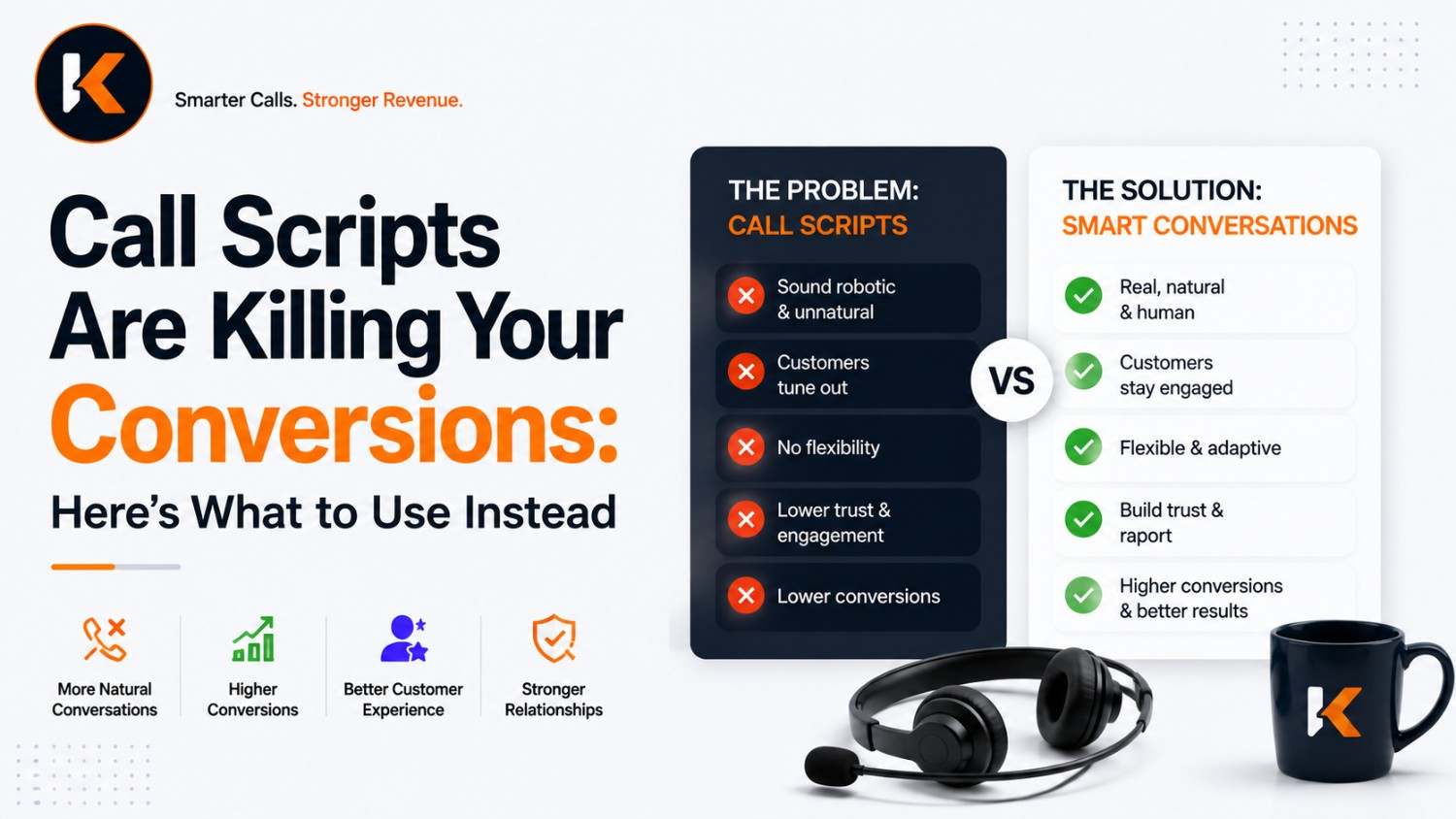
In practice, it's often quietly sabotaging conversions. Customers can tell within seconds when they're talking to someone reading from a page rather than actually listening to them. The moment a caller detects "script voice" — that flat, rehearsed cadence — trust drops, engagement drops, and so does the likelihood of a sale, a resolution, or a positive outcome.
The problem isn't structure. Every good sales or support conversation needs one. The problem is treating that structure as a script to recite instead of a framework to work within. Businesses that make this shift consistently see better conversion rates, higher CSAT, and agents who actually enjoy the job more.
Why Rigid Scripts Backfire
1. Customers Hear the Robot, Not the Message
Word-for-word scripts strip away natural speech patterns — pauses, tone shifts, casual phrasing — that signal a real human is engaged in the conversation. Even when the content is accurate, the delivery reads as inauthentic, and customers respond to authenticity far more than they respond to polish.
2. Scripts Can't Handle Real Objections
A script is written for the conversation the company expects, not the one the customer actually has. The moment a customer says something unexpected — a specific concern, a comparison to a competitor, an unusual question — a script-bound agent either goes off-book awkwardly or forces the conversation back onto the script, ignoring what the customer actually said. Both responses erode trust fast.
3. It Removes Agent Judgment at the Worst Moments
The best agents adjust their approach based on the customer's tone, urgency, and specific situation. Rigid scripting removes that judgment entirely, replacing it with a one-size-fits-all path that treats a frustrated, time-pressed customer the same way it treats a relaxed, browsing one.
4. It Punishes Good Instincts
Agents who naturally build rapport, ask smart follow-up questions, or read a customer's mood are often penalized in script-adherence QA scoring for deviating from the approved language — even when their approach produced a better outcome. Over time, this trains good agents to suppress the instincts that actually make them effective.
5. It Creates Painfully Long Calls
Scripts often include mandatory disclaimers, transitions, and phrasing that add time without adding value. Customers who already know what they want get walked through a full script anyway, extending handle time and increasing the odds they lose patience before the call even gets to the point.
What to Use Instead: The Framework Approach
The alternative to scripting isn't "no structure." It's shifting from word-for-word scripts to flexible frameworks — a defined sequence of objectives the agent needs to hit, with full freedom in how they get there.
1. Objective-Based Call Structure
Instead of dictating exact phrasing, define what needs to happen at each stage: build rapport, understand the need, address the specific concern, propose a next step. Agents fill in the language naturally, based on what the customer actually says, while still hitting every required checkpoint.
2. Objection-Handling Principles, Not Canned Rebuttals
Rather than memorized responses to specific objections, train agents on the underlying principle behind each objection — price sensitivity, trust concerns, timing hesitation — and how to address the principle in their own words. This lets agents handle objections they weren't specifically trained on, because they understand the "why," not just a scripted "what to say."
3. Discovery Questions Instead of Pitch Sequences
Give agents a bank of strong, open-ended questions to genuinely understand the customer's situation, rather than a fixed pitch they deliver regardless of what the customer needs. A conversation that starts with real discovery consistently outperforms one that starts with a rehearsed pitch, because the resulting recommendation actually fits the customer.
4. Mandatory Elements, Clearly Separated from Flexible Ones
Compliance disclosures, legal language, and required disclosures should remain fixed and non-negotiable — but clearly separated from the conversational parts of the call. Agents should know exactly what must be said verbatim versus what can be adapted, rather than treating the entire call as equally rigid.
5. Real Call Examples Over Written Scripts
Instead of handing new agents a script to memorize, use recorded calls from top-performing agents as training material. Hearing how a skilled agent naturally navigates a real conversation — including pauses, tone shifts, and genuine reactions — teaches judgment in a way a written script never can.
How to Make the Transition Without Losing Consistency
Leadership teams often resist moving away from scripts because scripts feel like the only way to guarantee consistency. The good news is that frameworks can deliver the same consistency on outcomes while allowing flexibility in delivery.
Redefine QA scoring around objectives, not phrasing. Instead of penalizing agents for not using the exact approved sentence, score whether they accomplished the objective — understanding the need, addressing the concern, offering a clear next step — regardless of the specific words used.
Use AI call analytics to identify what's actually working. Rather than assuming the script is correct and scoring agents against it, use voice analytics to find out which natural phrasings and approaches from top performers correlate with better outcomes, then build those patterns into training — not as mandatory scripts, but as examples of what good sounds like.
Train through role-play, not memorization. Practicing real scenarios with a supervisor or peer, where the "customer" throws unexpected objections and situations at the trainee, builds the adaptive skill that a memorized script never can.
Keep compliance language separate and clearly marked. Agents should never have to guess which parts of a call are legally required versus stylistically suggested. Make that distinction explicit in training materials so the flexible parts of the framework don't accidentally erode into skipped compliance steps.
What Changes When You Make the Shift
Businesses that move from rigid scripts to flexible frameworks typically see a few consistent shifts:
Conversion rates improve because agents can actually respond to what the customer says instead of forcing every call down the same predetermined path regardless of fit.
Average handle time often drops, not because agents are rushing, but because they're not wasting time on scripted phrasing the customer doesn't need to hear.
CSAT improves because customers feel heard rather than processed, which shows up directly in post-call sentiment.
Agent satisfaction improves, since the job shifts from reciting lines to actually problem-solving and connecting with people — a meaningful factor in reducing the burnout and turnover that plague script-heavy call centers.
Scripts were built to reduce risk, but in practice they often introduce a different kind of risk: conversations that sound hollow, miss what the customer actually needs, and quietly cap conversion rates well below what a more adaptive approach could achieve. The fix isn't abandoning structure — it's replacing rigid, word-for-word scripts with objective-based frameworks that give agents the freedom to actually listen and respond.
The call centers converting best in 2026 aren't the ones with the tightest scripts. They're the ones that trained their agents to have real conversations.
Ready to Get Your Agents Off the Script?
Rigid scripts might feel safe, but they're capping your conversion rate every single day. KrudraCX helps call centers build flexible, objective-based frameworks that let agents actually connect with customers — and close more.
👉 Partner with KrudraCX today and turn your call scripts into conversations that convert.
Visit www.krudracx.com and give your agents the freedom to sound human again.