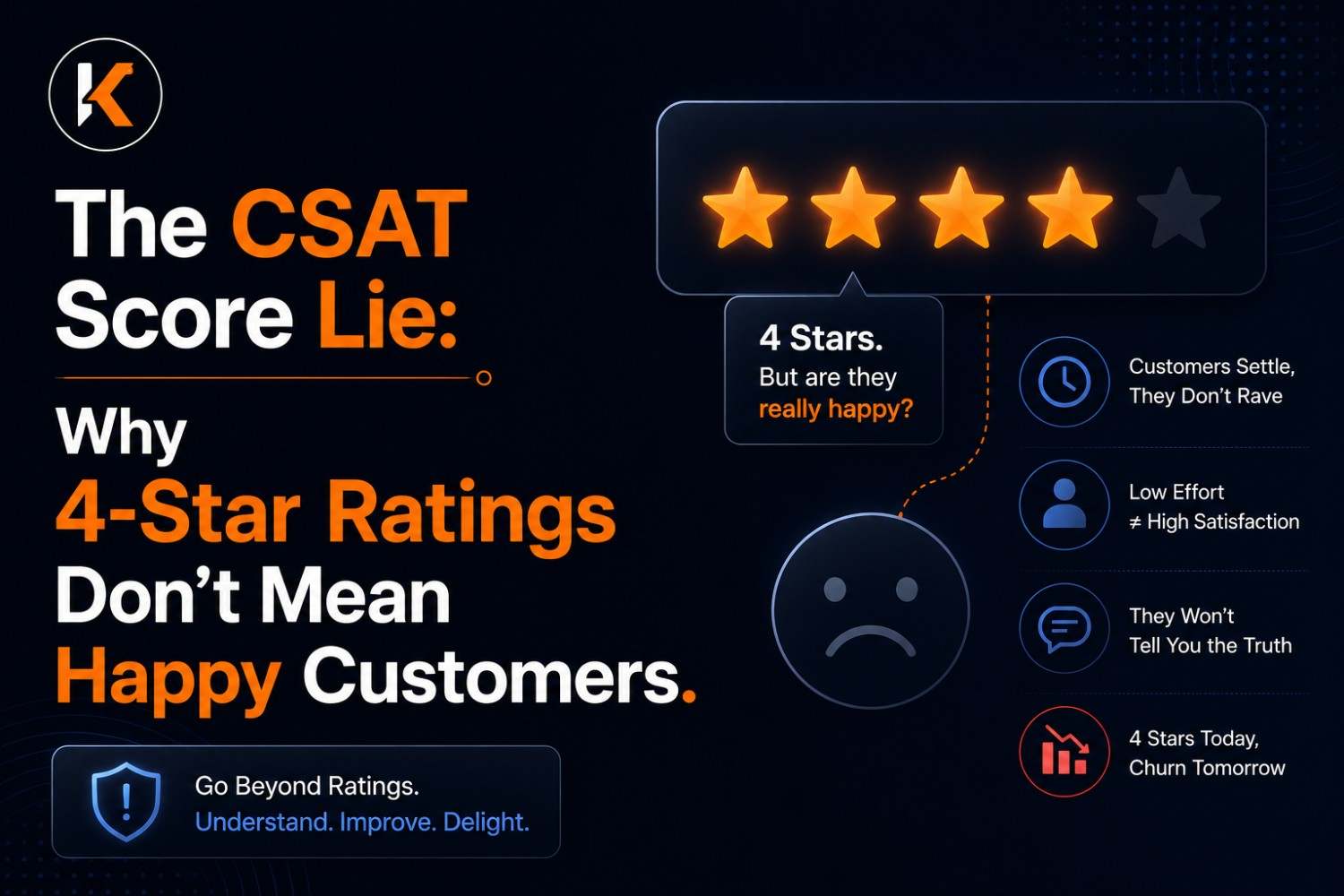
Introduction: The Number That Makes Everyone Feel Good
Walk into almost any call center review meeting and someone will put a slide up with a big, reassuring number on it. "Our CSAT is 4.6 out of 5." Heads nod. The meeting moves on. Nobody asks the harder question: does that number mean what everyone in the room assumes it means?
CSAT — Customer Satisfaction Score — has become the default health check for support quality almost everywhere, mostly because it's simple to collect and easy to report. One question, one rating, one number that rolls up neatly into a monthly report. But that simplicity is exactly the problem. A single post-call rating is being asked to represent something far more complicated than it can actually capture, and businesses that treat it as gospel often find out the hard way that their "happy" customers were never quite as happy as the dashboard suggested.
This isn't an argument to stop measuring CSAT. It's an argument to stop trusting it alone.
Why CSAT Feels Trustworthy (And Why That's the Trap)
CSAT surveys are usually sent right after an interaction ends. "How satisfied were you with this call?" One click, five stars, done. It feels objective because it comes straight from the customer, in their own words — or rather, their own click.
But a rating taken in the thirty seconds after a call ends is capturing a very narrow slice of reality: how the customer felt about the interaction itself, in that specific moment, often before they've even had a chance to see whether the actual fix worked. It's a mood check, not a satisfaction audit. And moods are heavily influenced by things that have very little to do with whether the underlying problem was solved.
Where CSAT Quietly Falls Apart
1. It Rewards Pleasantness, Not Resolution
A polite, friendly agent who didn't actually fix the problem can still score a 5. Customers often rate the person they spoke to rather than the outcome they received, especially when the agent was warm and apologetic. This means a call center can have a glowing CSAT average while first-call resolution — the metric that actually predicts whether the customer will need to call back — is quietly mediocre.
2. It Has a Massive Response Bias Problem
Most customers don't fill out satisfaction surveys. The ones who do tend to sit at the extremes — either genuinely delighted or genuinely furious. The large, silent middle — customers who were mildly annoyed, or whose issue only sort of got resolved — rarely bothers to respond. That means your CSAT score is often built from a skewed sample that doesn't represent your average customer's actual experience.
3. Timing Skews Everything
A survey sent immediately after a call captures relief, not satisfaction. If an agent just spent twenty minutes calming someone down and offering a fix, the customer might rate the call highly simply because the stress of the moment has passed — regardless of whether the fix will hold up. Ask that same customer three days later, after discovering the "fix" didn't actually work, and you'd get a very different number. Most CSAT programs never ask twice.
4. It Can Be Gamed, Intentionally or Not
Agents know their CSAT scores affect their performance reviews. It's not unusual — consciously or not — for agents to ask directly for a good rating at the end of a call, or to frame the survey in a way that nudges customers toward a higher score. None of this is necessarily malicious, but it does mean the number reflects survey behavior as much as it reflects genuine satisfaction.
5. One Score Can't Hold Two Different Truths
A customer can be satisfied with how they were treated and still be unhappy with the company overall — frustrated that the issue happened in the first place, tired of contacting support repeatedly, or quietly evaluating alternatives. CSAT collapses all of that nuance into a single number that can't distinguish "I liked this agent" from "I trust this company."
The Real-World Cost of Trusting CSAT Alone
When CSAT is the primary health signal a business relies on, a few predictable things start happening.
Repeat problems go unnoticed. If every individual interaction scores well, there's no obvious red flag pointing to a systemic issue — even if the same customers are calling back again and again for the same underlying problem.
Churn shows up as a surprise. Businesses that lean entirely on CSAT are often blindsided when a customer with a "5-star" support history cancels anyway. The rating measured the interaction; it never measured the relationship.
Coaching gets misdirected. Agents get praised or penalized based on a metric that reflects tone and warmth more than actual problem-solving, which can quietly reward the wrong behaviors over time.
Leadership gets a false sense of security. A healthy-looking CSAT dashboard can mask real operational problems, because it's answering a much narrower question than the one leadership thinks it's answering.
What to Track Alongside CSAT
None of this means CSAT should be thrown out — it's still a useful, easy-to-collect signal. It just needs company.
First Contact Resolution (FCR). This tells you whether the actual problem got solved, not just whether the conversation felt pleasant. Pairing CSAT with FCR quickly reveals cases where scores are high but resolution is low — a strong sign that politeness is being rated instead of outcomes.
Repeat Contact Rate. If the same customer is contacting you multiple times for the same issue, that's a far more honest signal of dissatisfaction than any single survey response, and it's something the customer never has to self-report for you to see.
Customer Effort Score (CES). Asking "how easy was it to get your issue resolved" surfaces a different kind of friction than CSAT does — one that's been shown to correlate more strongly with long-term loyalty than a simple satisfaction rating.
Delayed or Follow-Up Surveys. Sending a short check-in a few days after resolution, rather than only immediately after the call, captures whether the fix actually held — not just how the customer felt in the moment the call ended.
Churn and Retention Data, Segmented by Support History. Comparing retention rates between customers who contacted support and those who didn't, and between customers with high vs. low CSAT ratings, often reveals gaps that CSAT alone would never expose.
How to Read CSAT More Honestly
Rather than treating CSAT as a standalone verdict, use it as one input in a fuller picture:
Look at CSAT trends alongside FCR and repeat contact rate for the same period — a rising CSAT with a rising repeat contact rate is a warning sign, not a win. Segment CSAT by issue type and agent, since an aggregate average can hide serious problems concentrated in specific categories or teams. And treat a low response rate as a data quality issue in itself — a CSAT score built from 5% of interactions isn't a company-wide health check, it's a snapshot of your most emotionally engaged customers.
CSAT isn't wrong, exactly — it's just answering a much smaller question than most businesses think it is. It tells you how a customer felt about a single moment, filtered through whoever bothered to respond, measured before they've had time to see whether anything actually got fixed. Treating that as a complete verdict on customer happiness is where things go wrong.
The businesses that actually understand their customers pair CSAT with resolution data, repeat contact trends, and real churn analysis — because a good rating and a good outcome are not always the same thing, and the gap between them is exactly where customers quietly slip away.
Ready to See Past the CSAT Number ?
If your dashboard says customers are happy but your churn numbers disagree, the CSAT score isn't lying — it's just not telling you the whole story. KrudraCX helps businesses build a fuller, more honest picture of customer experience, beyond a single post-call rating.
👉 Talk to KrudraCX today and start measuring what actually keeps customers around.
Visit www.krudracx.com and find out what your CSAT score isn't telling you.