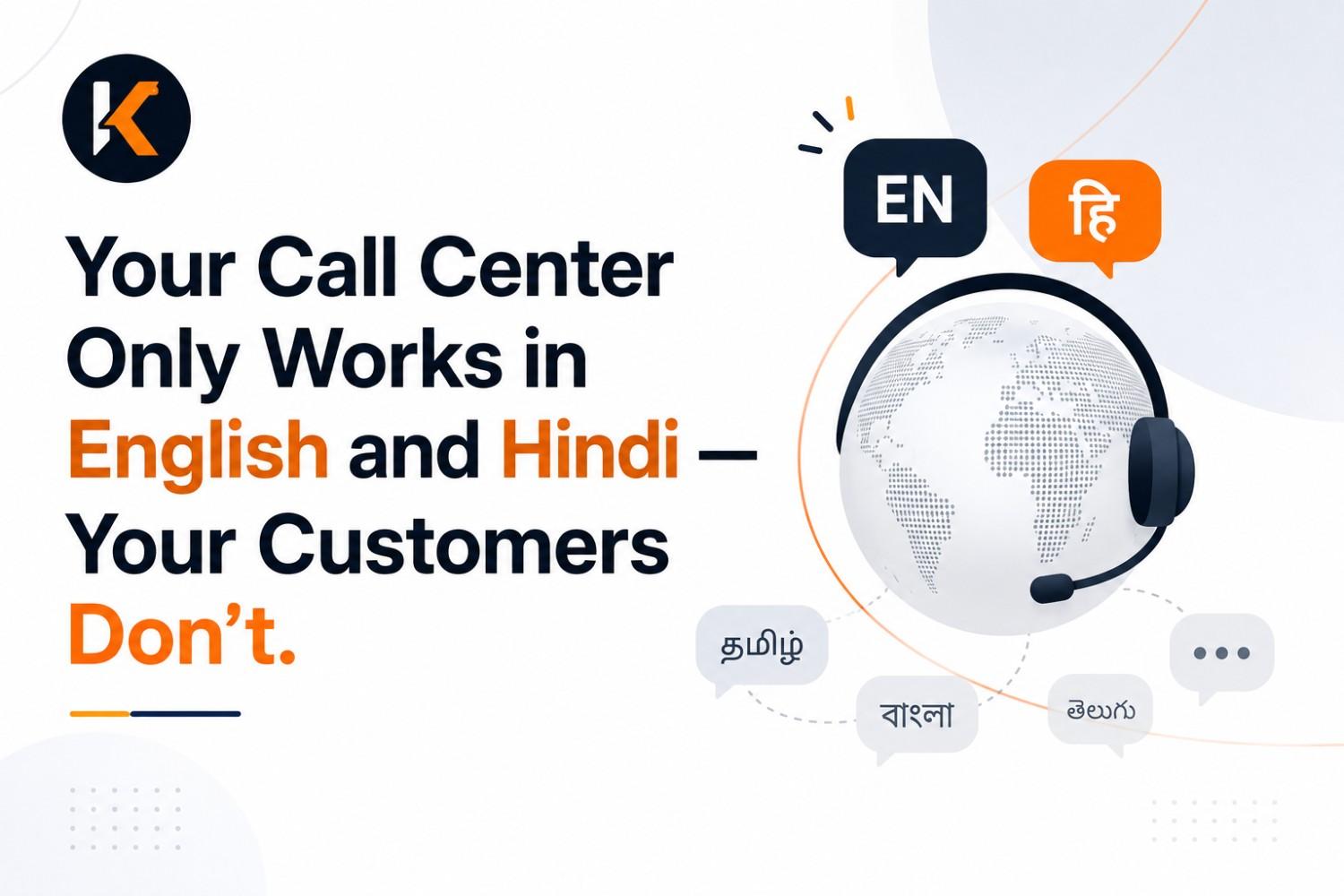
A customer in Coimbatore calls in speaking Tamil. The IVR menu is in English. The agent on the line speaks Hindi and English. The call limps through with the customer repeating themselves in broken English, or getting transferred twice looking for someone who speaks their language. Multiply that across every non-Hindi, non-English-speaking customer your business serves, and it's a quiet but significant chunk of resolution time, dropped calls, and frustrated customers that never shows up cleanly in your reporting.
Regional language voice AI — IVR, voice bots, and real-time transcription that work natively in Tamil, Telugu, Bengali, Marathi, Kannada, and other Indian languages — is what actually closes this gap, instead of routing around it with a small pool of language-specific agents who are perpetually overloaded.
Where this actually breaks today
Most contact center AI, including IVR and voice bots, is trained primarily on English and a version of Hindi that doesn't reflect regional dialects or code-switching patterns. That leaves three specific failure points:
IVR menus with no regional option, forcing customers to either struggle through English or wait for a language-specific transfer.
Voice bots that misfire badly on regional language input, because the underlying speech models were never trained on that language at scale.
QA and analytics tools that can transcribe and score English and Hindi calls but go blind the moment a call happens in Tamil or Bengali — meaning a real chunk of your call volume never gets analyzed at all.
What's changed to make this solvable now
Speech recognition and language models for major Indian languages have matured substantially through 2026, driven partly by national efforts like Bhashini pushing vernacular AI infrastructure forward. What used to require building and training language-specific models from scratch is now available as deployable infrastructure — the barrier has shifted from "can this be built" to "has this been deployed correctly for your customer base."
Why this matters beyond customer satisfaction
This connects directly to two things already on your blog. Your conversational AI voice bot post covered natural language replacing IVR menus — regional language support is what makes that shift actually work for the majority of India's population outside metro, English-first customer segments. And your AI voice analytics post covered catching problems human QA misses — but only for the languages that analytics tool actually understands. A BFSI contact center serving customers across states is otherwise running full QA coverage on maybe half its actual call volume.
What to check before deploying regional language AI
Dialect and accent coverage: "Tamil support" that's only trained on formalized, textbook Tamil will still struggle with real spoken dialects — ask vendors for accuracy benchmarks on actual regional call recordings, not lab conditions.
Code-switching handling: real Indian customers mix languages mid-sentence constantly — Tamil-English, Bengali-Hindi-English. A system that breaks the moment a customer switches languages mid-call isn't production-ready.
Agent-side support, not just customer-side: transcription and real-time assist tools need to work in the regional language too, or you've solved the customer's problem and created a new one for the agent trying to read a garbled transcript.
The honest tradeoff
Regional language coverage isn't uniform — major languages like Tamil, Telugu, and Bengali have far more mature AI support than lower-resource regional languages and dialects. Rolling this out means prioritizing the languages that cover the largest share of your actual customer base first, not assuming full coverage on day one.
Ready to stop losing regional customers to a language gap?
KRUDRA-CX helps Indian contact centers extend calling, IVR, and analytics beyond English and Hindi — built for how your customers actually speak, wherever they're calling from.
Book Free Demo → krudracx.com/book-for-demo
Talk to Sales → krudracx.com/contact