Introduction: Why "Good Enough" Isn't Good Enough Anymore ?
Most companies believe they deliver good customer support. And by conventional measures, many of them are right. Calls get answered. Tickets get resolved. CSAT scores sit comfortably in the "satisfied" range. By every standard operational metric, the support function is doing its job.
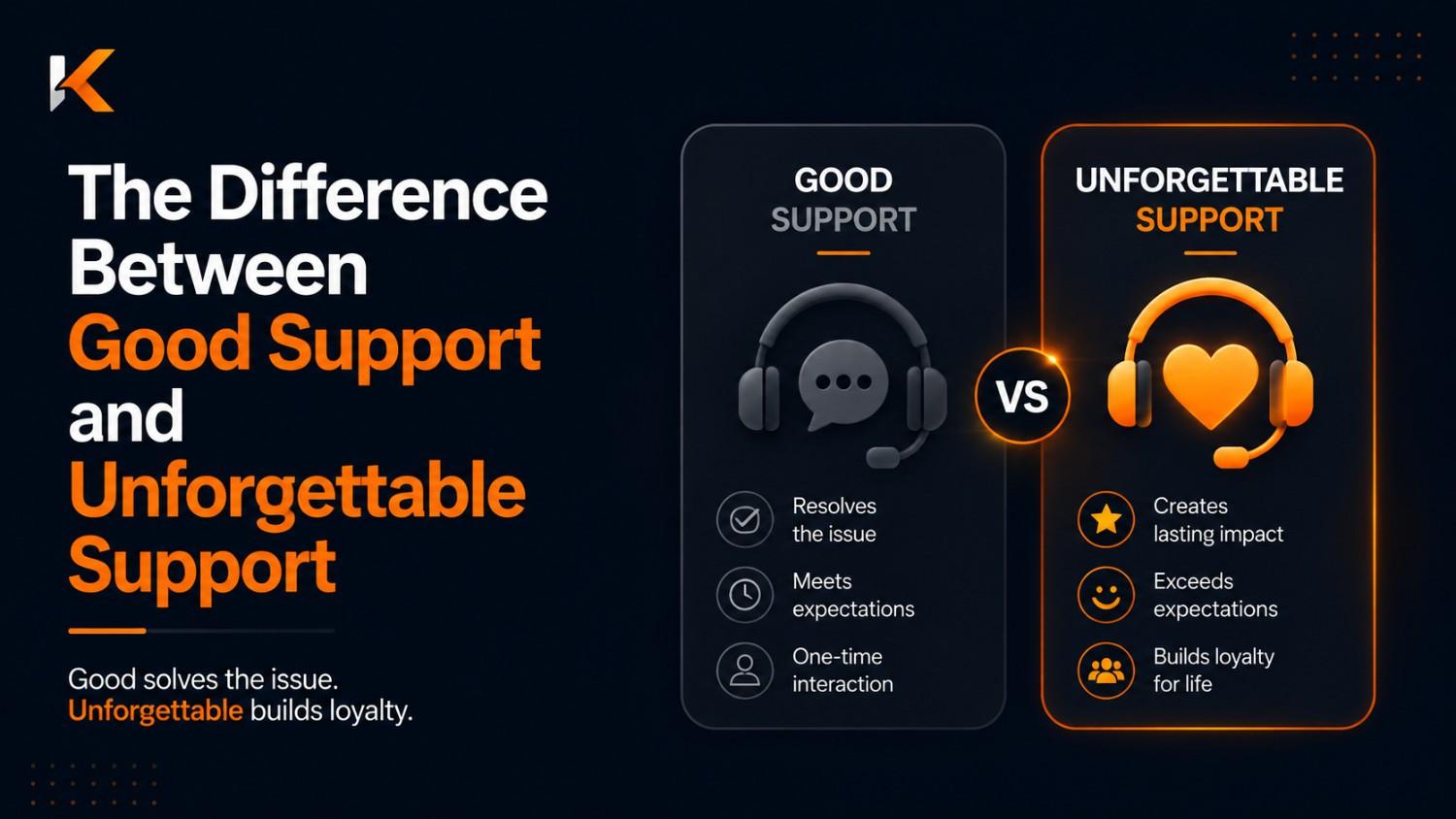
And yet almost none of these companies get talked about. Nobody tells a dinner party story about the time a support agent resolved their issue efficiently and within SLA. Good support is forgettable by design — it does what it's supposed to do, and then it disappears from memory the moment the problem is solved.
Unforgettable support is different. It's the story people actually tell — the time a company went so far beyond what was expected that the customer remembers it years later, mentions it unprompted to friends, and becomes genuinely loyal in a way no loyalty program could manufacture. It's rare specifically because it's not what companies optimize for. Most support operations are built, measured, and incentivized to produce "good" — fast, accurate, polite. Almost none are built to produce "unforgettable."
The gap between the two isn't about spending more money or hiring nicer people. It's about a fundamentally different set of choices in how support is designed, measured, and delivered. This post breaks down exactly what separates good support from the kind customers never forget — and how to close that gap deliberately.
Why This Distinction Matters More Than Most Businesses Realize
Before getting into the specifics, it's worth understanding why chasing "unforgettable" is a legitimate business strategy, not just a nice-to-have.
Good support retains customers. Unforgettable support creates advocates. A customer who receives efficient, satisfactory support has no particular reason to talk about it. A customer who receives support that genuinely surprised them tells other people, unprompted — turning a single interaction into free, highly credible marketing that no advertising budget can replicate at the same trust level.
Good support is easy to replicate. Unforgettable support is a genuine differentiator. In most industries, the baseline for competent support has risen across the board — competent phone systems, reasonable wait times, and knowledgeable agents are now table stakes rather than differentiators. When every competitor can deliver "good," good stops being a reason to choose or stay with a company.
Good support prevents churn. Unforgettable support drives expansion. Customers who've had a genuinely exceptional support experience are measurably more likely to expand their relationship with a company — upgrading, buying additional products, or renewing without price-shopping competitors first, because the relationship has moved beyond transactional.
The businesses that understand this distinction treat support not as a cost center to be minimized, but as one of the few remaining places where a genuine, hard-to-copy competitive advantage can still be built.
The Core Differences: Good Support vs. Unforgettable Support
1. Good Support Solves the Stated Problem. Unforgettable Support Solves the Underlying One.
Good support listens to what the customer says they need and addresses exactly that. If a customer asks for a refund, they get a refund. If a customer asks how to reset a password, they get password-reset instructions. The stated problem gets solved, efficiently and correctly.
Unforgettable support listens for what's actually going on beneath the stated request. A customer asking for a refund on a product that arrived late might actually be worried they've missed an important occasion it was meant for. An agent who catches that — and offers expedited replacement instead of just processing a refund — solves a problem the customer never explicitly stated, but that mattered far more to them than the transaction itself.
This requires agents to have both the training to listen for underlying context and the authority to act on it without needing three layers of approval.
2. Good Support Meets the Standard. Unforgettable Support Personalizes the Moment.
Good support treats every customer according to policy — consistent, fair, predictable. This is important; consistency prevents the kind of unfairness that damages trust at scale.
But unforgettable support finds room, within that consistency, for genuine personalization. It remembers that a customer mentioned a specific event, references something from a previous interaction without being prompted, or adjusts tone based on what the situation actually calls for rather than applying an identical script to every caller. The difference isn't breaking the rules — it's applying judgment inside them.
This is where a well-integrated CRM and call history genuinely matter: an agent who can see that this is a customer's third contact about the same issue can respond very differently — and far more effectively — than one starting from zero every time.
3. Good Support Apologizes. Unforgettable Support Makes It Right — And Then Some.
When something goes wrong, good support acknowledges the mistake and offers an appropriate remedy: a refund, a replacement, a sincere apology. This is the correct baseline response, and it's what most customers expect and consider fair.
Unforgettable support treats the failure as an opportunity, not just an obligation. It doesn't just make the customer whole — it does something slightly beyond what was strictly required, in a way that signals genuine care rather than transactional compensation. This doesn't have to be expensive. Often, it's simply exceeding the expected timeline, adding a small unexpected gesture, or having a senior team member personally follow up rather than letting the fix happen anonymously.
The distinction customers feel isn't the size of the gesture — it's whether the response felt like a formula or like genuine attention.
4. Good Support Is Reactive. Unforgettable Support Is Proactive.
Good support waits for the customer to reach out, then responds well. This is the entire operating model of most contact centers — inbound-focused, reactive by design.
Unforgettable support anticipates problems before the customer has to ask. This might mean proactively notifying a customer about a shipping delay before they call to ask where their order is, reaching out after a known service disruption to confirm everything's working again, or flagging a usage pattern that suggests a customer might be struggling with a product before they file a complaint about it.
Proactive outreach fundamentally changes how customers perceive a company — from "they respond when something goes wrong" to "they're watching out for me even when nothing's gone wrong yet."
5. Good Support Follows Process. Unforgettable Support Knows When to Break It — Thoughtfully.
Good support follows established procedures reliably, which is necessary for consistency, compliance, and fairness across a large customer base.
Unforgettable support recognizes the rare moments when following the standard process would actually produce a worse outcome, and has both the training and the authorization to deviate — not randomly, but deliberately, in service of the customer's actual situation. This requires trusting frontline agents with real judgment rather than treating every process as a rigid, zero-exception rule, and it requires leadership that backs agents up when they make a reasonable judgment call.
Companies that centralize every exception-handling decision through multiple approval layers make this kind of moment nearly impossible, because by the time an exception gets approved, the moment that would have made it meaningful has passed.
6. Good Support Measures Resolution. Unforgettable Support Measures the Story the Customer Tells Afterward.
Good support tracks whether the issue got fixed — resolution rate, time to close, CSAT score. These are legitimate, necessary metrics.
Unforgettable support asks a different question: what does this customer say about us afterward, to other people, without being prompted? This is a much harder thing to measure, but companies that build genuinely memorable support cultures often track qualitative signals deliberately — unsolicited social media mentions, spontaneous reviews that reference specific support interactions by name, referral patterns tied to support history — rather than relying solely on post-interaction surveys that measure satisfaction with the transaction, not the relationship.
7. Good Support Treats Every Interaction the Same. Unforgettable Support Recognizes Which Moments Matter Most.
Good support applies a consistent standard of service to every single interaction, regardless of context. This is operationally sound and necessary at scale.
Unforgettable support recognizes that not every interaction carries equal emotional weight, and it calibrates accordingly. A billing question and a call from someone dealing with a genuine crisis related to your product or service are not the same kind of interaction, even if they're both "support tickets" in a queue. Companies that build unforgettable support train agents — and empower supervisors — to recognize which moments are high-stakes emotionally, not just operationally, and to bring a different level of care to those specific interactions rather than treating a queue as an undifferentiated stream of tickets.
What Makes Unforgettable Support Hard to Build (And Why Most Companies Don't)
If the differences above sound achievable, it's worth being honest about why most companies still don't deliver this level of experience consistently.
It requires trusting frontline staff with real authority. Many organizations centralize decision-making so tightly that agents have no room to exercise the judgment unforgettable support requires. Every exception needs a supervisor. Every deviation needs approval. By the time authorization comes through, the moment is gone.
It requires metrics that go beyond speed and volume. Organizations that measure success purely through AHT, ticket volume, and resolution speed inadvertently punish the exact behaviors — spending extra time on a complex situation, going beyond the standard fix — that create unforgettable moments. What gets measured gets managed, and if the metrics only reward speed, speed is what agents will optimize for.
It requires hiring and training for judgment, not just process compliance. Scripted, checklist-driven training produces agents who are good at following procedure but under-equipped to recognize and act on the moments that fall outside it. Building unforgettable support requires investing in the kind of training that builds judgment — role-playing ambiguous situations, studying what top performers do differently, and giving agents real decision-making practice, not just procedural memorization.
It requires leadership that treats support as strategic, not just operational. When support is viewed purely as a cost to minimize, none of the above investments make sense. It's only when leadership genuinely understands support as a growth and retention lever that the resourcing, training, and authority delegation required for unforgettable experiences becomes a priority rather than a luxury.
How to Start Building Unforgettable Support Without Overhauling Everything
Moving from good to unforgettable doesn't require reinventing an entire support operation overnight. A few practical starting points:
Identify your highest-stakes moments and design specifically for them. Not every interaction needs the "unforgettable" treatment — most genuinely don't require it. But identify the specific moments in your customer journey with the highest emotional stakes (a major service failure, a first-time complaint, a long-tenured customer's issue) and build deliberate playbooks — not scripts — for how those specific moments should be handled with extra care.
Give agents a real, defined budget of discretionary authority. Rather than requiring approval for every exception, give frontline agents a clear, bounded amount of authority to make judgment calls — a refund threshold, a goodwill gesture allowance, the ability to expedite something without escalation. Boundaries keep this manageable; the existence of real authority is what makes unforgettable moments possible in real time rather than after a delay.
Study and share your own best moments internally. Most companies already have unforgettable support stories buried in call recordings, chat transcripts, or social media mentions — they just never surface them as training material. Actively collecting these moments and using them to train other agents on what "great" actually looks like is far more effective than abstract standards.
Add proactive outreach to your support operating model, even in small ways. Start with the highest-impact, lowest-effort proactive moments — notifying customers of known issues before they have to ask, following up after a difficult resolution to confirm things are genuinely fixed. These build the reactive-to-proactive muscle without requiring a complete operational overhaul.
Track qualitative signals alongside quantitative ones. Build a lightweight process for surfacing unsolicited customer mentions, spontaneous positive reviews referencing support, and referral patterns tied to support interactions. These are harder to quantify than CSAT, but they're a far more honest signal of whether support is actually becoming memorable.
Good support is the baseline every company needs — reliable, consistent, and competent. It prevents churn and keeps operations running. But in a market where competent support has become table stakes across nearly every industry, "good" no longer differentiates a business from its competitors, and it rarely turns customers into advocates.
Unforgettable support is a different, deliberate choice. It requires trusting frontline agents with real judgment, measuring outcomes beyond speed and resolution, training for empathy and discretion rather than just process compliance, and treating support as a strategic function rather than a cost to be minimized. It's harder to build and harder to scale — which is exactly why the companies that manage to build it stand out so clearly from everyone else.
The question worth asking isn't whether your support team is good. Most are. The real question is whether your customers have a story to tell about you — and whether your support operation is actually built to create one.
Ready to Move From Good to Unforgettable?
Your customers can already get "good" support anywhere. What builds real loyalty — the kind that turns customers into advocates — is support they didn't expect and won't forget.
👉 Partner with KrudraCX today and build a support operation designed to create moments customers actually talk about.
Visit www.krudracx.com and turn every customer interaction into a reason they stay — and tell others why.