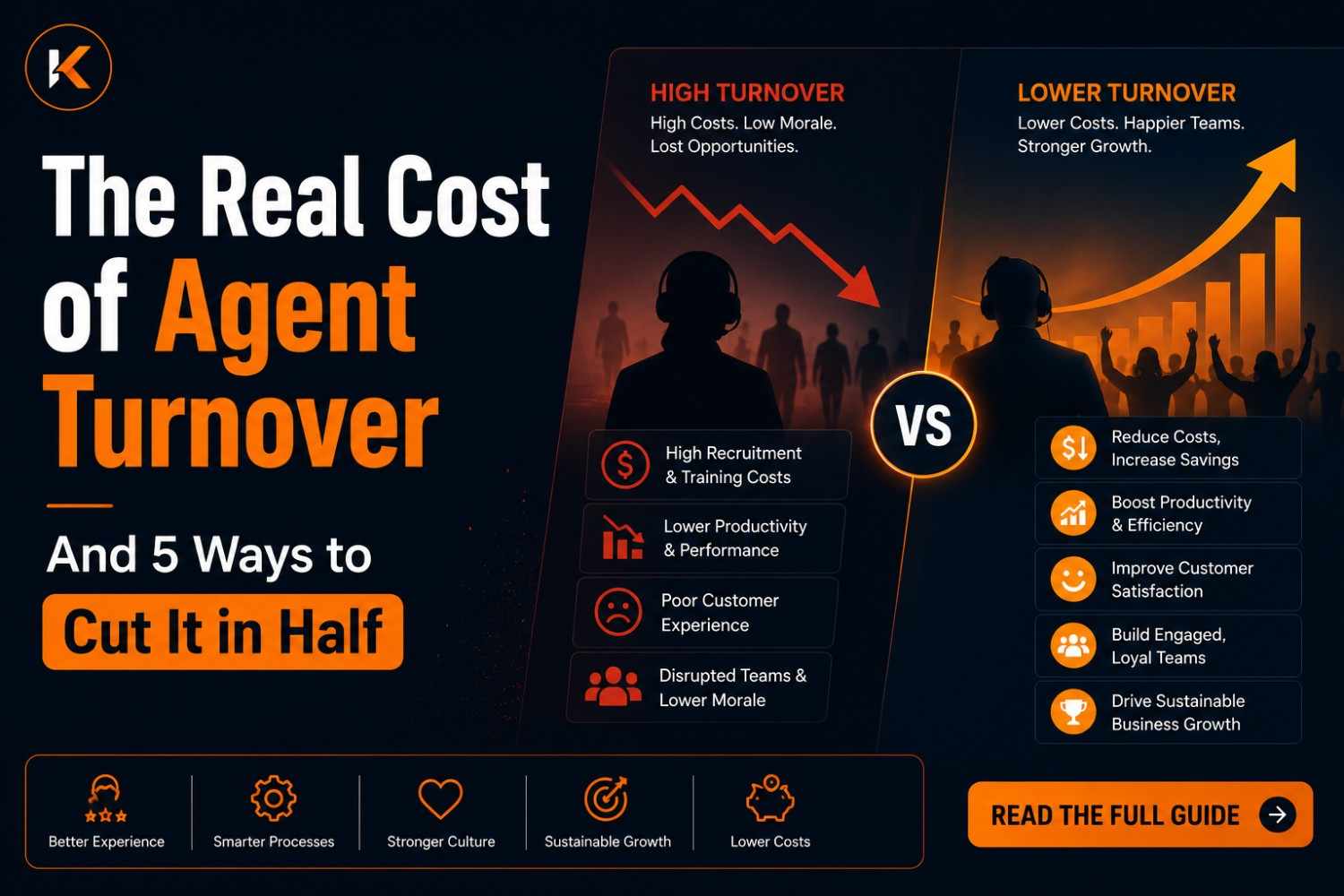
Introduction: The Number Hiding in Plain Sight
Ask most call center leaders what agent turnover costs them, and you'll usually get a number based on recruitment fees — job postings, background checks, maybe a signing bonus. That number is almost always wrong, and not by a small margin.
The real cost of losing an agent includes recruitment, onboarding, training time, lost productivity during the ramp-up period, the burden placed on remaining agents, and the customer experience damage caused by an under-skilled or under-staffed floor. When you add it all up, replacing a single agent can cost anywhere from 50% to well over 100% of their annual salary.
Call centers routinely operate with turnover rates between 30% and 45% annually — some of the highest attrition rates of any industry. For a mid-sized center running 100 seats, that means replacing 30 to 45 agents every single year. The financial bleed isn't a rounding error. It's often one of the largest hidden costs on the entire operating budget.
Why Agent Turnover Costs So Much More Than People Think
1. Recruitment and Hiring Costs
Job board postings, recruiter time, interview hours, and background checks add up quickly — and that's before a single day of training begins.
2. Training and Onboarding Investment
New agents typically require several weeks of formal training before they're fully productive, plus additional weeks of shadowing and supervised calls. Every hour spent training is an hour of paid time with no direct call output.
3. The Ramp-Up Productivity Gap
Even after training ends, new agents typically perform below the productivity and quality levels of tenured staff for months. Lower first-call resolution, longer handle times, and lower CSAT scores during this ramp-up period represent real, measurable revenue and satisfaction loss.
4. Burden on Remaining Agents
When someone leaves, their call volume doesn't disappear — it gets redistributed. Remaining agents absorb heavier workloads, often leading to increased stress, lower morale, and a higher likelihood that they, too, start looking elsewhere. Turnover has a way of accelerating itself.
5. Customer Experience Damage
Newer agents, understaffed shifts, and rising average handle times all translate into a measurably worse customer experience. Lower FCR and CSAT scores during high-turnover periods often correlate directly with increased customer churn — meaning agent attrition doesn't just cost you internally, it costs you externally too.
6. Institutional Knowledge Loss
Experienced agents carry undocumented knowledge — how to handle edge cases, which workarounds actually work, how to de-escalate specific types of complaints. When they leave, that knowledge leaves with them, and it's rarely captured anywhere before it walks out the door.
Why Agents Actually Leave
Understanding root causes matters more than treating turnover as an inevitable cost of doing business. The most common drivers include:
- Burnout from repetitive, high-pressure work, especially when metrics like AHT are enforced without regard for call complexity or emotional labor.
- Limited growth opportunities, with many agents seeing the role as a dead end rather than a career path.
- Inadequate coaching and feedback, leaving agents unsure how to improve or feeling unsupported when calls go badly.
- Compensation misaligned with workload, particularly in centers where pay hasn't kept pace with rising call complexity or volume.
- Poor scheduling flexibility, which disproportionately affects retention among agents balancing other responsibilities.
5 Ways to Cut Agent Turnover in Half
1. Rebalance Performance Metrics Away from Pure Speed
When AHT is the dominant metric agents are judged on, the job becomes about beating a clock rather than solving problems — a major contributor to burnout. Shift toward a balanced scorecard that includes FCR, CSAT, and quality scores alongside handle time. Agents who feel judged on outcomes rather than just speed report significantly higher job satisfaction.
2. Build a Real Coaching Cadence, Not Just Corrective Feedback
Many agents only hear from supervisors when something goes wrong. Regular, structured coaching sessions — focused on growth rather than correction — give agents a sense of investment and progression. Pairing this with AI-assisted call analytics can help supervisors spend their limited coaching time on the calls and agents who need it most, rather than reviewing at random.
3. Create Visible Career Pathways
Agents who can see a path forward — team lead, QA specialist, trainer, workforce management — are far more likely to stay through the difficult early months. Even informal mentorship programs and skill-based pay tiers can meaningfully shift how agents view the role's long-term potential.
4. Fix the Onboarding Experience
A large share of first-year attrition happens in the first 90 days, often because new hires feel underprepared or unsupported once they're on live calls. Extending shadowing periods, assigning a peer mentor, and gradually ramping call complexity — rather than throwing new agents into the deep end — significantly improves early retention.
5. Give Agents Flexibility Where It's Feasible
Rigid scheduling is consistently cited as a top reason agents leave, particularly in markets with strong competition for talent. Offering shift-swapping options, hybrid or remote arrangements where possible, and predictable schedules published well in advance can meaningfully reduce voluntary attrition without requiring a pay increase.
Measuring the Impact of Retention Efforts
Reducing turnover isn't just a feel-good HR initiative — it should be tracked as a financial metric. Compare cost-per-hire and time-to-productivity before and after implementing changes. Track 90-day and 1-year retention rates as leading indicators. And connect retention data to CSAT and FCR trends to build the business case that better retention directly protects customer experience, not just headcount stability.
Agent turnover isn't an unavoidable cost of running a call center — it's a symptom of specific, fixable conditions: metrics that reward the wrong behavior, coaching that only shows up after failure, and career paths that don't exist. Call centers that treat retention as a strategic priority rather than an HR afterthought consistently see the return show up in lower hiring costs, stronger customer satisfaction, and a floor of agents who actually want to be there.
The math is simple: keeping a good agent is always cheaper than replacing one. The organizations that act on that math are the ones pulling ahead.
Ready to Stop the Revolving Door ?
Every agent who walks out the door takes months of training investment, institutional knowledge, and customer trust with them. The call centers winning on retention aren't working harder — they're working smarter, with the right tools and the right metrics.
👉 Partner with KrudraCX today and build a call center operation where agents stay, perform, and grow.
Visit www.krudracx.com and turn your retention problem into your competitive advantage.